p.33 抽出テキスト
7.1.3 Smoking

Patients with PAAD who smoke should strongly be advised to quit (see Supplementary data online, Section 1.1.5). Complete smoking cessation and avoiding second-hand smoke or environmental particle air pollution are crucial in patients with PAAD to reduce the risk of death, AD, acute mesenteric ischaemia (AMI), AAA, and PAD.119,260–267 Smokers should be offered structural follow-up support, including nicotine replacement therapy, varenicline, and bupropion, individually or in combination.19,268,269 Smoking avoidance also includes cannabis, associated with premature ASCVD.266 Vaping and e-cigarette use has surged in the past decade, viewed by some as a healthier option than smoked tobacco, though long-term health effects remain unknown.270 E-cigarettes may be considered as an aid to quit tobacco smoking, as a recent Cochrane review found that they increase quit rates as compared with nicotine replacement therapy,271 but their use has been associated with adverse effects on CV, respiratory, immunological, and periodontal health compared with non-users, but with a milder impact than smoked cigarettes.272–274 However, their use should be brief and preferably not concurrent with traditional cigarettes.271,275 The main limitation of the evidence base remains imprecision due to the small number of randomized controlled trials (RCTs), often with low event rates and follow-up limited to 2 years.

7.1.4 Patient education

While detailed explanations of CVRFs might not always inspire lifestyle changes,276 providing plain language and visual aids is essential for patient understanding.277 Structured programmes, incorporating psychological and behavioural aspects, are pivotal in fostering desired changes.276 Engaging patients’ families, friends, and support networks significantly contributes to perpetuating these changes (particularly in self-care),276 and increases treatment compliance and self-efficacy, reducing hospitalization risk and enriching patient HRQoL.278,279 When caregivers disconnect from healthcare professionals, they should be recognised to receive better support systems.280,281 Psychosocial interventions are crucial to navigating complexities with resilience.282 Advocating active involvement, education, clear communication, and shared decision-making is key for achieving optimal patient outcomes.276–283

7.1.5 Risk scoring models in secondary prevention

Recent ESC CV prevention guidelines discuss risk models for developing vascular disease in healthy individuals and ASCVD patients.19 Several registries enabling risk prediction in ASCVD have been developed: REACH (The REduction of Atherothrombosis for Continued Health)284 and SMART (Secondary Manifestation of ARTerial disease)285 which use clinical parameters such as medical history, SBP, and common biomarkers. Addition of carotid ultrasound did not improve the model.286 A new algorithm combining the SMART and REACH models287 enables calculation of lifetime risk and treatment effects. The SMART model has recently been updated and validated288,289 with the SMART-2 algorithm. These tools are available online as clinical risk calculators (see www.u-preveotnt.com) and smartphone apps on the ESC website (https://www.escardio.org/ Education/ESC-Prevention-of-CVD-Programme/Risk-assessment/SMART- Risk-Score).

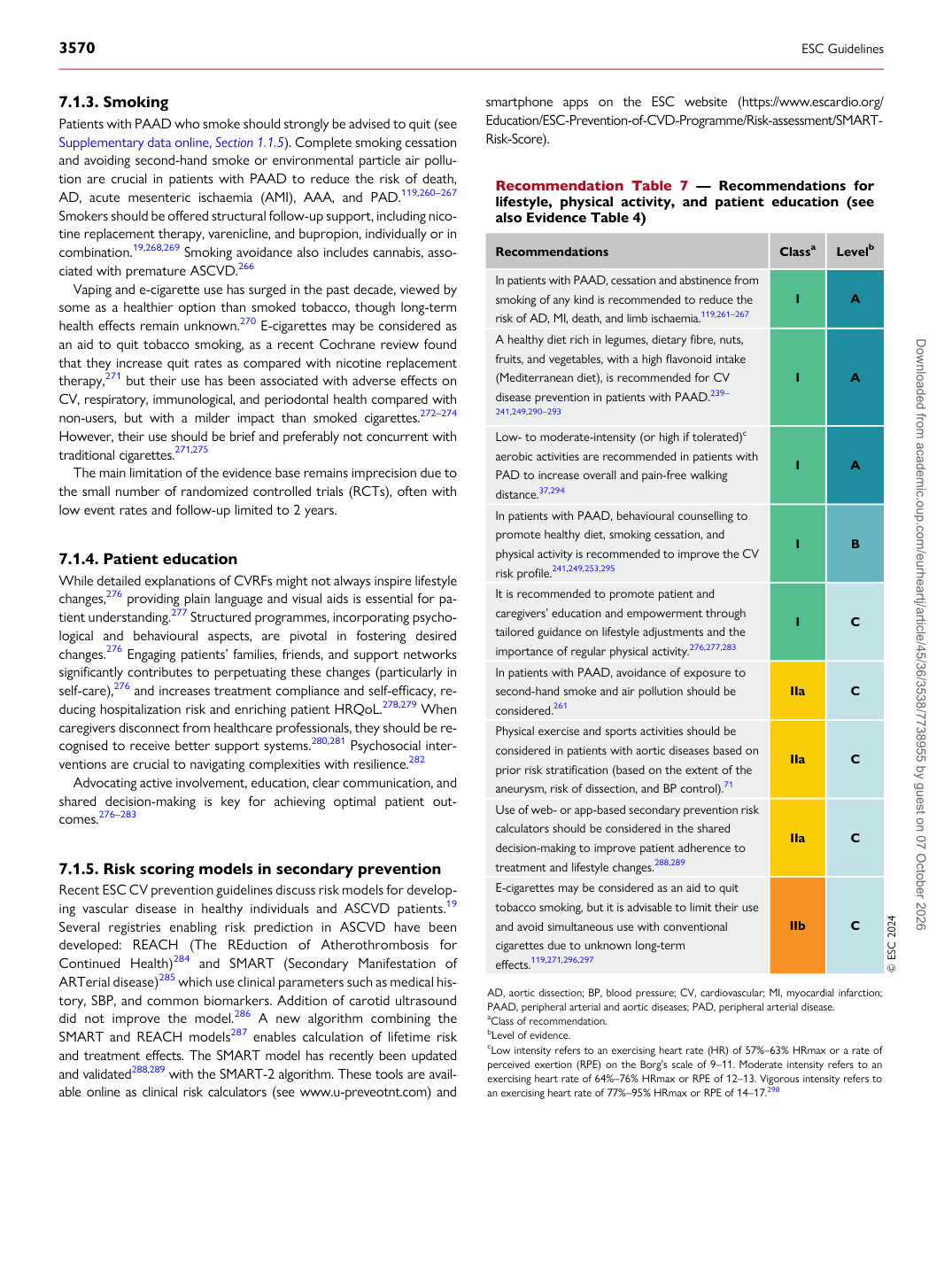
Recommendation Table 7 — Recommendations for lifestyle, physical activity, and patient education (see also Evidence Table 4)

Recommendations Classa Levelb

In patients with PAAD, cessation and abstinence from smoking of any kind is recommended to reduce the risk of AD, MI, death, and limb ischaemia.119,261–267 I A A healthy diet rich in legumes, dietary fibre, nuts, fruits, and vegetables, with a high flavonoid intake (Mediterranean diet), is recommended for CV disease prevention in patients with PAAD.239– 241,249,290–293 I A Low- to moderate-intensity (or high if tolerated)c aerobic activities are recommended in patients with PAD to increase overall and pain-free walking distance.37,294 I A In patients with PAAD, behavioural counselling to promote healthy diet, smoking cessation, and physical activity is recommended to improve the CV risk profile.241,249,253,295 I B It is recommended to promote patient and caregivers’ education and empowerment through tailored guidance on lifestyle adjustments and the importance of regular physical activity.276,277,283 I C In patients with PAAD, avoidance of exposure to second-hand smoke and air pollution should be considered.261 IIa C Physical exercise and sports activities should be considered in patients with aortic diseases based on prior risk stratification (based on the extent of the aneurysm, risk of dissection, and BP control).71 IIa C Use of web- or app-based secondary prevention risk calculators should be considered in the shared decision-making to improve patient adherence to treatment and lifestyle changes.288,289 IIa C E-cigarettes may be considered as an aid to quit tobacco smoking, but it is advisable to limit their use and avoid simultaneous use with conventional cigarettes due to unknown long-term effects.119,271,296,297 IIb C © ESC 2024

AD, aortic dissection; BP, blood pressure; CV, cardiovascular; MI, myocardial infarction; PAAD, peripheral arterial and aortic diseases; PAD, peripheral arterial disease. aClass of recommendation. bLevel of evidence. cLow intensity refers to an exercising heart rate (HR) of 57%–63% HRmax or a rate of perceived exertion (RPE) on the Borg’s scale of 9–11. Moderate intensity refers to an exercising heart rate of 64%–76% HRmax or RPE of 12–13. Vigorous intensity refers to an exercising heart rate of 77%–95% HRmax or RPE of 14–17.298 Downloaded from academic.oup.com/eurheartj/article/45/36/3538/7738955 by guest on 07 October 2026