p.31 抽出テキスト
been shown to be of potential assistance in CV risk reclassification of ‘presumed moderate-risk patients’ into a higher-risk category, leading to more aggressive prevention strategies.205–209

6.2 Screening for aortic diseases

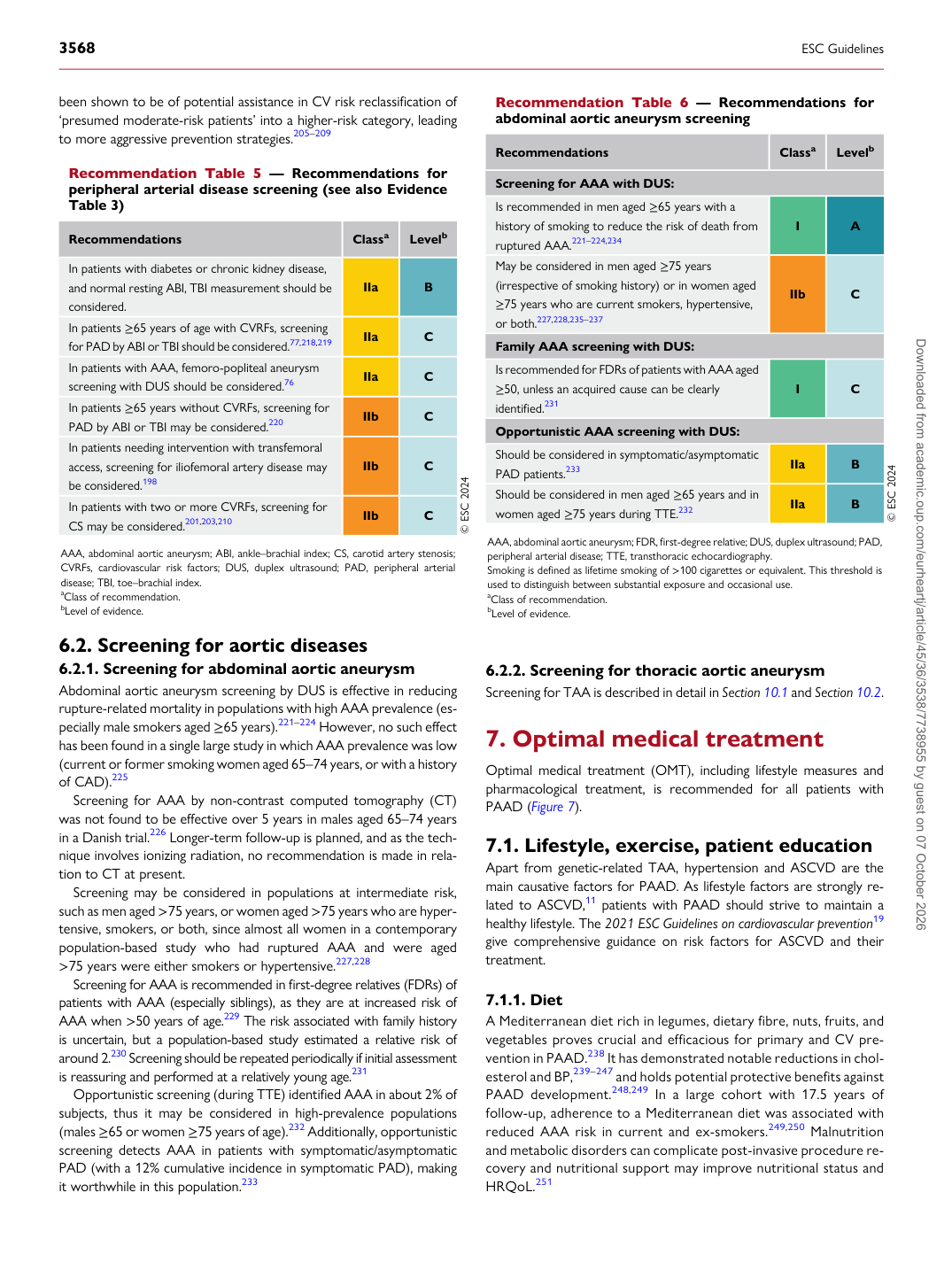
6.2.1. Screening for abdominal aortic aneurysm Abdominal aortic aneurysm screening by DUS is effective in reducing rupture-related mortality in populations with high AAA prevalence (especially male smokers aged ≥65 years).221–224 However, no such effect has been found in a single large study in which AAA prevalence was low (current or former smoking women aged 65–74 years, or with a history of CAD).225 Screening for AAA by non-contrast computed tomography (CT) was not found to be effective over 5 years in males aged 65–74 years in a Danish trial.226 Longer-term follow-up is planned, and as the technique involves ionizing radiation, no recommendation is made in relation to CT at present. Screening may be considered in populations at intermediate risk, such as men aged >75 years, or women aged >75 years who are hypertensive, smokers, or both, since almost all women in a contemporary population-based study who had ruptured AAA and were aged >75 years were either smokers or hypertensive.227,228 Screening for AAA is recommended in first-degree relatives (FDRs) of patients with AAA (especially siblings), as they are at increased risk of AAA when >50 years of age.229 The risk associated with family history is uncertain, but a population-based study estimated a relative risk of around 2.230 Screening should be repeated periodically if initial assessment is reassuring and performed at a relatively young age.231 Opportunistic screening (during TTE) identified AAA in about 2% of subjects, thus it may be considered in high-prevalence populations (males ≥65 or women ≥75 years of age).232 Additionally, opportunistic screening detects AAA in patients with symptomatic/asymptomatic PAD (with a 12% cumulative incidence in symptomatic PAD), making it worthwhile in this population.233 6.2.2 Screening for thoracic aortic aneurysm

Screening for TAA is described in detail in Section 10.1 and Section 10.2.

7 Optimal medical treatment

Optimal medical treatment (OMT), including lifestyle measures and pharmacological treatment, is recommended for all patients with PAAD (Figure 7).

7.1 Lifestyle, exercise, patient education

Apart from genetic-related TAA, hypertension and ASCVD are the main causative factors for PAAD. As lifestyle factors are strongly related to ASCVD,11 patients with PAAD should strive to maintain a healthy lifestyle. The 2021 ESC Guidelines on cardiovascular prevention19 give comprehensive guidance on risk factors for ASCVD and their treatment.

7.1.1 Diet

A Mediterranean diet rich in legumes, dietary fibre, nuts, fruits, and vegetables proves crucial and efficacious for primary and CV prevention in PAAD.238 It has demonstrated notable reductions in cholesterol and BP,239–247 and holds potential protective benefits against PAAD development.248,249 In a large cohort with 17.5 years of follow-up, adherence to a Mediterranean diet was associated with reduced AAA risk in current and ex-smokers.249,250 Malnutrition and metabolic disorders can complicate post-invasive procedure recovery and nutritional support may improve nutritional status and HRQoL.251

Recommendation Table 5 — Recommendations for peripheral arterial disease screening (see also Evidence Table 3)

Recommendations Classa Levelb

In patients with diabetes or chronic kidney disease, and normal resting ABI, TBI measurement should be considered. IIa B In patients ≥65 years of age with CVRFs, screening for PAD by ABI or TBI should be considered.77,218,219 IIa C In patients with AAA, femoro-popliteal aneurysm screening with DUS should be considered.76 IIa C In patients ≥65 years without CVRFs, screening for PAD by ABI or TBI may be considered.220 IIb C In patients needing intervention with transfemoral access, screening for iliofemoral artery disease may be considered.198 IIb C In patients with two or more CVRFs, screening for CS may be considered.201,203,210 IIb C © ESC 2024

AAA, abdominal aortic aneurysm; ABI, ankle–brachial index; CS, carotid artery stenosis; CVRFs, cardiovascular risk factors; DUS, duplex ultrasound; PAD, peripheral arterial disease; TBI, toe–brachial index. aClass of recommendation. bLevel of evidence. Recommendation Table 6 — Recommendations for abdominal aortic aneurysm screening

Recommendations Classa Levelb

Screening for AAA with DUS: Is recommended in men aged ≥65 years with a history of smoking to reduce the risk of death from ruptured AAA.221–224,234 I A May be considered in men aged ≥75 years (irrespective of smoking history) or in women aged ≥75 years who are current smokers, hypertensive, or both.227,228,235–237 IIb C Family AAA screening with DUS: Is recommended for FDRs of patients with AAA aged ≥50, unless an acquired cause can be clearly identified.231 I C Opportunistic AAA screening with DUS: Should be considered in symptomatic/asymptomatic PAD patients.233 IIa B Should be considered in men aged ≥65 years and in women aged ≥75 years during TTE.232 IIa B © ESC 2024

AAA, abdominal aortic aneurysm; FDR, first-degree relative; DUS, duplex ultrasound; PAD, peripheral arterial disease; TTE, transthoracic echocardiography. Smoking is defined as lifetime smoking of >100 cigarettes or equivalent. This threshold is used to distinguish between substantial exposure and occasional use. aClass of recommendation. bLevel of evidence. Downloaded from academic.oup.com/eurheartj/article/45/36/3538/7738955 by guest on 07 October 2026