p.24 抽出テキスト
5.3 Vascular examination of peripheral

arteries

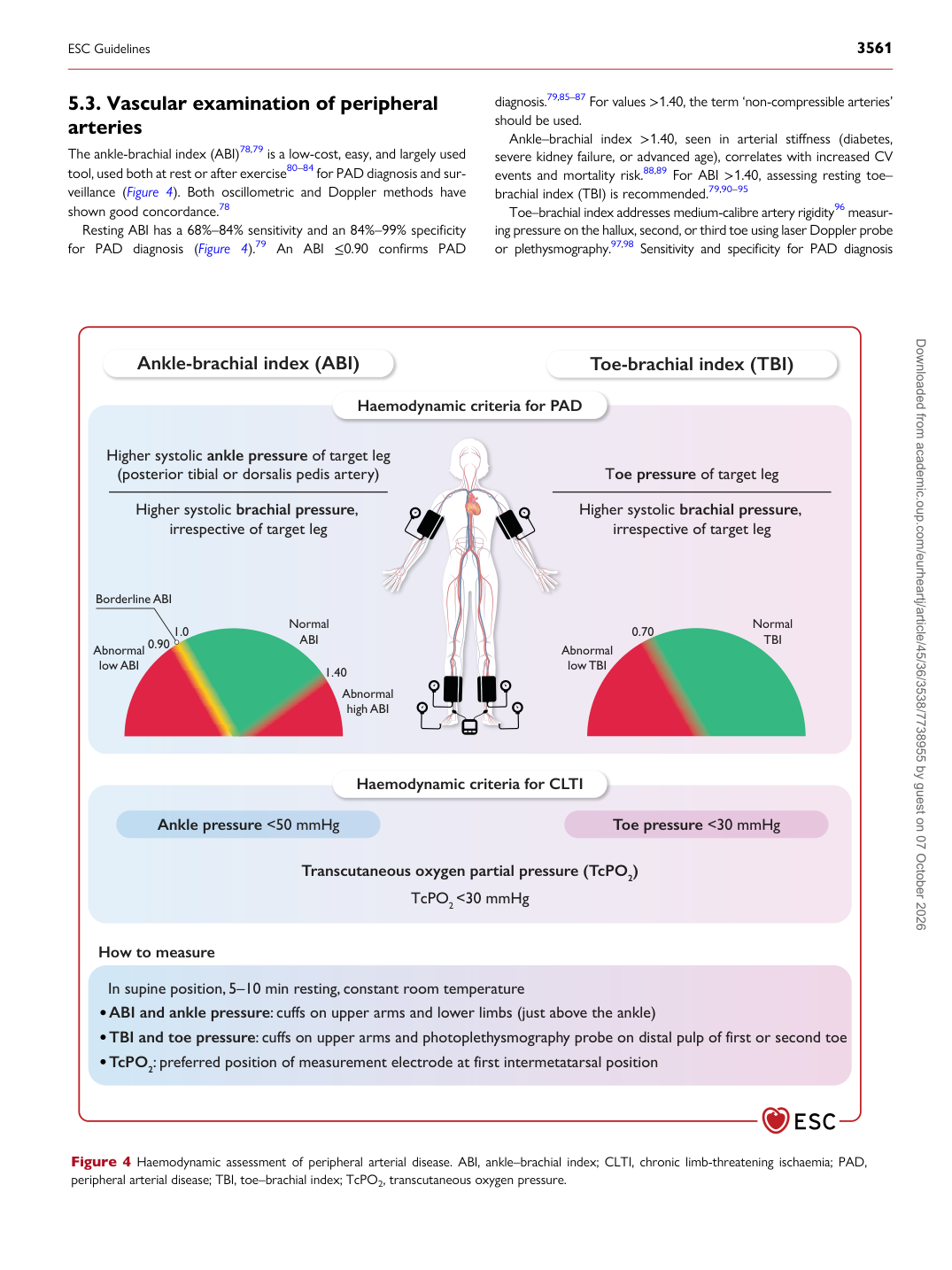
The ankle-brachial index (ABI)78,79 is a low-cost, easy, and largely used tool, used both at rest or after exercise80–84 for PAD diagnosis and surveillance (Figure 4). Both oscillometric and Doppler methods have shown good concordance.78 Resting ABI has a 68%–84% sensitivity and an 84%–99% specificity for PAD diagnosis (Figure 4).79 An ABI ≤0.90 confirms PAD diagnosis.79,85–87 For values >1.40, the term ‘non-compressible arteries’ should be used.

Ankle–brachial index >1.40, seen in arterial stiffness (diabetes, severe kidney failure, or advanced age), correlates with increased CV events and mortality risk.88,89 For ABI >1.40, assessing resting toe– brachial index (TBI) is recommended.79,90–95 Toe–brachial index addresses medium-calibre artery rigidity96 measuring pressure on the hallux, second, or third toe using laser Doppler probe or plethysmography.97,98 Sensitivity and specificity for PAD diagnosis

Ankle-brachial index (ABI)

Haemodynamic criteria for PAD

Haemodynamic criteria for CLTI

Higher systolic ankle pressure of target leg

(posterior tibial or dorsalis pedis artery)

Higher systolic brachial pressure,

irrespective of target leg Toe-brachial index (TBI)

Toe pressure of target leg Higher systolic brachial pressure,

irrespective of target leg

Borderline ABI

0.90 1.0 0.70

1.40 Abnormal

low ABI Abnormal

low TBI

Abnormal high ABI

Normal

ABI Normal

TBI

Ankle pressure <50 mmHg

How to measure Transcutaneous oxygen partial pressure (TcPO2)

Toe pressure <30 mmHg

TcPO2 <30 mmHg

In supine position, 5–10 min resting, constant room temperature ABI and ankle pressure: cuffs on upper arms and lower limbs (just above the ankle) TBI and toe pressure: cuffs on upper arms and photoplethysmography probe on distal pulp of first or second toe TcPO2: preferred position of measurement electrode at first intermetatarsal position

Figure 4 Haemodynamic assessment of peripheral arterial disease. ABI, ankle–brachial index; CLTI, chronic limb-threatening ischaemia; PAD, peripheral arterial disease; TBI, toe–brachial index; TcPO2, transcutaneous oxygen pressure.

ESC Guidelines                                                                                                                                                                                          3561

Downloaded from academic.oup.com/eurheartj/article/45/36/3538/7738955 by guest on 07 October 2026