p.23 抽出テキスト
amplifying PAD risk by 2–4 times each.20 Both men and women face a similar risk of PAD, but women have distinct risk factors (Figure 3).21 Hypertension and male sex are major risk factors for AAA, whereas diabetes mellitus lowers its incidence by 25%.22–24 Thoracic aortic aneurysm (TAA) or dissection share atherosclerotic risk factors, yet monogenic or polygenic diseases like Marfan syndrome (MFS), more prevalent in younger individuals, also contribute.24,25 Inflammation as a risk factor can be observed in PAAD26 and the potential for inflammation to be a modifiable risk factor is indicated by research related to colchicine and the effects demonstrated by canakinumab (a monoclonal antibody that reduces inflammation by inhibiting interleukin-1 beta).27,28

5 Evaluation of peripheral arteries

and aorta

To be consistent with existing literature, the term PAD is used to refer to lower-extremity atherosclerotic arterial disease.

5.1 Clinical history and examination, and

laboratory assessment, in patients with peripheral arterial and aortic diseases Clinical evaluation encompassing history (including family history), review of symptoms, and physical examination are the first steps in diagnosing and assessing patients with PAAD. Pulse palpation, femoral, carotid, and abdominal bruit auscultation, heart auscultation, and observation of the legs and feet need to be part of the vascular examination. Clinical signs, beyond aiding diagnosis, offer prognostic insights. Carotid bruits double the risk of myocardial infarction (MI) and CV death,29,30 while a brachial systolic blood pressure (SBP) difference of more than 15 mmHg raises CV death risk by 50%.31 Hence, bilateral arm blood pressure (BP) measurement is recommended.32 Lab assessments should include lipid profile (including lipoprotein[a] at least once in a lifetime),33 fasting glycaemia, glycated haemoglobin (HbA1c), renal function, blood count, coagulation studies, liver function, electrolytes, and inflammatory markers (C-reactive protein [CRP] and erythrocyte sedimentation rate). Additional evaluations, like thyroid function tests, are advised as needed.

5.2 Functional and quality of life

assessment in patients with peripheral arterial and aortic diseases Patients with PAD have decreased walking performance and selfreported physical and mental health-related quality of life (HRQoL).34–40 Muscle strength and balance are also impaired,41–45 leading to a faster decline in functional (physical functioning) performance in both symptomatic and asymptomatic patients.46,47 Depression is associated with greater impairment in functional performance.48,49 Impaired functional status is related to decreased self-reported HRQoL,50,51 and predicts further mobility loss and CV mortality.52,53 Very poor HRQoL has been found in patients with chronic limbthreatening ischaemia (CLTI).54 Different questionnaires are available assessing different facets (functional, mental, and social status) of patient-reported outcome measures (PROMs).34–36,38 The Short-form 36-item health questionnaire (SF-36) (including physical- and mental health-related items) is the most used generic questionnaire in PAD.35,36,38 The Edinburgh Claudication Questionnaire is a modified version of the initially developed Rose questionnaire and has a sensitivity of 91% and a specificity of 99% in comparison with a physician-based diagnosis.55,56 The Walking Impairment Questionnaire (WIQ), the Walking Estimated Limitation Calculated by History (WELCH), and the Vascular quality of life (VascuQoL) questionnaire are the most used PAD-specific questionnaires.34–36,38

Treadmill testing, using standardized criteria, is the gold standard to assess walking performance.37,57–62 Patients are asked to walk until maximal pain levels, defining the maximal walking distance (MWD). Patients are also asked to indicate the point at which pain begins, defining the pain-free walking distance (PFWD). Constant-load protocols have poorer reliability than graded protocols.60–64 Additionally, the six-minute walk test (6MWT) should be performed to assess functional walking performance.62,65 For muscular lower-limb strength assessment,66 isokinetic dynamometry has good test–retest reliability.67 Alternatively, the Short physical performance battery (SPPB) test should be used.62,64,68,69 The SPPB has good test–retest reliability.64 Few data exist on HRQoL, functional assessment, and exercise capacity in patients with aortic diseases.70,71 Those with acute aortic dissection (AAD), as well as patients who had aortic valve or thoracic aortic surgery, may present with depression and anxiety, leading to mental health issues72,73 that can also be assessed with the SF-36 questionnaire or the hospital anxiety and depression score (HADS).72 Patients with MFS have reduced HRQoL and a significant decline over time in physical HRQoL.74,75 Assessing HRQoL in aortic disease patients is crucial for understanding well-being, disease impact, and treatment effects. This involves PROMs, including surveys, symptom assessment, functional evaluation, psychological well-being (HADS), social and occupational function, and medication/treatment side effects. It also covers healthcare utilization and patient satisfaction, informing care and enhancing aortic disease management.

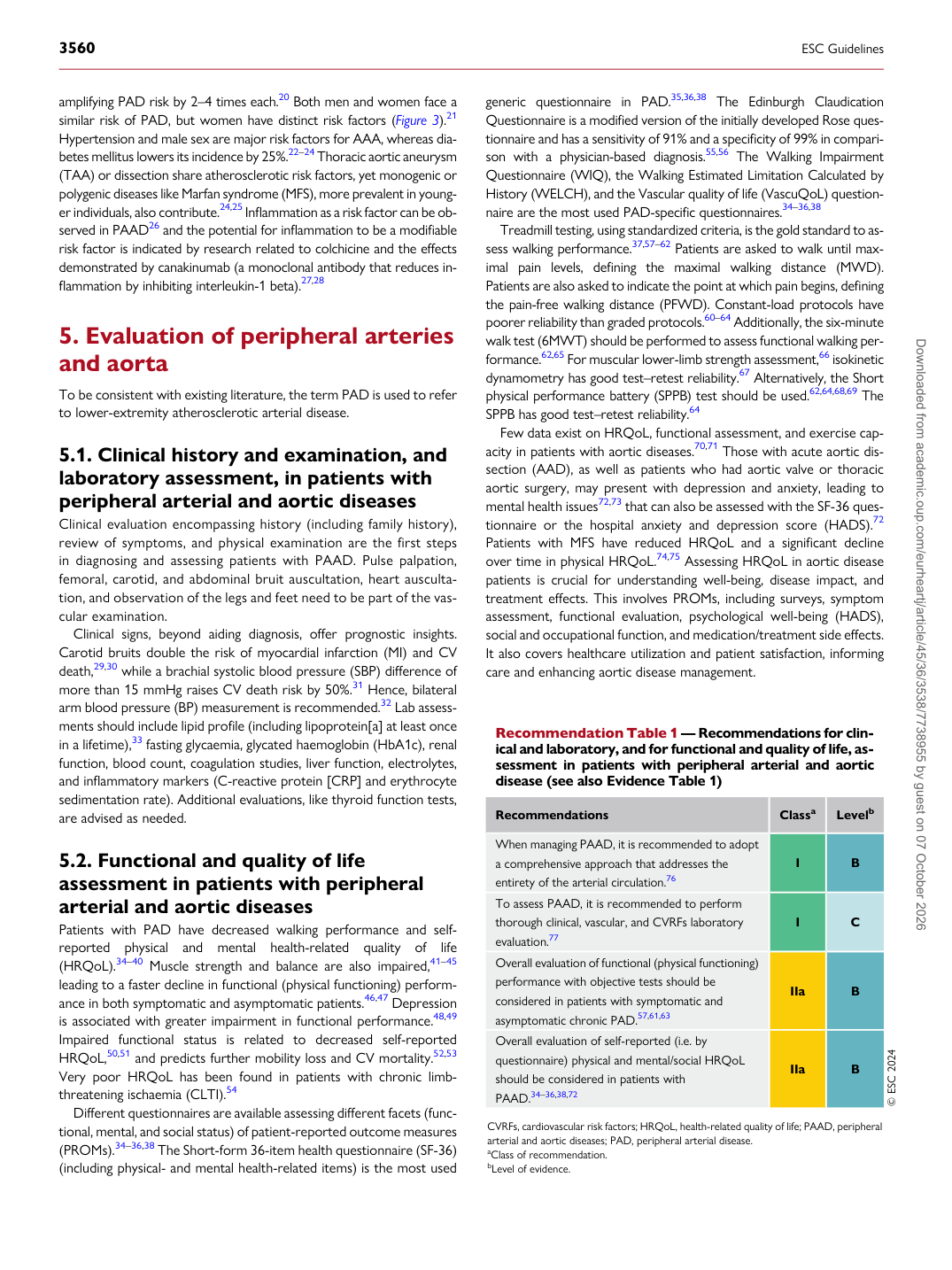
Recommendation Table 1 — Recommendations for clinical and laboratory, and for functional and quality of life, assessment in patients with peripheral arterial and aortic disease (see also Evidence Table 1)

Recommendations Classa Levelb

When managing PAAD, it is recommended to adopt a comprehensive approach that addresses the entirety of the arterial circulation.76 I B To assess PAAD, it is recommended to perform thorough clinical, vascular, and CVRFs laboratory evaluation.77 I C Overall evaluation of functional (physical functioning) performance with objective tests should be considered in patients with symptomatic and asymptomatic chronic PAD.57,61,63 IIa B Overall evaluation of self-reported (i.e. by questionnaire) physical and mental/social HRQoL should be considered in patients with PAAD.34–36,38,72 IIa B © ESC 2024

CVRFs, cardiovascular risk factors; HRQoL, health-related quality of life; PAAD, peripheral arterial and aortic diseases; PAD, peripheral arterial disease. aClass of recommendation. bLevel of evidence. Downloaded from academic.oup.com/eurheartj/article/45/36/3538/7738955 by guest on 07 October 2026