p.21 抽出テキスト
4 Epidemiology and risk factors

4.1 Epidemiology

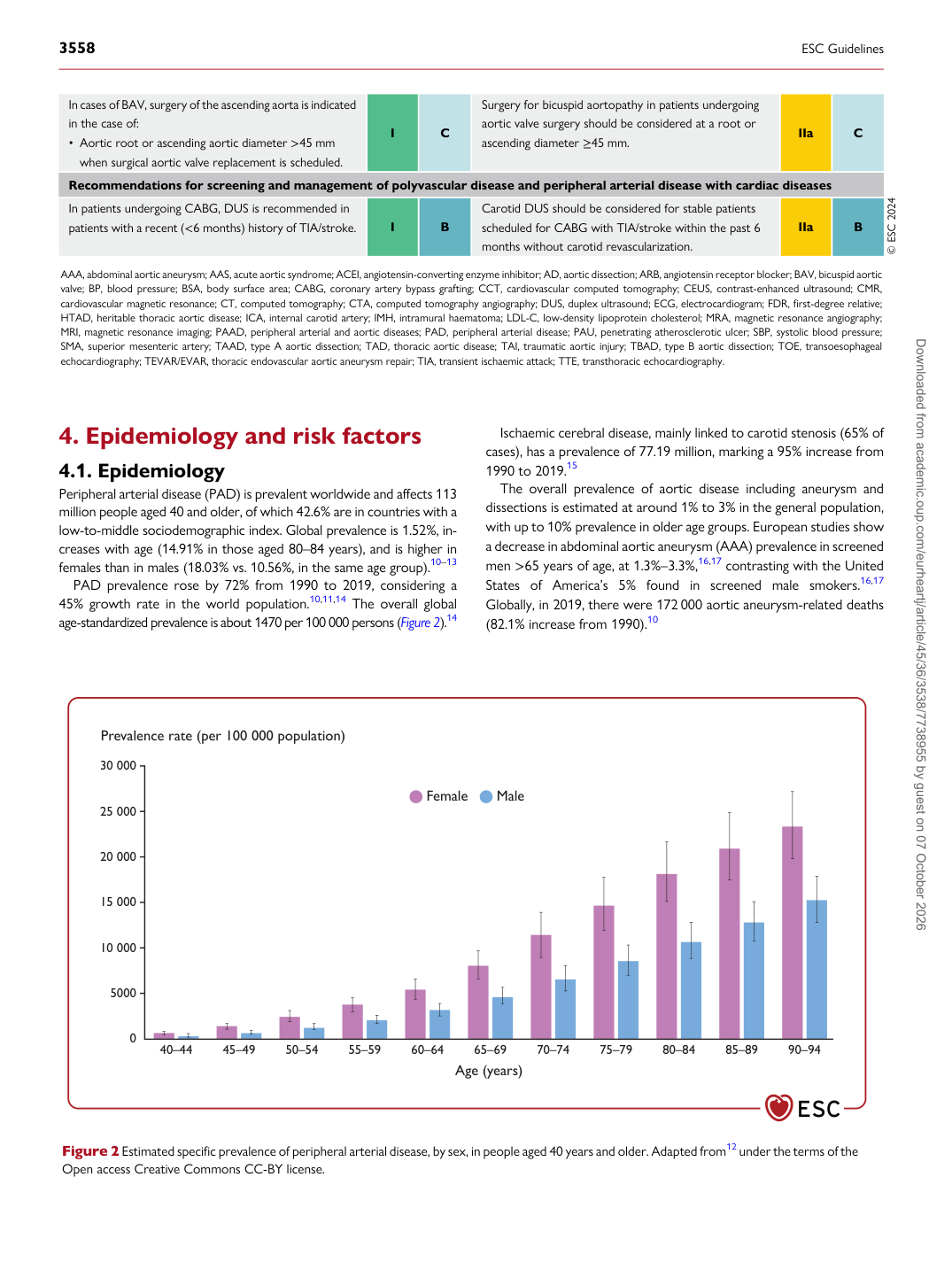
Peripheral arterial disease (PAD) is prevalent worldwide and affects 113 million people aged 40 and older, of which 42.6% are in countries with a low-to-middle sociodemographic index. Global prevalence is 1.52%, increases with age (14.91% in those aged 80–84 years), and is higher in females than in males (18.03% vs. 10.56%, in the same age group).10–13 PAD prevalence rose by 72% from 1990 to 2019, considering a 45% growth rate in the world population.10,11,14 The overall global age-standardized prevalence is about 1470 per 100 000 persons (Figure 2).14 Ischaemic cerebral disease, mainly linked to carotid stenosis (65% of cases), has a prevalence of 77.19 million, marking a 95% increase from 1990 to 2019.15

The overall prevalence of aortic disease including aneurysm and dissections is estimated at around 1% to 3% in the general population, with up to 10% prevalence in older age groups. European studies show a decrease in abdominal aortic aneurysm (AAA) prevalence in screened men >65 years of age, at 1.3%–3.3%,16,17 contrasting with the United States of America’s 5% found in screened male smokers.16,17 Globally, in 2019, there were 172 000 aortic aneurysm-related deaths (82.1% increase from 1990).10

In cases of BAV, surgery of the ascending aorta is indicated in the case of: • Aortic root or ascending aortic diameter >45 mm when surgical aortic valve replacement is scheduled. I C Surgery for bicuspid aortopathy in patients undergoing

aortic valve surgery should be considered at a root or ascending diameter ≥45 mm. IIa C

Recommendations for screening and management of polyvascular disease and peripheral arterial disease with cardiac diseases In patients undergoing CABG, DUS is recommended in patients with a recent (<6 months) history of TIA/stroke. I B Carotid DUS should be considered for stable patients

scheduled for CABG with TIA/stroke within the past 6 months without carotid revascularization. IIa B © ESC 2024

AAA, abdominal aortic aneurysm; AAS, acute aortic syndrome; ACEI, angiotensin-converting enzyme inhibitor; AD, aortic dissection; ARB, angiotensin receptor blocker; BAV, bicuspid aortic valve; BP, blood pressure; BSA, body surface area; CABG, coronary artery bypass grafting; CCT, cardiovascular computed tomography; CEUS, contrast-enhanced ultrasound; CMR, cardiovascular magnetic resonance; CT, computed tomography; CTA, computed tomography angiography; DUS, duplex ultrasound; ECG, electrocardiogram; FDR, first-degree relative; HTAD, heritable thoracic aortic disease; ICA, internal carotid artery; IMH, intramural haematoma; LDL-C, low-density lipoprotein cholesterol; MRA, magnetic resonance angiography; MRI, magnetic resonance imaging; PAAD, peripheral arterial and aortic diseases; PAD, peripheral arterial disease; PAU, penetrating atherosclerotic ulcer; SBP, systolic blood pressure; SMA, superior mesenteric artery; TAAD, type A aortic dissection; TAD, thoracic aortic disease; TAI, traumatic aortic injury; TBAD, type B aortic dissection; TOE, transoesophageal echocardiography; TEVAR/EVAR, thoracic endovascular aortic aneurysm repair; TIA, transient ischaemic attack; TTE, transthoracic echocardiography.

30 000

25 000

20 000

15 000

10 000

5000 0 40–44 45–49 50–54 55–59 60–64 65–69 70–74 75–79 80–84 85–89 90–94

Female Male

Age (years)

Prevalence rate (per 100 000 population)

Figure 2 Estimated specific prevalence of peripheral arterial disease, by sex, in people aged 40 years and older. Adapted from12 under the terms of the Open access Creative Commons CC-BY license. Downloaded from academic.oup.com/eurheartj/article/45/36/3538/7738955 by guest on 07 October 2026