p.20 抽出テキスト
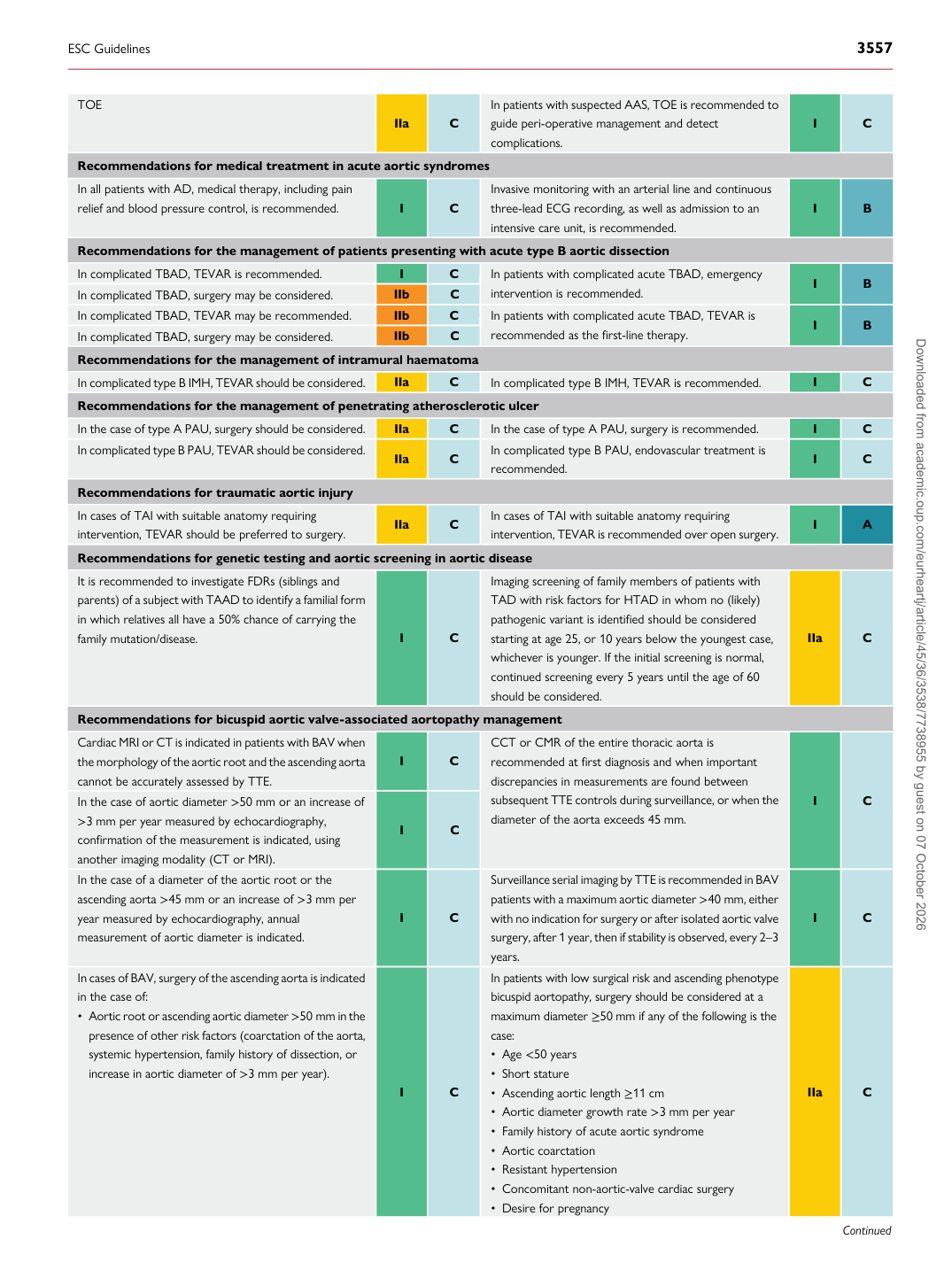
TOE

IIa C In patients with suspected AAS, TOE is recommended to

guide peri-operative management and detect complications. I C

Recommendations for medical treatment in acute aortic syndromes In all patients with AD, medical therapy, including pain relief and blood pressure control, is recommended. I C Invasive monitoring with an arterial line and continuous

three-lead ECG recording, as well as admission to an intensive care unit, is recommended. I B

Recommendations for the management of patients presenting with acute type B aortic dissection In complicated TBAD, TEVAR is recommended. I C In patients with complicated acute TBAD, emergency intervention is recommended. I B In complicated TBAD, surgery may be considered. IIb C In complicated TBAD, TEVAR may be recommended. IIb C In patients with complicated acute TBAD, TEVAR is recommended as the first-line therapy. I B In complicated TBAD, surgery may be considered. IIb C Recommendations for the management of intramural haematoma In complicated type B IMH, TEVAR should be considered. IIa C In complicated type B IMH, TEVAR is recommended. I C Recommendations for the management of penetrating atherosclerotic ulcer In the case of type A PAU, surgery should be considered. IIa C In the case of type A PAU, surgery is recommended. I C In complicated type B PAU, TEVAR should be considered. IIa C In complicated type B PAU, endovascular treatment is

recommended. I C

Recommendations for traumatic aortic injury In cases of TAI with suitable anatomy requiring intervention, TEVAR should be preferred to surgery. IIa C In cases of TAI with suitable anatomy requiring intervention, TEVAR is recommended over open surgery. I A Recommendations for genetic testing and aortic screening in aortic disease It is recommended to investigate FDRs (siblings and parents) of a subject with TAAD to identify a familial form in which relatives all have a 50% chance of carrying the family mutation/disease. I C Imaging screening of family members of patients with TAD with risk factors for HTAD in whom no (likely)

pathogenic variant is identified should be considered starting at age 25, or 10 years below the youngest case, whichever is younger. If the initial screening is normal, continued screening every 5 years until the age of 60 should be considered. IIa C

Recommendations for bicuspid aortic valve-associated aortopathy management Cardiac MRI or CT is indicated in patients with BAV when the morphology of the aortic root and the ascending aorta cannot be accurately assessed by TTE. I C CCT or CMR of the entire thoracic aorta is

recommended at first diagnosis and when important discrepancies in measurements are found between subsequent TTE controls during surveillance, or when the diameter of the aorta exceeds 45 mm.

I C In the case of aortic diameter >50 mm or an increase of >3 mm per year measured by echocardiography, confirmation of the measurement is indicated, using another imaging modality (CT or MRI). I C In the case of a diameter of the aortic root or the ascending aorta >45 mm or an increase of >3 mm per year measured by echocardiography, annual measurement of aortic diameter is indicated. I C Surveillance serial imaging by TTE is recommended in BAV

patients with a maximum aortic diameter >40 mm, either with no indication for surgery or after isolated aortic valve surgery, after 1 year, then if stability is observed, every 2–3 years. I C

In cases of BAV, surgery of the ascending aorta is indicated in the case of: • Aortic root or ascending aortic diameter >50 mm in the presence of other risk factors (coarctation of the aorta,

systemic hypertension, family history of dissection, or increase in aortic diameter of >3 mm per year).

I C In patients with low surgical risk and ascending phenotype

bicuspid aortopathy, surgery should be considered at a maximum diameter ≥50 mm if any of the following is the case: • Age <50 years • Short stature • Ascending aortic length ≥11 cm • Aortic diameter growth rate >3 mm per year • Family history of acute aortic syndrome • Aortic coarctation • Resistant hypertension • Concomitant non-aortic-valve cardiac surgery • Desire for pregnancy IIa C

ESC Guidelines                                                                                                                                                                                          3557

Downloaded from academic.oup.com/eurheartj/article/45/36/3538/7738955 by guest on 07 October 2026