p.18 抽出テキスト
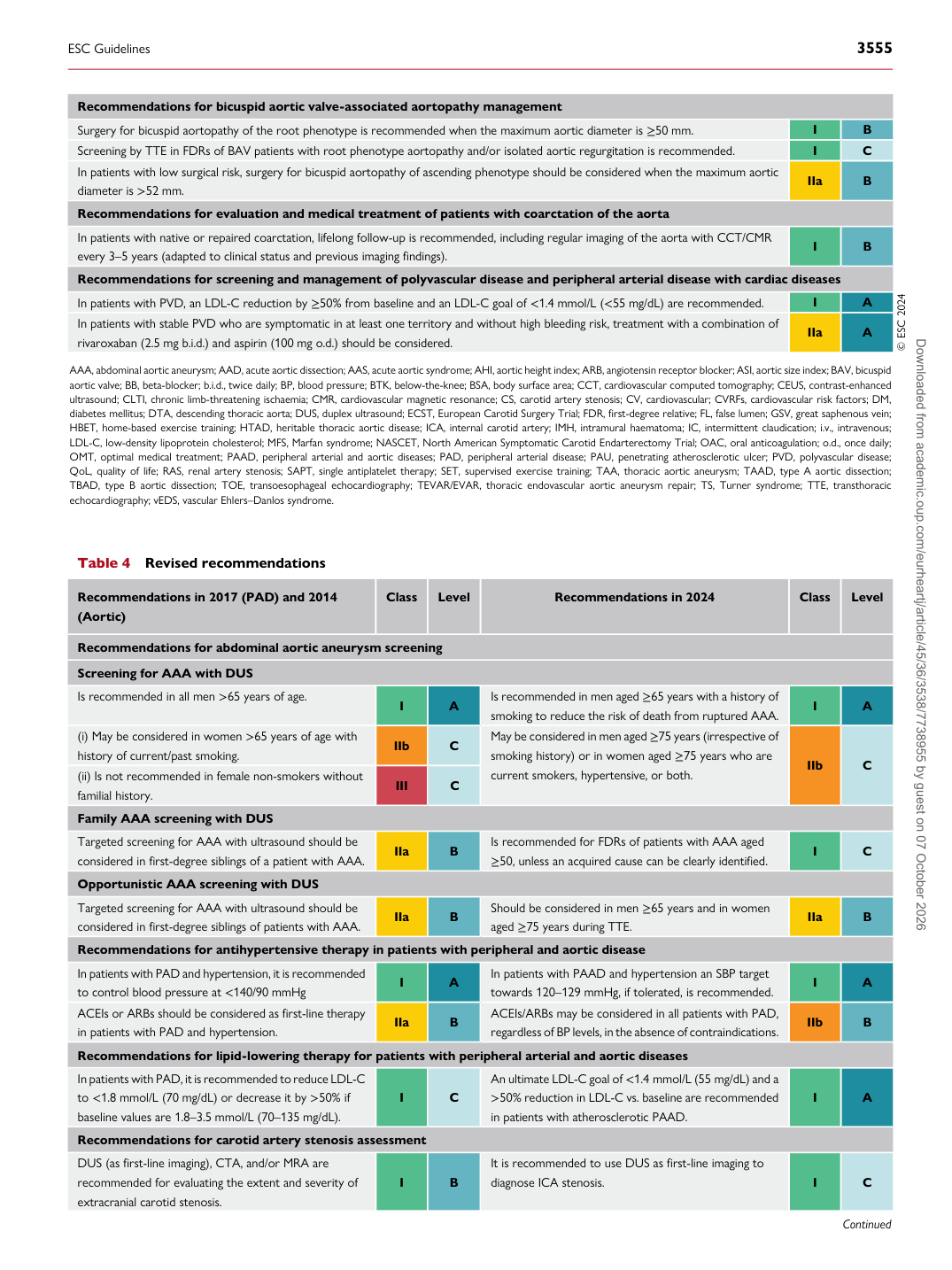
Recommendations for bicuspid aortic valve-associated aortopathy management Surgery for bicuspid aortopathy of the root phenotype is recommended when the maximum aortic diameter is ≥50 mm. I B Screening by TTE in FDRs of BAV patients with root phenotype aortopathy and/or isolated aortic regurgitation is recommended. I C In patients with low surgical risk, surgery for bicuspid aortopathy of ascending phenotype should be considered when the maximum aortic diameter is >52 mm. IIa B Recommendations for evaluation and medical treatment of patients with coarctation of the aorta In patients with native or repaired coarctation, lifelong follow-up is recommended, including regular imaging of the aorta with CCT/CMR every 3–5 years (adapted to clinical status and previous imaging findings). I B Recommendations for screening and management of polyvascular disease and peripheral arterial disease with cardiac diseases In patients with PVD, an LDL-C reduction by ≥50% from baseline and an LDL-C goal of <1.4 mmol/L (<55 mg/dL) are recommended. I A In patients with stable PVD who are symptomatic in at least one territory and without high bleeding risk, treatment with a combination of rivaroxaban (2.5 mg b.i.d.) and aspirin (100 mg o.d.) should be considered. IIa A © ESC 2024

AAA, abdominal aortic aneurysm; AAD, acute aortic dissection; AAS, acute aortic syndrome; AHI, aortic height index; ARB, angiotensin receptor blocker; ASI, aortic size index; BAV, bicuspid aortic valve; BB, beta-blocker; b.i.d., twice daily; BP, blood pressure; BTK, below-the-knee; BSA, body surface area; CCT, cardiovascular computed tomography; CEUS, contrast-enhanced ultrasound; CLTI, chronic limb-threatening ischaemia; CMR, cardiovascular magnetic resonance; CS, carotid artery stenosis; CV, cardiovascular; CVRFs, cardiovascular risk factors; DM, diabetes mellitus; DTA, descending thoracic aorta; DUS, duplex ultrasound; ECST, European Carotid Surgery Trial; FDR, first-degree relative; FL, false lumen; GSV, great saphenous vein; HBET, home-based exercise training; HTAD, heritable thoracic aortic disease; ICA, internal carotid artery; IMH, intramural haematoma; IC, intermittent claudication; i.v., intravenous; LDL-C, low-density lipoprotein cholesterol; MFS, Marfan syndrome; NASCET, North American Symptomatic Carotid Endarterectomy Trial; OAC, oral anticoagulation; o.d., once daily; OMT, optimal medical treatment; PAAD, peripheral arterial and aortic diseases; PAD, peripheral arterial disease; PAU, penetrating atherosclerotic ulcer; PVD, polyvascular disease; QoL, quality of life; RAS, renal artery stenosis; SAPT, single antiplatelet therapy; SET, supervised exercise training; TAA, thoracic aortic aneurysm; TAAD, type A aortic dissection; TBAD, type B aortic dissection; TOE, transoesophageal echocardiography; TEVAR/EVAR, thoracic endovascular aortic aneurysm repair; TS, Turner syndrome; TTE, transthoracic echocardiography; vEDS, vascular Ehlers–Danlos syndrome.

Table 4 Revised recommendations

Recommendations in 2017 (PAD) and 2014 (Aortic) Class Level Recommendations in 2024 Class Level

Recommendations for abdominal aortic aneurysm screening Screening for AAA with DUS Is recommended in all men >65 years of age. I A Is recommended in men aged ≥65 years with a history of

smoking to reduce the risk of death from ruptured AAA. I A

(i) May be considered in women >65 years of age with

history of current/past smoking. IIb C May be considered in men aged ≥75 years (irrespective of

smoking history) or in women aged ≥75 years who are

current smokers, hypertensive, or both. IIb C (ii) Is not recommended in female non-smokers without familial history. III C Family AAA screening with DUS Targeted screening for AAA with ultrasound should be considered in first-degree siblings of a patient with AAA. IIa B Is recommended for FDRs of patients with AAA aged

≥50, unless an acquired cause can be clearly identified. I C

Opportunistic AAA screening with DUS Targeted screening for AAA with ultrasound should be considered in first-degree siblings of patients with AAA. IIa B Should be considered in men ≥65 years and in women aged ≥75 years during TTE. IIa B Recommendations for antihypertensive therapy in patients with peripheral and aortic disease In patients with PAD and hypertension, it is recommended to control blood pressure at <140/90 mmHg I A In patients with PAAD and hypertension an SBP target

towards 120–129 mmHg, if tolerated, is recommended. I A

ACEIs or ARBs should be considered as first-line therapy in patients with PAD and hypertension. IIa B ACEIs/ARBs may be considered in all patients with PAD, regardless of BP levels, in the absence of contraindications. IIb B Recommendations for lipid-lowering therapy for patients with peripheral arterial and aortic diseases In patients with PAD, it is recommended to reduce LDL-C to <1.8 mmol/L (70 mg/dL) or decrease it by >50% if baseline values are 1.8–3.5 mmol/L (70–135 mg/dL). I C An ultimate LDL-C goal of <1.4 mmol/L (55 mg/dL) and a

>50% reduction in LDL-C vs. baseline are recommended in patients with atherosclerotic PAAD. I A

Recommendations for carotid artery stenosis assessment DUS (as first-line imaging), CTA, and/or MRA are recommended for evaluating the extent and severity of extracranial carotid stenosis. I B It is recommended to use DUS as first-line imaging to

diagnose ICA stenosis. I C

ESC Guidelines                                                                                                                                                                                          3555

Downloaded from academic.oup.com/eurheartj/article/45/36/3538/7738955 by guest on 07 October 2026