p.16 抽出テキスト
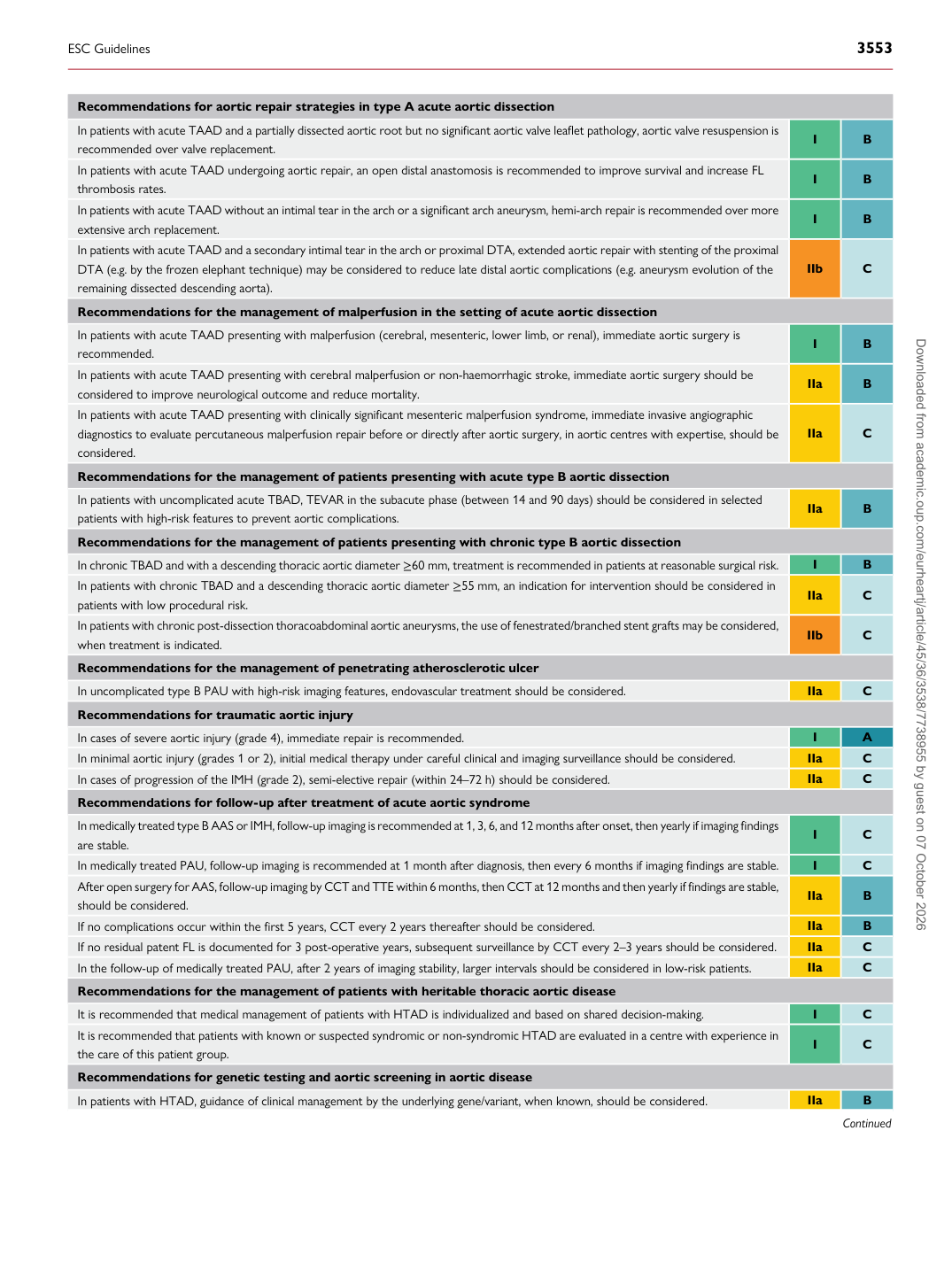
Recommendations for aortic repair strategies in type A acute aortic dissection In patients with acute TAAD and a partially dissected aortic root but no significant aortic valve leaflet pathology, aortic valve resuspension is recommended over valve replacement. I B In patients with acute TAAD undergoing aortic repair, an open distal anastomosis is recommended to improve survival and increase FL thrombosis rates. I B In patients with acute TAAD without an intimal tear in the arch or a significant arch aneurysm, hemi-arch repair is recommended over more extensive arch replacement. I B In patients with acute TAAD and a secondary intimal tear in the arch or proximal DTA, extended aortic repair with stenting of the proximal DTA (e.g. by the frozen elephant technique) may be considered to reduce late distal aortic complications (e.g. aneurysm evolution of the remaining dissected descending aorta). IIb C Recommendations for the management of malperfusion in the setting of acute aortic dissection In patients with acute TAAD presenting with malperfusion (cerebral, mesenteric, lower limb, or renal), immediate aortic surgery is recommended. I B In patients with acute TAAD presenting with cerebral malperfusion or non-haemorrhagic stroke, immediate aortic surgery should be considered to improve neurological outcome and reduce mortality. IIa B In patients with acute TAAD presenting with clinically significant mesenteric malperfusion syndrome, immediate invasive angiographic diagnostics to evaluate percutaneous malperfusion repair before or directly after aortic surgery, in aortic centres with expertise, should be considered. IIa C Recommendations for the management of patients presenting with acute type B aortic dissection In patients with uncomplicated acute TBAD, TEVAR in the subacute phase (between 14 and 90 days) should be considered in selected patients with high-risk features to prevent aortic complications. IIa B Recommendations for the management of patients presenting with chronic type B aortic dissection In chronic TBAD and with a descending thoracic aortic diameter ≥60 mm, treatment is recommended in patients at reasonable surgical risk. I B In patients with chronic TBAD and a descending thoracic aortic diameter ≥55 mm, an indication for intervention should be considered in patients with low procedural risk. IIa C In patients with chronic post-dissection thoracoabdominal aortic aneurysms, the use of fenestrated/branched stent grafts may be considered, when treatment is indicated. IIb C Recommendations for the management of penetrating atherosclerotic ulcer In uncomplicated type B PAU with high-risk imaging features, endovascular treatment should be considered. IIa C Recommendations for traumatic aortic injury In cases of severe aortic injury (grade 4), immediate repair is recommended. I A In minimal aortic injury (grades 1 or 2), initial medical therapy under careful clinical and imaging surveillance should be considered. IIa C In cases of progression of the IMH (grade 2), semi-elective repair (within 24–72 h) should be considered. IIa C Recommendations for follow-up after treatment of acute aortic syndrome In medically treated type B AAS or IMH, follow-up imaging is recommended at 1, 3, 6, and 12 months after onset, then yearly if imaging findings are stable. I C In medically treated PAU, follow-up imaging is recommended at 1 month after diagnosis, then every 6 months if imaging findings are stable. I C After open surgery for AAS, follow-up imaging by CCT and TTE within 6 months, then CCT at 12 months and then yearly if findings are stable, should be considered. IIa B If no complications occur within the first 5 years, CCT every 2 years thereafter should be considered. IIa B If no residual patent FL is documented for 3 post-operative years, subsequent surveillance by CCT every 2–3 years should be considered. IIa C In the follow-up of medically treated PAU, after 2 years of imaging stability, larger intervals should be considered in low-risk patients. IIa C Recommendations for the management of patients with heritable thoracic aortic disease It is recommended that medical management of patients with HTAD is individualized and based on shared decision-making. I C It is recommended that patients with known or suspected syndromic or non-syndromic HTAD are evaluated in a centre with experience in the care of this patient group. I C Recommendations for genetic testing and aortic screening in aortic disease In patients with HTAD, guidance of clinical management by the underlying gene/variant, when known, should be considered. IIa B

Continued

ESC Guidelines                                                                                                                                                                                          3553

Downloaded from academic.oup.com/eurheartj/article/45/36/3538/7738955 by guest on 07 October 2026