p.15 抽出テキスト
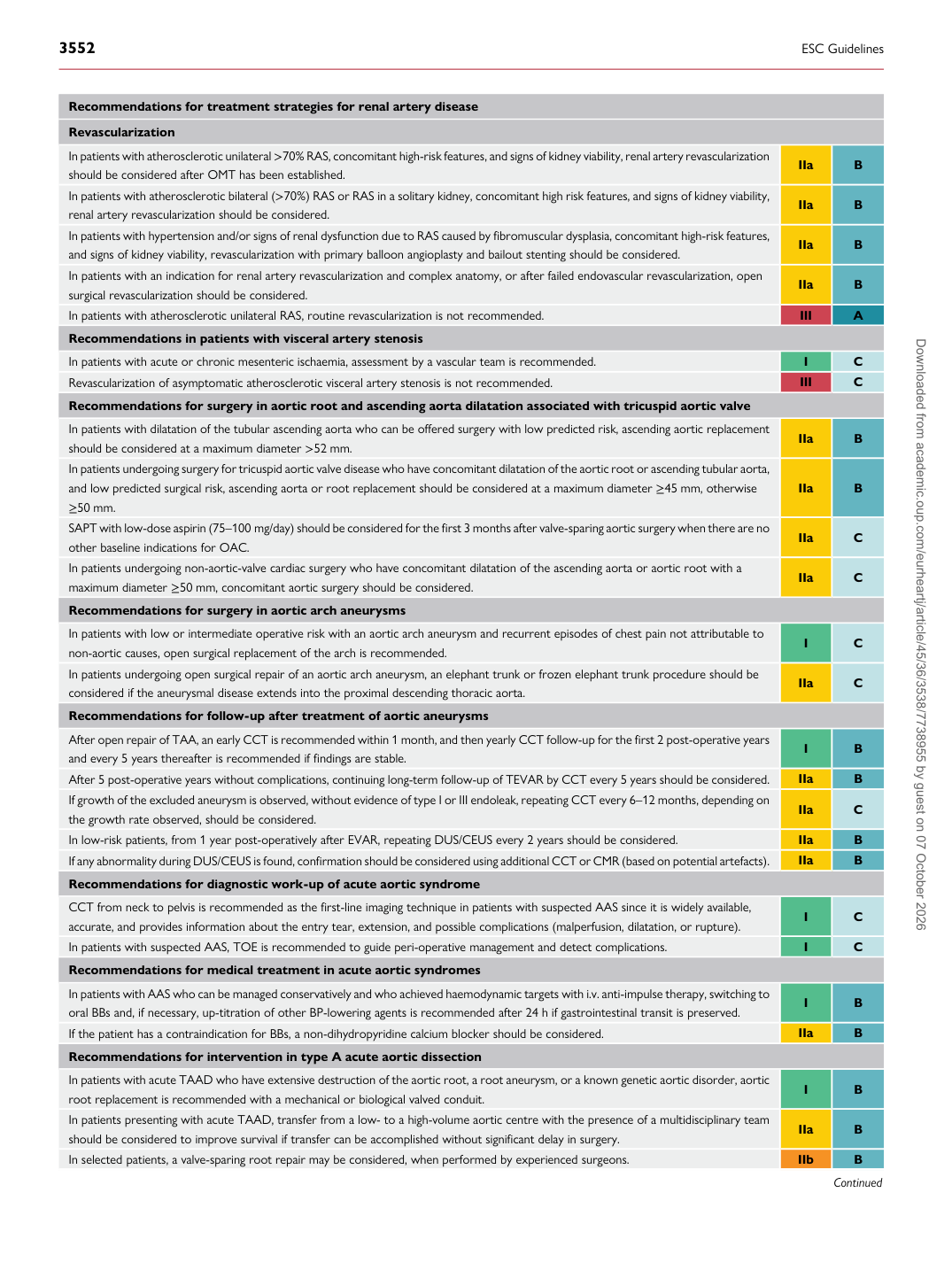
Recommendations for treatment strategies for renal artery disease Revascularization In patients with atherosclerotic unilateral >70% RAS, concomitant high-risk features, and signs of kidney viability, renal artery revascularization should be considered after OMT has been established. IIa B In patients with atherosclerotic bilateral (>70%) RAS or RAS in a solitary kidney, concomitant high risk features, and signs of kidney viability, renal artery revascularization should be considered. IIa B In patients with hypertension and/or signs of renal dysfunction due to RAS caused by fibromuscular dysplasia, concomitant high-risk features, and signs of kidney viability, revascularization with primary balloon angioplasty and bailout stenting should be considered. IIa B In patients with an indication for renal artery revascularization and complex anatomy, or after failed endovascular revascularization, open surgical revascularization should be considered. IIa B In patients with atherosclerotic unilateral RAS, routine revascularization is not recommended. III A Recommendations in patients with visceral artery stenosis In patients with acute or chronic mesenteric ischaemia, assessment by a vascular team is recommended. I C Revascularization of asymptomatic atherosclerotic visceral artery stenosis is not recommended. III C Recommendations for surgery in aortic root and ascending aorta dilatation associated with tricuspid aortic valve In patients with dilatation of the tubular ascending aorta who can be offered surgery with low predicted risk, ascending aortic replacement should be considered at a maximum diameter >52 mm. IIa B In patients undergoing surgery for tricuspid aortic valve disease who have concomitant dilatation of the aortic root or ascending tubular aorta, and low predicted surgical risk, ascending aorta or root replacement should be considered at a maximum diameter ≥45 mm, otherwise ≥50 mm. IIa B SAPT with low-dose aspirin (75–100 mg/day) should be considered for the first 3 months after valve-sparing aortic surgery when there are no other baseline indications for OAC. IIa C In patients undergoing non-aortic-valve cardiac surgery who have concomitant dilatation of the ascending aorta or aortic root with a maximum diameter ≥50 mm, concomitant aortic surgery should be considered. IIa C Recommendations for surgery in aortic arch aneurysms In patients with low or intermediate operative risk with an aortic arch aneurysm and recurrent episodes of chest pain not attributable to non-aortic causes, open surgical replacement of the arch is recommended. I C In patients undergoing open surgical repair of an aortic arch aneurysm, an elephant trunk or frozen elephant trunk procedure should be considered if the aneurysmal disease extends into the proximal descending thoracic aorta. IIa C Recommendations for follow-up after treatment of aortic aneurysms After open repair of TAA, an early CCT is recommended within 1 month, and then yearly CCT follow-up for the first 2 post-operative years and every 5 years thereafter is recommended if findings are stable. I B After 5 post-operative years without complications, continuing long-term follow-up of TEVAR by CCT every 5 years should be considered. IIa B If growth of the excluded aneurysm is observed, without evidence of type I or III endoleak, repeating CCT every 6–12 months, depending on the growth rate observed, should be considered. IIa C In low-risk patients, from 1 year post-operatively after EVAR, repeating DUS/CEUS every 2 years should be considered. IIa B If any abnormality during DUS/CEUS is found, confirmation should be considered using additional CCT or CMR (based on potential artefacts). IIa B Recommendations for diagnostic work-up of acute aortic syndrome CCT from neck to pelvis is recommended as the first-line imaging technique in patients with suspected AAS since it is widely available, accurate, and provides information about the entry tear, extension, and possible complications (malperfusion, dilatation, or rupture). I C In patients with suspected AAS, TOE is recommended to guide peri-operative management and detect complications. I C Recommendations for medical treatment in acute aortic syndromes In patients with AAS who can be managed conservatively and who achieved haemodynamic targets with i.v. anti-impulse therapy, switching to oral BBs and, if necessary, up-titration of other BP-lowering agents is recommended after 24 h if gastrointestinal transit is preserved. I B If the patient has a contraindication for BBs, a non-dihydropyridine calcium blocker should be considered. IIa B Recommendations for intervention in type A acute aortic dissection In patients with acute TAAD who have extensive destruction of the aortic root, a root aneurysm, or a known genetic aortic disorder, aortic root replacement is recommended with a mechanical or biological valved conduit. I B In patients presenting with acute TAAD, transfer from a low- to a high-volume aortic centre with the presence of a multidisciplinary team should be considered to improve survival if transfer can be accomplished without significant delay in surgery. IIa B In selected patients, a valve-sparing root repair may be considered, when performed by experienced surgeons. IIb B

Continued Downloaded from academic.oup.com/eurheartj/article/45/36/3538/7738955 by guest on 07 October 2026