p.14 抽出テキスト
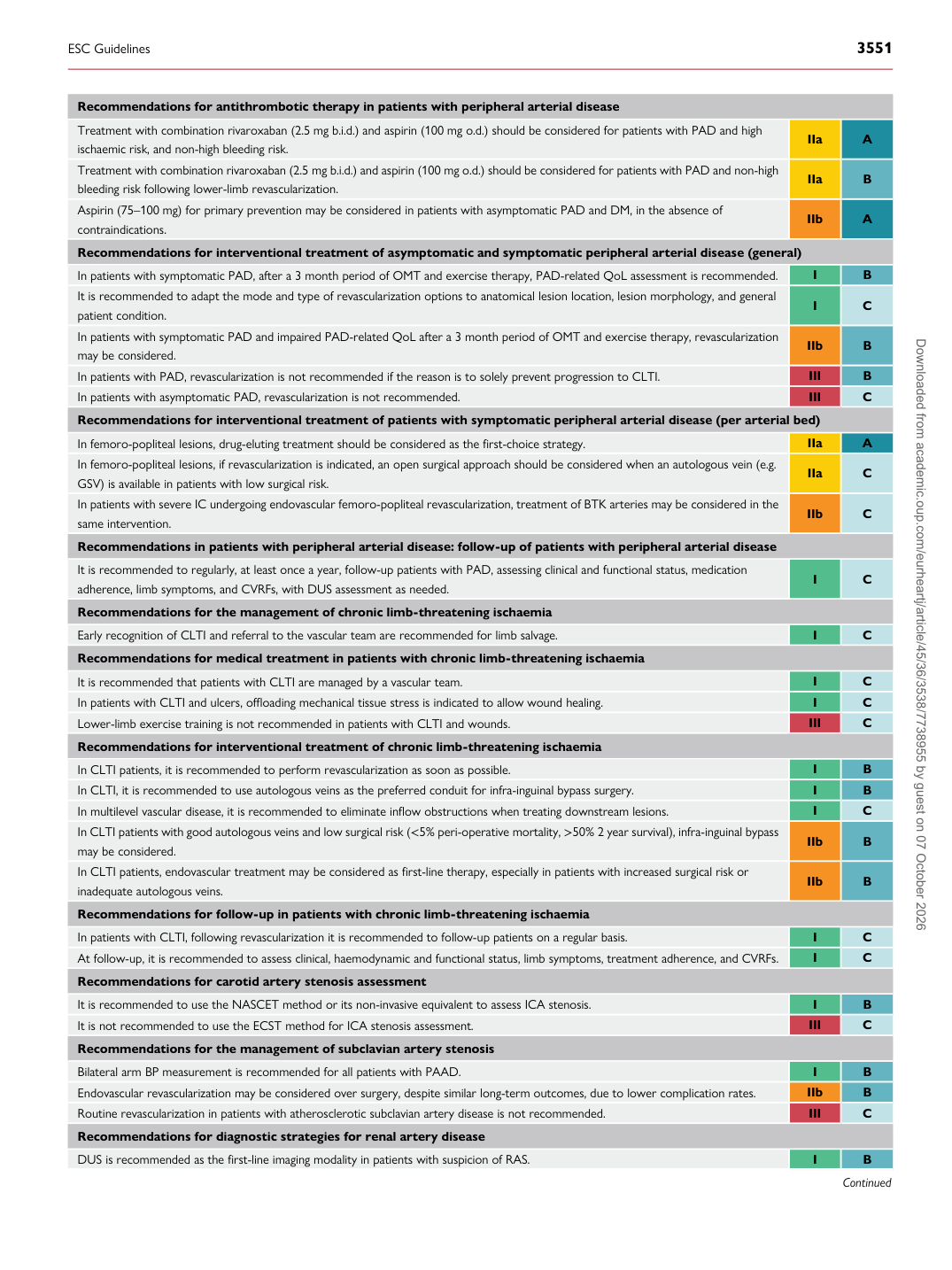
Recommendations for antithrombotic therapy in patients with peripheral arterial disease Treatment with combination rivaroxaban (2.5 mg b.i.d.) and aspirin (100 mg o.d.) should be considered for patients with PAD and high ischaemic risk, and non-high bleeding risk. IIa A Treatment with combination rivaroxaban (2.5 mg b.i.d.) and aspirin (100 mg o.d.) should be considered for patients with PAD and non-high bleeding risk following lower-limb revascularization. IIa B Aspirin (75–100 mg) for primary prevention may be considered in patients with asymptomatic PAD and DM, in the absence of contraindications. IIb A Recommendations for interventional treatment of asymptomatic and symptomatic peripheral arterial disease (general) In patients with symptomatic PAD, after a 3 month period of OMT and exercise therapy, PAD-related QoL assessment is recommended. I B It is recommended to adapt the mode and type of revascularization options to anatomical lesion location, lesion morphology, and general patient condition. I C In patients with symptomatic PAD and impaired PAD-related QoL after a 3 month period of OMT and exercise therapy, revascularization may be considered. IIb B In patients with PAD, revascularization is not recommended if the reason is to solely prevent progression to CLTI. III B In patients with asymptomatic PAD, revascularization is not recommended. III C Recommendations for interventional treatment of patients with symptomatic peripheral arterial disease (per arterial bed) In femoro-popliteal lesions, drug-eluting treatment should be considered as the first-choice strategy. IIa A In femoro-popliteal lesions, if revascularization is indicated, an open surgical approach should be considered when an autologous vein (e.g. GSV) is available in patients with low surgical risk. IIa C In patients with severe IC undergoing endovascular femoro-popliteal revascularization, treatment of BTK arteries may be considered in the same intervention. IIb C Recommendations in patients with peripheral arterial disease: follow-up of patients with peripheral arterial disease It is recommended to regularly, at least once a year, follow-up patients with PAD, assessing clinical and functional status, medication adherence, limb symptoms, and CVRFs, with DUS assessment as needed. I C Recommendations for the management of chronic limb-threatening ischaemia Early recognition of CLTI and referral to the vascular team are recommended for limb salvage. I C Recommendations for medical treatment in patients with chronic limb-threatening ischaemia It is recommended that patients with CLTI are managed by a vascular team. I C In patients with CLTI and ulcers, offloading mechanical tissue stress is indicated to allow wound healing. I C Lower-limb exercise training is not recommended in patients with CLTI and wounds. III C Recommendations for interventional treatment of chronic limb-threatening ischaemia In CLTI patients, it is recommended to perform revascularization as soon as possible. I B In CLTI, it is recommended to use autologous veins as the preferred conduit for infra-inguinal bypass surgery. I B In multilevel vascular disease, it is recommended to eliminate inflow obstructions when treating downstream lesions. I C In CLTI patients with good autologous veins and low surgical risk (<5% peri-operative mortality, >50% 2 year survival), infra-inguinal bypass may be considered. IIb B In CLTI patients, endovascular treatment may be considered as first-line therapy, especially in patients with increased surgical risk or inadequate autologous veins. IIb B Recommendations for follow-up in patients with chronic limb-threatening ischaemia In patients with CLTI, following revascularization it is recommended to follow-up patients on a regular basis. I C At follow-up, it is recommended to assess clinical, haemodynamic and functional status, limb symptoms, treatment adherence, and CVRFs. I C Recommendations for carotid artery stenosis assessment It is recommended to use the NASCET method or its non-invasive equivalent to assess ICA stenosis. I B It is not recommended to use the ECST method for ICA stenosis assessment. III C Recommendations for the management of subclavian artery stenosis Bilateral arm BP measurement is recommended for all patients with PAAD. I B Endovascular revascularization may be considered over surgery, despite similar long-term outcomes, due to lower complication rates. IIb B Routine revascularization in patients with atherosclerotic subclavian artery disease is not recommended. III C Recommendations for diagnostic strategies for renal artery disease DUS is recommended as the first-line imaging modality in patients with suspicion of RAS. I B

Continued

ESC Guidelines                                                                                                                                                                                          3551

Downloaded from academic.oup.com/eurheartj/article/45/36/3538/7738955 by guest on 07 October 2026