p.13 抽出テキスト
3 What is new

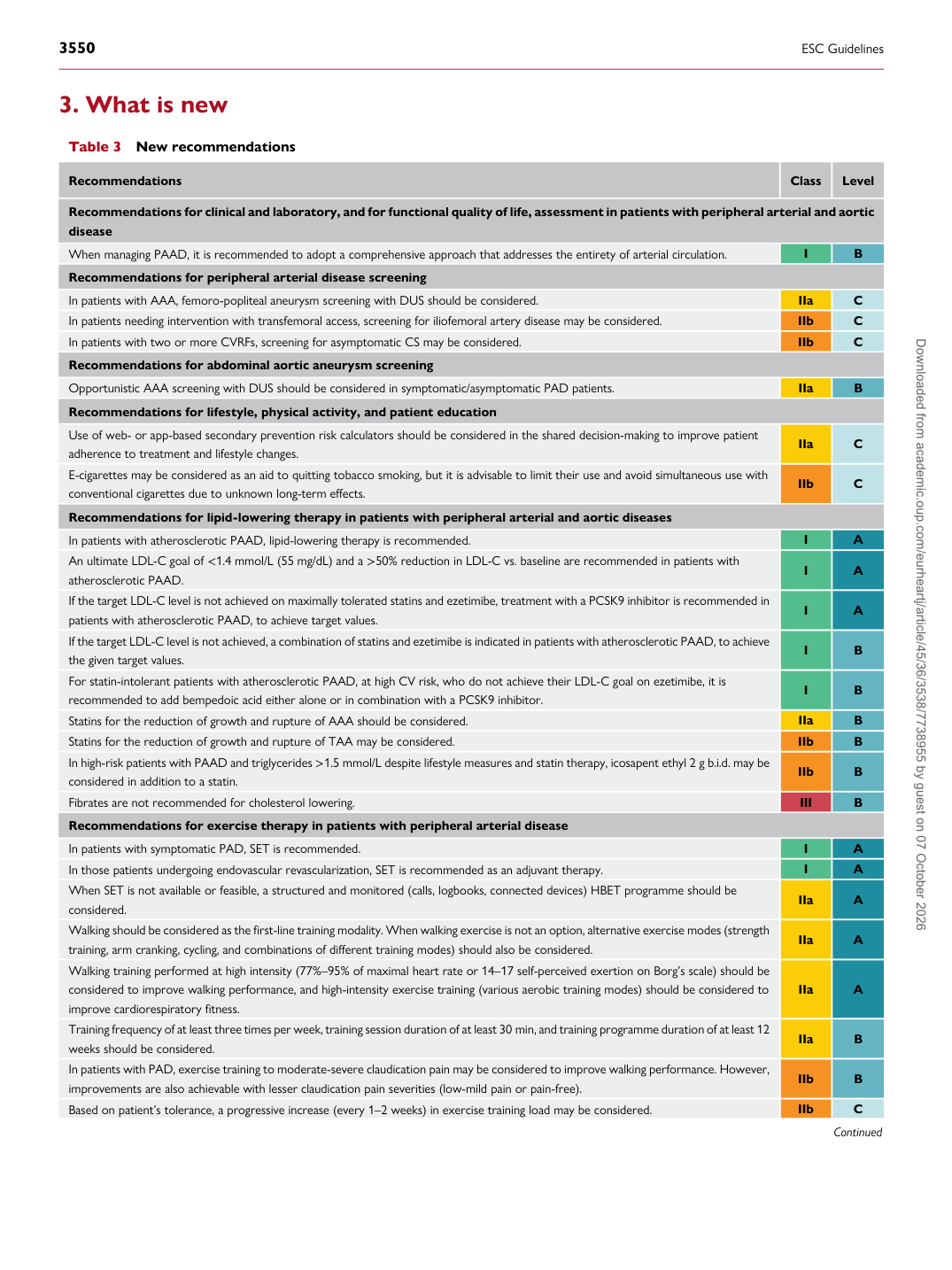
Table 3 New recommendations

Recommendations Class Level

Recommendations for clinical and laboratory, and for functional quality of life, assessment in patients with peripheral arterial and aortic disease When managing PAAD, it is recommended to adopt a comprehensive approach that addresses the entirety of arterial circulation. I B Recommendations for peripheral arterial disease screening In patients with AAA, femoro-popliteal aneurysm screening with DUS should be considered. IIa C In patients needing intervention with transfemoral access, screening for iliofemoral artery disease may be considered. IIb C In patients with two or more CVRFs, screening for asymptomatic CS may be considered. IIb C Recommendations for abdominal aortic aneurysm screening Opportunistic AAA screening with DUS should be considered in symptomatic/asymptomatic PAD patients. IIa B Recommendations for lifestyle, physical activity, and patient education Use of web- or app-based secondary prevention risk calculators should be considered in the shared decision-making to improve patient adherence to treatment and lifestyle changes. IIa C E-cigarettes may be considered as an aid to quitting tobacco smoking, but it is advisable to limit their use and avoid simultaneous use with conventional cigarettes due to unknown long-term effects. IIb C Recommendations for lipid-lowering therapy in patients with peripheral arterial and aortic diseases In patients with atherosclerotic PAAD, lipid-lowering therapy is recommended. I A An ultimate LDL-C goal of <1.4 mmol/L (55 mg/dL) and a >50% reduction in LDL-C vs. baseline are recommended in patients with atherosclerotic PAAD. I A If the target LDL-C level is not achieved on maximally tolerated statins and ezetimibe, treatment with a PCSK9 inhibitor is recommended in patients with atherosclerotic PAAD, to achieve target values. I A If the target LDL-C level is not achieved, a combination of statins and ezetimibe is indicated in patients with atherosclerotic PAAD, to achieve the given target values. I B For statin-intolerant patients with atherosclerotic PAAD, at high CV risk, who do not achieve their LDL-C goal on ezetimibe, it is recommended to add bempedoic acid either alone or in combination with a PCSK9 inhibitor. I B Statins for the reduction of growth and rupture of AAA should be considered. IIa B Statins for the reduction of growth and rupture of TAA may be considered. IIb B In high-risk patients with PAAD and triglycerides >1.5 mmol/L despite lifestyle measures and statin therapy, icosapent ethyl 2 g b.i.d. may be considered in addition to a statin. IIb B Fibrates are not recommended for cholesterol lowering. III B Recommendations for exercise therapy in patients with peripheral arterial disease In patients with symptomatic PAD, SET is recommended. I A In those patients undergoing endovascular revascularization, SET is recommended as an adjuvant therapy. I A When SET is not available or feasible, a structured and monitored (calls, logbooks, connected devices) HBET programme should be considered. IIa A Walking should be considered as the first-line training modality. When walking exercise is not an option, alternative exercise modes (strength training, arm cranking, cycling, and combinations of different training modes) should also be considered. IIa A Walking training performed at high intensity (77%–95% of maximal heart rate or 14–17 self-perceived exertion on Borg’s scale) should be considered to improve walking performance, and high-intensity exercise training (various aerobic training modes) should be considered to improve cardiorespiratory fitness. IIa A Training frequency of at least three times per week, training session duration of at least 30 min, and training programme duration of at least 12 weeks should be considered. IIa B In patients with PAD, exercise training to moderate-severe claudication pain may be considered to improve walking performance. However, improvements are also achievable with lesser claudication pain severities (low-mild pain or pain-free). IIb B Based on patient’s tolerance, a progressive increase (every 1–2 weeks) in exercise training load may be considered. IIb C

Continued Downloaded from academic.oup.com/eurheartj/article/45/36/3538/7738955 by guest on 07 October 2026