p.123 抽出テキスト
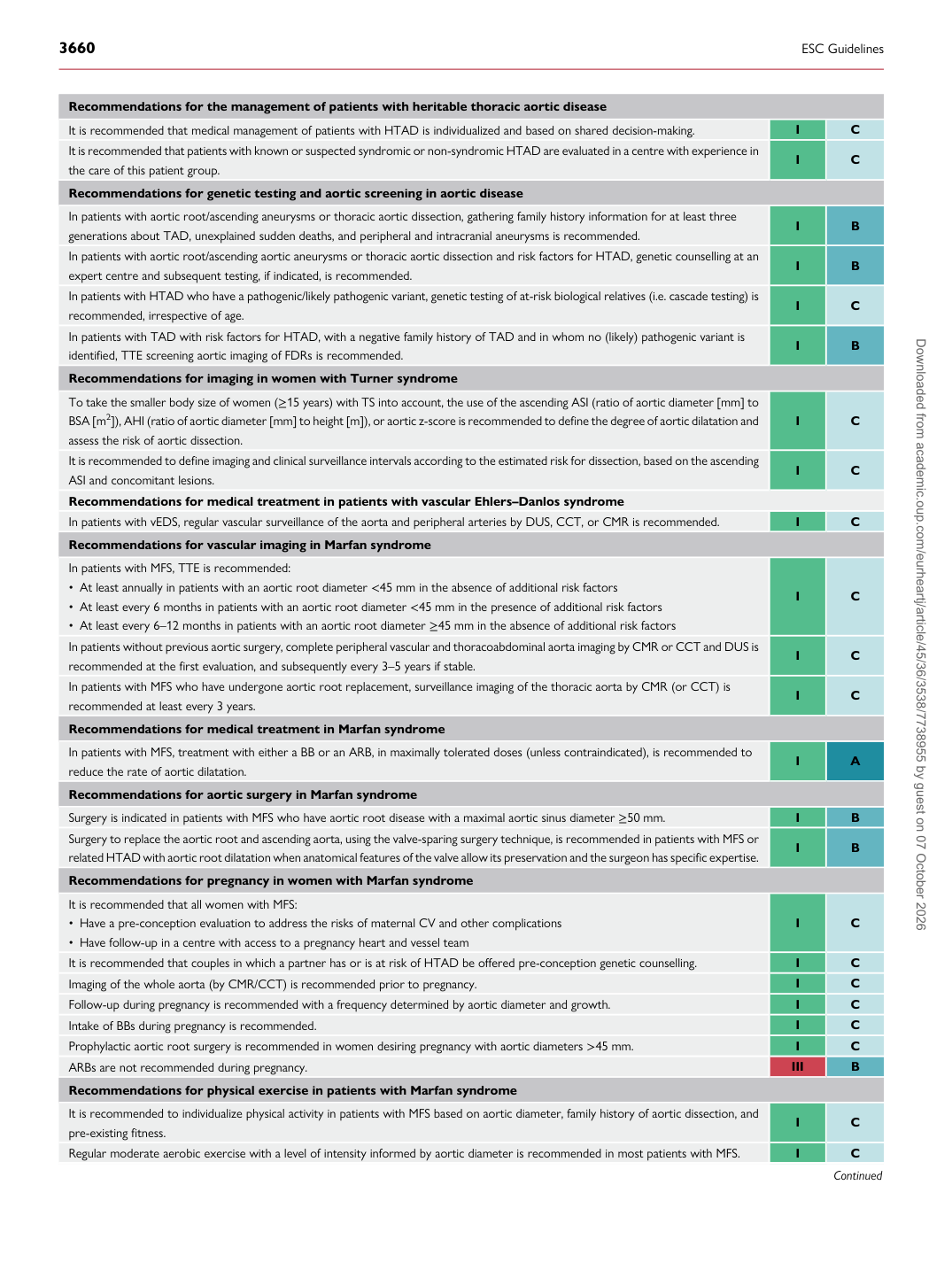
Recommendations for the management of patients with heritable thoracic aortic disease It is recommended that medical management of patients with HTAD is individualized and based on shared decision-making. I C It is recommended that patients with known or suspected syndromic or non-syndromic HTAD are evaluated in a centre with experience in the care of this patient group. I C Recommendations for genetic testing and aortic screening in aortic disease In patients with aortic root/ascending aneurysms or thoracic aortic dissection, gathering family history information for at least three generations about TAD, unexplained sudden deaths, and peripheral and intracranial aneurysms is recommended. I B In patients with aortic root/ascending aortic aneurysms or thoracic aortic dissection and risk factors for HTAD, genetic counselling at an expert centre and subsequent testing, if indicated, is recommended. I B In patients with HTAD who have a pathogenic/likely pathogenic variant, genetic testing of at-risk biological relatives (i.e. cascade testing) is recommended, irrespective of age. I C In patients with TAD with risk factors for HTAD, with a negative family history of TAD and in whom no (likely) pathogenic variant is identified, TTE screening aortic imaging of FDRs is recommended. I B Recommendations for imaging in women with Turner syndrome To take the smaller body size of women (≥15 years) with TS into account, the use of the ascending ASI (ratio of aortic diameter [mm] to BSA [m2]), AHI (ratio of aortic diameter [mm] to height [m]), or aortic z-score is recommended to define the degree of aortic dilatation and assess the risk of aortic dissection. I C It is recommended to define imaging and clinical surveillance intervals according to the estimated risk for dissection, based on the ascending ASI and concomitant lesions. I C Recommendations for medical treatment in patients with vascular Ehlers–Danlos syndrome In patients with vEDS, regular vascular surveillance of the aorta and peripheral arteries by DUS, CCT, or CMR is recommended. I C Recommendations for vascular imaging in Marfan syndrome In patients with MFS, TTE is recommended: • At least annually in patients with an aortic root diameter <45 mm in the absence of additional risk factors • At least every 6 months in patients with an aortic root diameter <45 mm in the presence of additional risk factors • At least every 6–12 months in patients with an aortic root diameter ≥45 mm in the absence of additional risk factors I C In patients without previous aortic surgery, complete peripheral vascular and thoracoabdominal aorta imaging by CMR or CCT and DUS is recommended at the first evaluation, and subsequently every 3–5 years if stable. I C In patients with MFS who have undergone aortic root replacement, surveillance imaging of the thoracic aorta by CMR (or CCT) is recommended at least every 3 years. I C Recommendations for medical treatment in Marfan syndrome In patients with MFS, treatment with either a BB or an ARB, in maximally tolerated doses (unless contraindicated), is recommended to reduce the rate of aortic dilatation. I A Recommendations for aortic surgery in Marfan syndrome Surgery is indicated in patients with MFS who have aortic root disease with a maximal aortic sinus diameter ≥50 mm. I B Surgery to replace the aortic root and ascending aorta, using the valve-sparing surgery technique, is recommended in patients with MFS or related HTAD with aortic root dilatation when anatomical features of the valve allow its preservation and the surgeon has specific expertise. I B Recommendations for pregnancy in women with Marfan syndrome It is recommended that all women with MFS: • Have a pre-conception evaluation to address the risks of maternal CV and other complications • Have follow-up in a centre with access to a pregnancy heart and vessel team I C It is recommended that couples in which a partner has or is at risk of HTAD be offered pre-conception genetic counselling. I C Imaging of the whole aorta (by CMR/CCT) is recommended prior to pregnancy. I C Follow-up during pregnancy is recommended with a frequency determined by aortic diameter and growth. I C Intake of BBs during pregnancy is recommended. I C Prophylactic aortic root surgery is recommended in women desiring pregnancy with aortic diameters >45 mm. I C ARBs are not recommended during pregnancy. III B Recommendations for physical exercise in patients with Marfan syndrome It is recommended to individualize physical activity in patients with MFS based on aortic diameter, family history of aortic dissection, and pre-existing fitness. I C Regular moderate aerobic exercise with a level of intensity informed by aortic diameter is recommended in most patients with MFS. I C

Continued Downloaded from academic.oup.com/eurheartj/article/45/36/3538/7738955 by guest on 07 October 2026