p.121 抽出テキスト
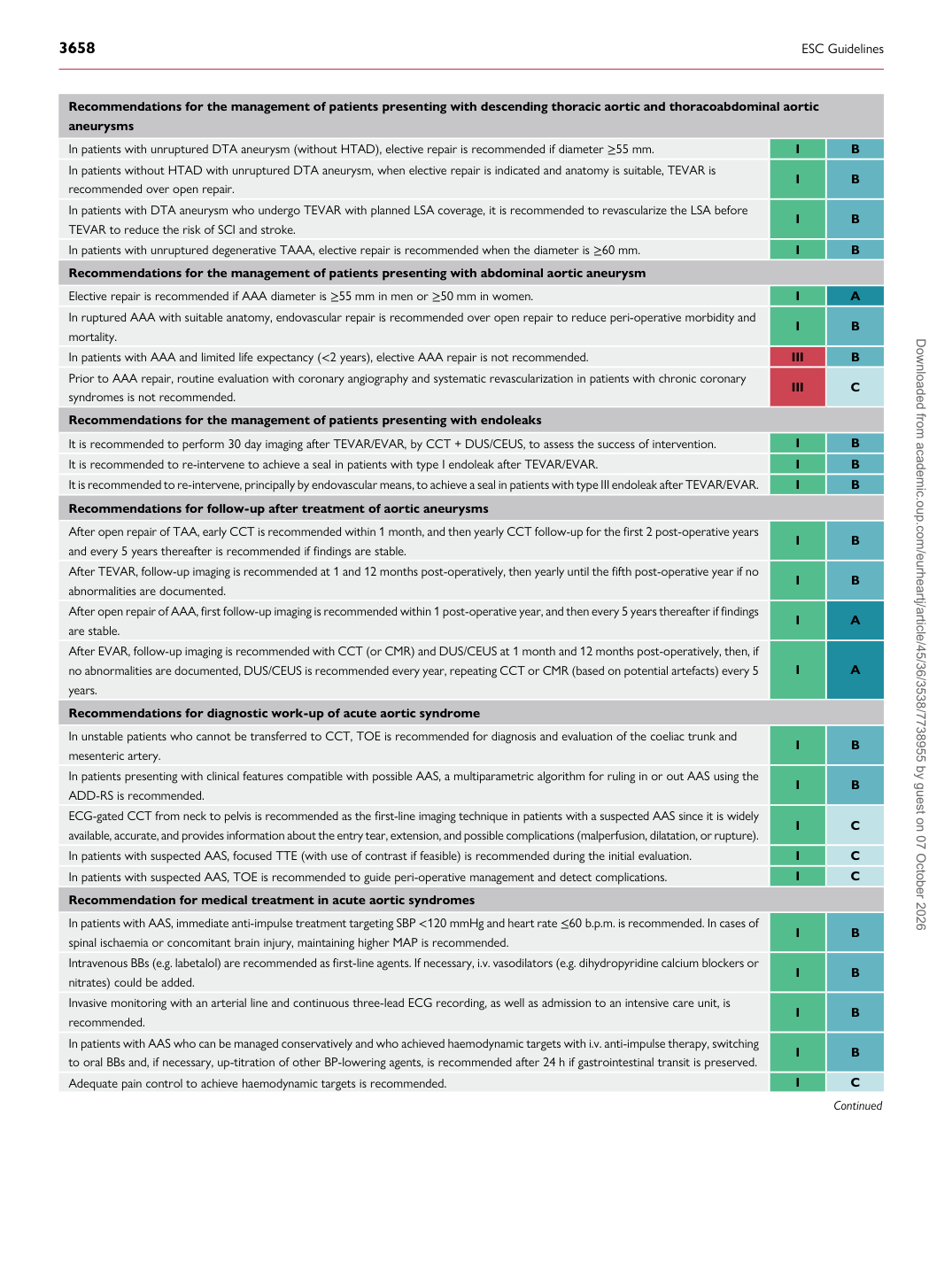
Recommendations for the management of patients presenting with descending thoracic aortic and thoracoabdominal aortic aneurysms In patients with unruptured DTA aneurysm (without HTAD), elective repair is recommended if diameter ≥55 mm. I B In patients without HTAD with unruptured DTA aneurysm, when elective repair is indicated and anatomy is suitable, TEVAR is recommended over open repair. I B In patients with DTA aneurysm who undergo TEVAR with planned LSA coverage, it is recommended to revascularize the LSA before TEVAR to reduce the risk of SCI and stroke. I B In patients with unruptured degenerative TAAA, elective repair is recommended when the diameter is ≥60 mm. I B Recommendations for the management of patients presenting with abdominal aortic aneurysm Elective repair is recommended if AAA diameter is ≥55 mm in men or ≥50 mm in women. I A In ruptured AAA with suitable anatomy, endovascular repair is recommended over open repair to reduce peri-operative morbidity and mortality. I B In patients with AAA and limited life expectancy (<2 years), elective AAA repair is not recommended. III B Prior to AAA repair, routine evaluation with coronary angiography and systematic revascularization in patients with chronic coronary syndromes is not recommended. III C Recommendations for the management of patients presenting with endoleaks It is recommended to perform 30 day imaging after TEVAR/EVAR, by CCT + DUS/CEUS, to assess the success of intervention. I B It is recommended to re-intervene to achieve a seal in patients with type I endoleak after TEVAR/EVAR. I B It is recommended to re-intervene, principally by endovascular means, to achieve a seal in patients with type III endoleak after TEVAR/EVAR. I B Recommendations for follow-up after treatment of aortic aneurysms After open repair of TAA, early CCT is recommended within 1 month, and then yearly CCT follow-up for the first 2 post-operative years and every 5 years thereafter is recommended if findings are stable. I B After TEVAR, follow-up imaging is recommended at 1 and 12 months post-operatively, then yearly until the fifth post-operative year if no abnormalities are documented. I B After open repair of AAA, first follow-up imaging is recommended within 1 post-operative year, and then every 5 years thereafter if findings are stable. I A After EVAR, follow-up imaging is recommended with CCT (or CMR) and DUS/CEUS at 1 month and 12 months post-operatively, then, if no abnormalities are documented, DUS/CEUS is recommended every year, repeating CCT or CMR (based on potential artefacts) every 5 years. I A Recommendations for diagnostic work-up of acute aortic syndrome In unstable patients who cannot be transferred to CCT, TOE is recommended for diagnosis and evaluation of the coeliac trunk and mesenteric artery. I B In patients presenting with clinical features compatible with possible AAS, a multiparametric algorithm for ruling in or out AAS using the ADD-RS is recommended. I B ECG-gated CCT from neck to pelvis is recommended as the first-line imaging technique in patients with a suspected AAS since it is widely available, accurate, and provides information about the entry tear, extension, and possible complications (malperfusion, dilatation, or rupture). I C In patients with suspected AAS, focused TTE (with use of contrast if feasible) is recommended during the initial evaluation. I C In patients with suspected AAS, TOE is recommended to guide peri-operative management and detect complications. I C Recommendation for medical treatment in acute aortic syndromes In patients with AAS, immediate anti-impulse treatment targeting SBP <120 mmHg and heart rate ≤60 b.p.m. is recommended. In cases of spinal ischaemia or concomitant brain injury, maintaining higher MAP is recommended. I B Intravenous BBs (e.g. labetalol) are recommended as first-line agents. If necessary, i.v. vasodilators (e.g. dihydropyridine calcium blockers or nitrates) could be added. I B Invasive monitoring with an arterial line and continuous three-lead ECG recording, as well as admission to an intensive care unit, is recommended. I B In patients with AAS who can be managed conservatively and who achieved haemodynamic targets with i.v. anti-impulse therapy, switching to oral BBs and, if necessary, up-titration of other BP-lowering agents, is recommended after 24 h if gastrointestinal transit is preserved. I B Adequate pain control to achieve haemodynamic targets is recommended. I C

Continued Downloaded from academic.oup.com/eurheartj/article/45/36/3538/7738955 by guest on 07 October 2026