p.120 抽出テキスト
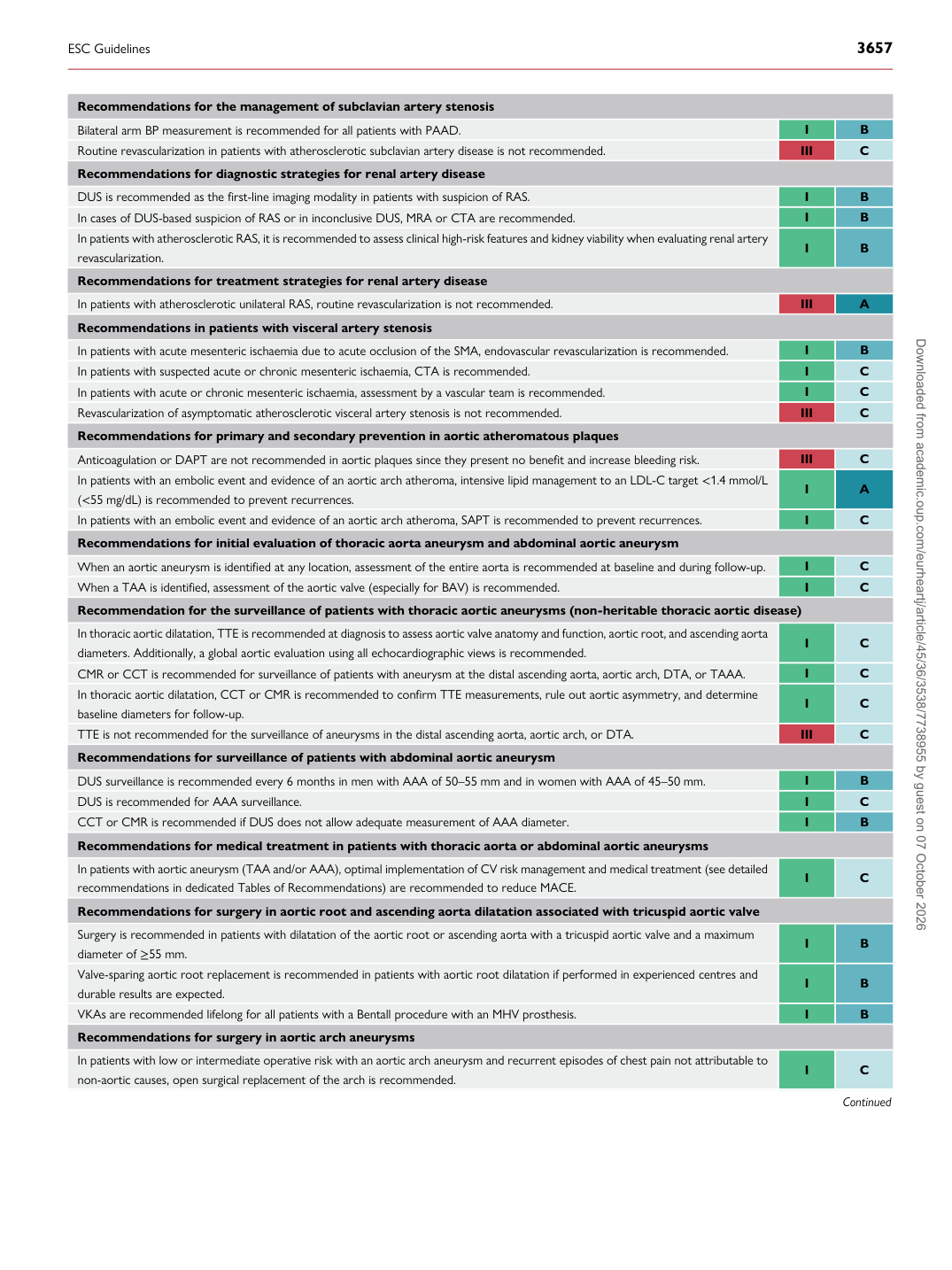
Recommendations for the management of subclavian artery stenosis Bilateral arm BP measurement is recommended for all patients with PAAD. I B Routine revascularization in patients with atherosclerotic subclavian artery disease is not recommended. III C Recommendations for diagnostic strategies for renal artery disease DUS is recommended as the first-line imaging modality in patients with suspicion of RAS. I B In cases of DUS-based suspicion of RAS or in inconclusive DUS, MRA or CTA are recommended. I B In patients with atherosclerotic RAS, it is recommended to assess clinical high-risk features and kidney viability when evaluating renal artery revascularization. I B Recommendations for treatment strategies for renal artery disease In patients with atherosclerotic unilateral RAS, routine revascularization is not recommended. III A Recommendations in patients with visceral artery stenosis In patients with acute mesenteric ischaemia due to acute occlusion of the SMA, endovascular revascularization is recommended. I B In patients with suspected acute or chronic mesenteric ischaemia, CTA is recommended. I C In patients with acute or chronic mesenteric ischaemia, assessment by a vascular team is recommended. I C Revascularization of asymptomatic atherosclerotic visceral artery stenosis is not recommended. III C Recommendations for primary and secondary prevention in aortic atheromatous plaques Anticoagulation or DAPT are not recommended in aortic plaques since they present no benefit and increase bleeding risk. III C In patients with an embolic event and evidence of an aortic arch atheroma, intensive lipid management to an LDL-C target <1.4 mmol/L (<55 mg/dL) is recommended to prevent recurrences. I A In patients with an embolic event and evidence of an aortic arch atheroma, SAPT is recommended to prevent recurrences. I C Recommendations for initial evaluation of thoracic aorta aneurysm and abdominal aortic aneurysm When an aortic aneurysm is identified at any location, assessment of the entire aorta is recommended at baseline and during follow-up. I C When a TAA is identified, assessment of the aortic valve (especially for BAV) is recommended. I C Recommendation for the surveillance of patients with thoracic aortic aneurysms (non-heritable thoracic aortic disease) In thoracic aortic dilatation, TTE is recommended at diagnosis to assess aortic valve anatomy and function, aortic root, and ascending aorta diameters. Additionally, a global aortic evaluation using all echocardiographic views is recommended. I C CMR or CCT is recommended for surveillance of patients with aneurysm at the distal ascending aorta, aortic arch, DTA, or TAAA. I C In thoracic aortic dilatation, CCT or CMR is recommended to confirm TTE measurements, rule out aortic asymmetry, and determine baseline diameters for follow-up. I C TTE is not recommended for the surveillance of aneurysms in the distal ascending aorta, aortic arch, or DTA. III C Recommendations for surveillance of patients with abdominal aortic aneurysm DUS surveillance is recommended every 6 months in men with AAA of 50–55 mm and in women with AAA of 45–50 mm. I B DUS is recommended for AAA surveillance. I C CCT or CMR is recommended if DUS does not allow adequate measurement of AAA diameter. I B Recommendations for medical treatment in patients with thoracic aorta or abdominal aortic aneurysms In patients with aortic aneurysm (TAA and/or AAA), optimal implementation of CV risk management and medical treatment (see detailed recommendations in dedicated Tables of Recommendations) are recommended to reduce MACE. I C Recommendations for surgery in aortic root and ascending aorta dilatation associated with tricuspid aortic valve Surgery is recommended in patients with dilatation of the aortic root or ascending aorta with a tricuspid aortic valve and a maximum diameter of ≥55 mm. I B Valve-sparing aortic root replacement is recommended in patients with aortic root dilatation if performed in experienced centres and durable results are expected. I B VKAs are recommended lifelong for all patients with a Bentall procedure with an MHV prosthesis. I B Recommendations for surgery in aortic arch aneurysms In patients with low or intermediate operative risk with an aortic arch aneurysm and recurrent episodes of chest pain not attributable to non-aortic causes, open surgical replacement of the arch is recommended. I C

Continued

ESC Guidelines                                                                                                                                                                                          3657

Downloaded from academic.oup.com/eurheartj/article/45/36/3538/7738955 by guest on 07 October 2026