p.119 抽出テキスト
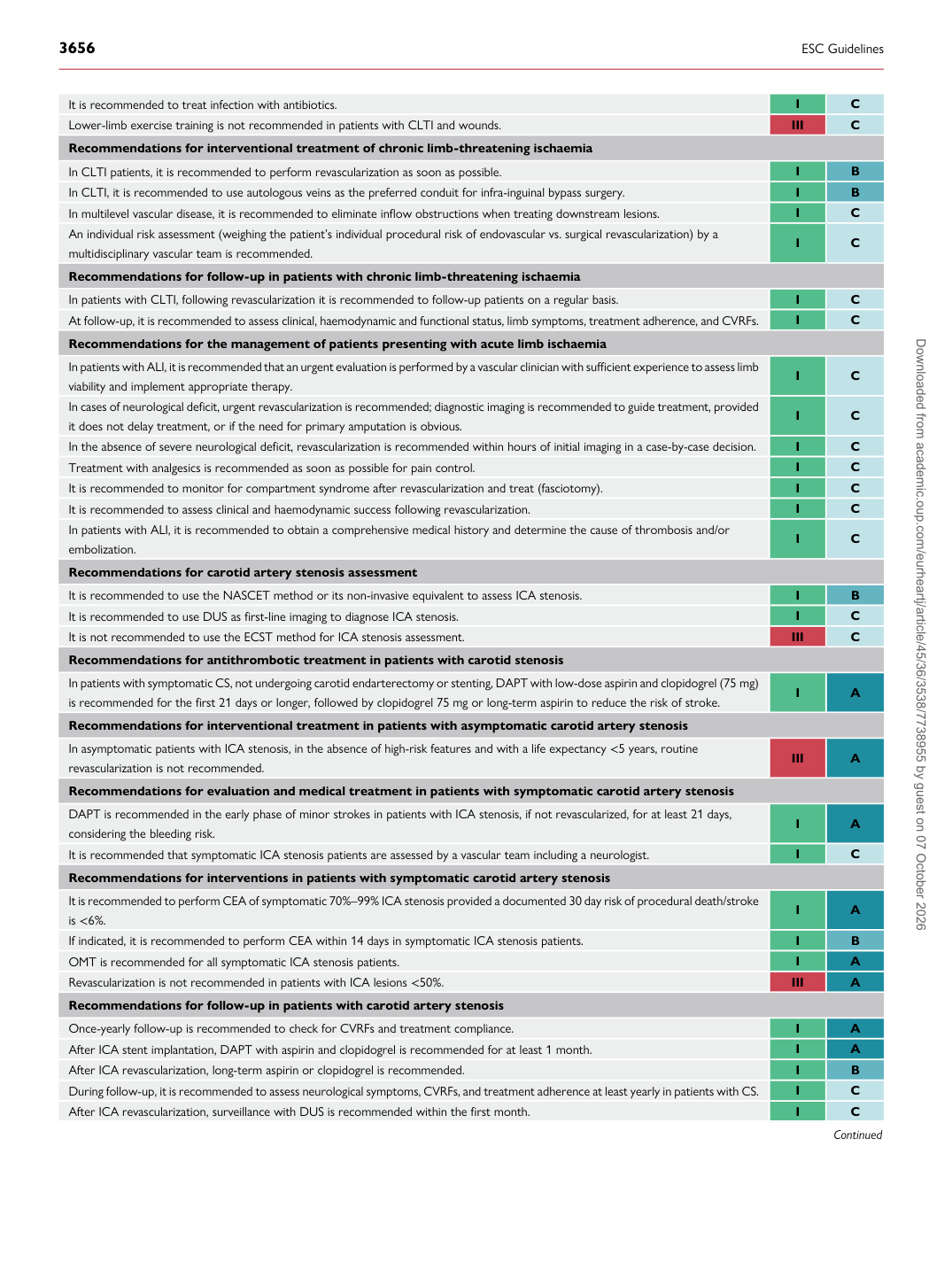
It is recommended to treat infection with antibiotics. I C Lower-limb exercise training is not recommended in patients with CLTI and wounds. III C Recommendations for interventional treatment of chronic limb-threatening ischaemia In CLTI patients, it is recommended to perform revascularization as soon as possible. I B In CLTI, it is recommended to use autologous veins as the preferred conduit for infra-inguinal bypass surgery. I B In multilevel vascular disease, it is recommended to eliminate inflow obstructions when treating downstream lesions. I C An individual risk assessment (weighing the patient’s individual procedural risk of endovascular vs. surgical revascularization) by a multidisciplinary vascular team is recommended. I C Recommendations for follow-up in patients with chronic limb-threatening ischaemia In patients with CLTI, following revascularization it is recommended to follow-up patients on a regular basis. I C At follow-up, it is recommended to assess clinical, haemodynamic and functional status, limb symptoms, treatment adherence, and CVRFs. I C Recommendations for the management of patients presenting with acute limb ischaemia In patients with ALI, it is recommended that an urgent evaluation is performed by a vascular clinician with sufficient experience to assess limb viability and implement appropriate therapy. I C In cases of neurological deficit, urgent revascularization is recommended; diagnostic imaging is recommended to guide treatment, provided it does not delay treatment, or if the need for primary amputation is obvious. I C In the absence of severe neurological deficit, revascularization is recommended within hours of initial imaging in a case-by-case decision. I C Treatment with analgesics is recommended as soon as possible for pain control. I C It is recommended to monitor for compartment syndrome after revascularization and treat (fasciotomy). I C It is recommended to assess clinical and haemodynamic success following revascularization. I C In patients with ALI, it is recommended to obtain a comprehensive medical history and determine the cause of thrombosis and/or embolization. I C Recommendations for carotid artery stenosis assessment It is recommended to use the NASCET method or its non-invasive equivalent to assess ICA stenosis. I B It is recommended to use DUS as first-line imaging to diagnose ICA stenosis. I C It is not recommended to use the ECST method for ICA stenosis assessment. III C Recommendations for antithrombotic treatment in patients with carotid stenosis In patients with symptomatic CS, not undergoing carotid endarterectomy or stenting, DAPT with low-dose aspirin and clopidogrel (75 mg) is recommended for the first 21 days or longer, followed by clopidogrel 75 mg or long-term aspirin to reduce the risk of stroke. I A Recommendations for interventional treatment in patients with asymptomatic carotid artery stenosis In asymptomatic patients with ICA stenosis, in the absence of high-risk features and with a life expectancy <5 years, routine revascularization is not recommended. III A Recommendations for evaluation and medical treatment in patients with symptomatic carotid artery stenosis DAPT is recommended in the early phase of minor strokes in patients with ICA stenosis, if not revascularized, for at least 21 days, considering the bleeding risk. I A It is recommended that symptomatic ICA stenosis patients are assessed by a vascular team including a neurologist. I C Recommendations for interventions in patients with symptomatic carotid artery stenosis It is recommended to perform CEA of symptomatic 70%–99% ICA stenosis provided a documented 30 day risk of procedural death/stroke is <6%. I A If indicated, it is recommended to perform CEA within 14 days in symptomatic ICA stenosis patients. I B OMT is recommended for all symptomatic ICA stenosis patients. I A Revascularization is not recommended in patients with ICA lesions <50%. III A Recommendations for follow-up in patients with carotid artery stenosis Once-yearly follow-up is recommended to check for CVRFs and treatment compliance. I A After ICA stent implantation, DAPT with aspirin and clopidogrel is recommended for at least 1 month. I A After ICA revascularization, long-term aspirin or clopidogrel is recommended. I B During follow-up, it is recommended to assess neurological symptoms, CVRFs, and treatment adherence at least yearly in patients with CS. I C After ICA revascularization, surveillance with DUS is recommended within the first month. I C

Continued Downloaded from academic.oup.com/eurheartj/article/45/36/3538/7738955 by guest on 07 October 2026