p.118 抽出テキスト
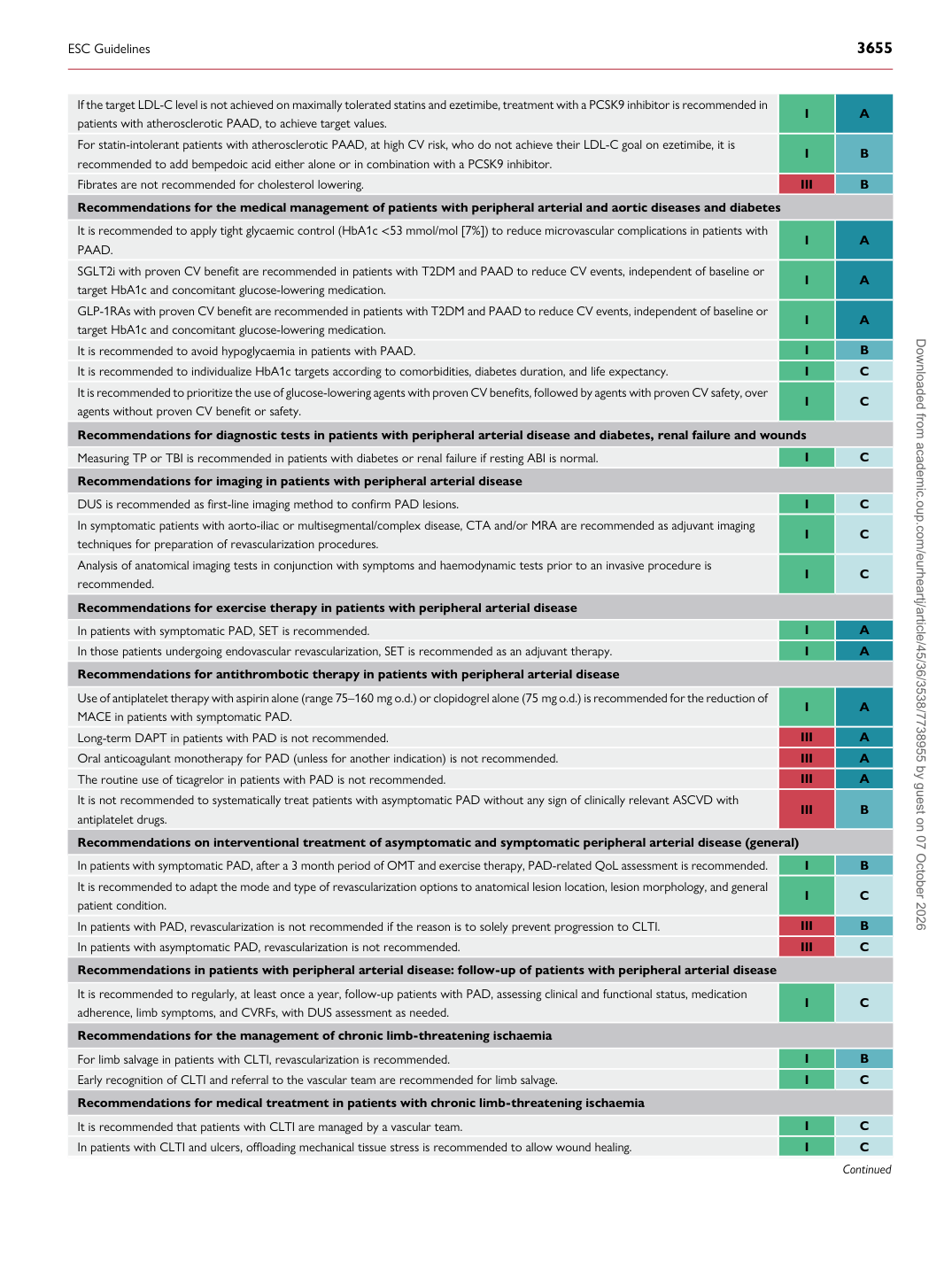
If the target LDL-C level is not achieved on maximally tolerated statins and ezetimibe, treatment with a PCSK9 inhibitor is recommended in patients with atherosclerotic PAAD, to achieve target values. I A For statin-intolerant patients with atherosclerotic PAAD, at high CV risk, who do not achieve their LDL-C goal on ezetimibe, it is recommended to add bempedoic acid either alone or in combination with a PCSK9 inhibitor. I B Fibrates are not recommended for cholesterol lowering. III B Recommendations for the medical management of patients with peripheral arterial and aortic diseases and diabetes It is recommended to apply tight glycaemic control (HbA1c <53 mmol/mol [7%]) to reduce microvascular complications in patients with PAAD. I A SGLT2i with proven CV benefit are recommended in patients with T2DM and PAAD to reduce CV events, independent of baseline or target HbA1c and concomitant glucose-lowering medication. I A GLP-1RAs with proven CV benefit are recommended in patients with T2DM and PAAD to reduce CV events, independent of baseline or target HbA1c and concomitant glucose-lowering medication. I A It is recommended to avoid hypoglycaemia in patients with PAAD. I B It is recommended to individualize HbA1c targets according to comorbidities, diabetes duration, and life expectancy. I C It is recommended to prioritize the use of glucose-lowering agents with proven CV benefits, followed by agents with proven CV safety, over agents without proven CV benefit or safety. I C Recommendations for diagnostic tests in patients with peripheral arterial disease and diabetes, renal failure and wounds Measuring TP or TBI is recommended in patients with diabetes or renal failure if resting ABI is normal. I C Recommendations for imaging in patients with peripheral arterial disease DUS is recommended as first-line imaging method to confirm PAD lesions. I C In symptomatic patients with aorto-iliac or multisegmental/complex disease, CTA and/or MRA are recommended as adjuvant imaging techniques for preparation of revascularization procedures. I C Analysis of anatomical imaging tests in conjunction with symptoms and haemodynamic tests prior to an invasive procedure is recommended. I C Recommendations for exercise therapy in patients with peripheral arterial disease In patients with symptomatic PAD, SET is recommended. I A In those patients undergoing endovascular revascularization, SET is recommended as an adjuvant therapy. I A Recommendations for antithrombotic therapy in patients with peripheral arterial disease Use of antiplatelet therapy with aspirin alone (range 75–160 mg o.d.) or clopidogrel alone (75 mg o.d.) is recommended for the reduction of MACE in patients with symptomatic PAD. I A Long-term DAPT in patients with PAD is not recommended. III A Oral anticoagulant monotherapy for PAD (unless for another indication) is not recommended. III A The routine use of ticagrelor in patients with PAD is not recommended. III A It is not recommended to systematically treat patients with asymptomatic PAD without any sign of clinically relevant ASCVD with antiplatelet drugs. III B Recommendations on interventional treatment of asymptomatic and symptomatic peripheral arterial disease (general) In patients with symptomatic PAD, after a 3 month period of OMT and exercise therapy, PAD-related QoL assessment is recommended. I B It is recommended to adapt the mode and type of revascularization options to anatomical lesion location, lesion morphology, and general patient condition. I C In patients with PAD, revascularization is not recommended if the reason is to solely prevent progression to CLTI. III B In patients with asymptomatic PAD, revascularization is not recommended. III C Recommendations in patients with peripheral arterial disease: follow-up of patients with peripheral arterial disease It is recommended to regularly, at least once a year, follow-up patients with PAD, assessing clinical and functional status, medication adherence, limb symptoms, and CVRFs, with DUS assessment as needed. I C Recommendations for the management of chronic limb-threatening ischaemia For limb salvage in patients with CLTI, revascularization is recommended. I B Early recognition of CLTI and referral to the vascular team are recommended for limb salvage. I C Recommendations for medical treatment in patients with chronic limb-threatening ischaemia It is recommended that patients with CLTI are managed by a vascular team. I C In patients with CLTI and ulcers, offloading mechanical tissue stress is recommended to allow wound healing. I C

Continued

ESC Guidelines                                                                                                                                                                                          3655

Downloaded from academic.oup.com/eurheartj/article/45/36/3538/7738955 by guest on 07 October 2026