p.117 抽出テキスト
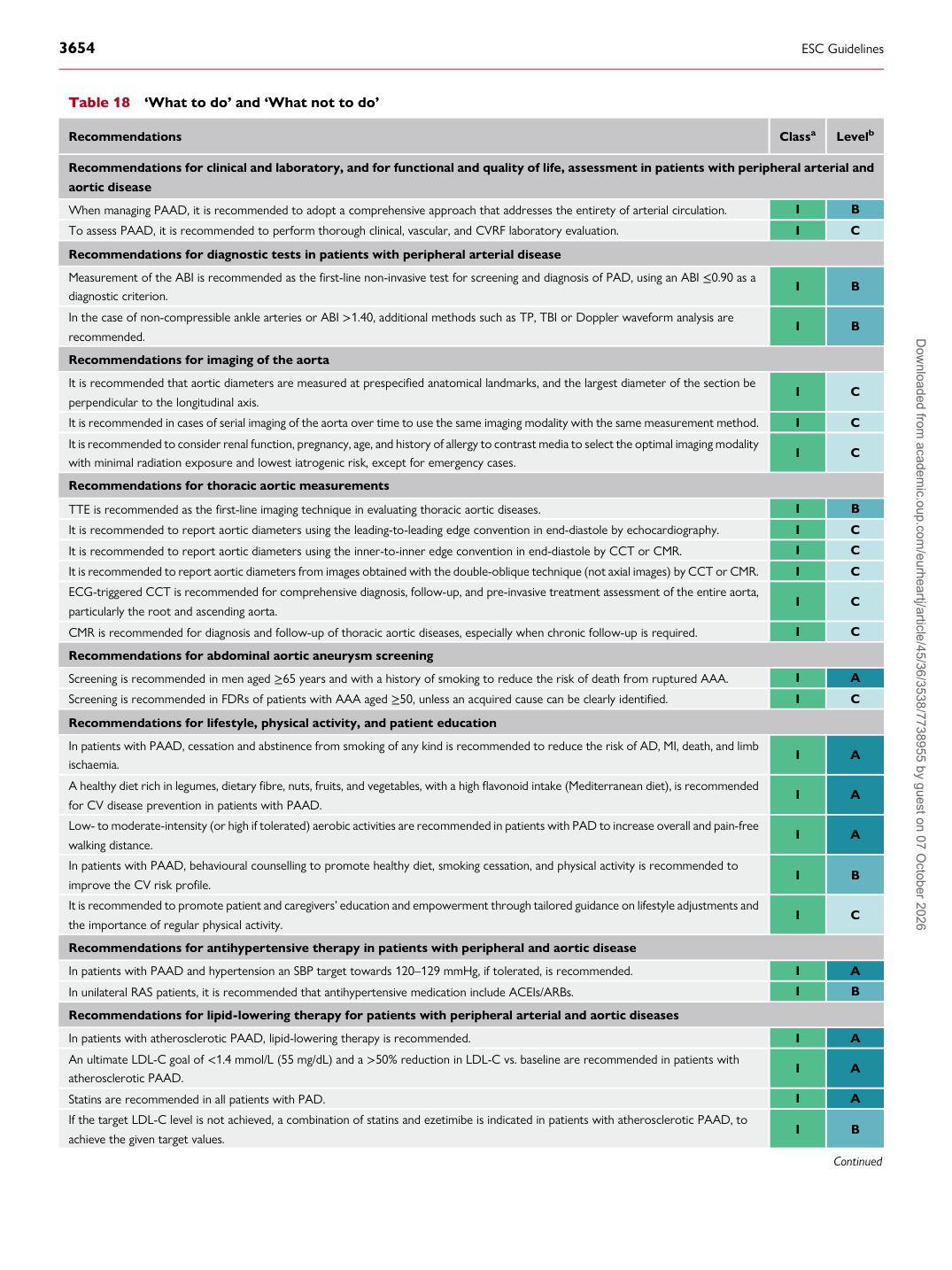
Table 18 ‘What to do’ and ‘What not to do’

Recommendations Classa Levelb

Recommendations for clinical and laboratory, and for functional and quality of life, assessment in patients with peripheral arterial and aortic disease When managing PAAD, it is recommended to adopt a comprehensive approach that addresses the entirety of arterial circulation. I B To assess PAAD, it is recommended to perform thorough clinical, vascular, and CVRF laboratory evaluation. I C Recommendations for diagnostic tests in patients with peripheral arterial disease Measurement of the ABI is recommended as the first-line non-invasive test for screening and diagnosis of PAD, using an ABI ≤0.90 as a diagnostic criterion. I B In the case of non-compressible ankle arteries or ABI >1.40, additional methods such as TP, TBI or Doppler waveform analysis are recommended. I B Recommendations for imaging of the aorta It is recommended that aortic diameters are measured at prespecified anatomical landmarks, and the largest diameter of the section be perpendicular to the longitudinal axis. I C It is recommended in cases of serial imaging of the aorta over time to use the same imaging modality with the same measurement method. I C It is recommended to consider renal function, pregnancy, age, and history of allergy to contrast media to select the optimal imaging modality with minimal radiation exposure and lowest iatrogenic risk, except for emergency cases. I C Recommendations for thoracic aortic measurements TTE is recommended as the first-line imaging technique in evaluating thoracic aortic diseases. I B It is recommended to report aortic diameters using the leading-to-leading edge convention in end-diastole by echocardiography. I C It is recommended to report aortic diameters using the inner-to-inner edge convention in end-diastole by CCT or CMR. I C It is recommended to report aortic diameters from images obtained with the double-oblique technique (not axial images) by CCT or CMR. I C ECG-triggered CCT is recommended for comprehensive diagnosis, follow-up, and pre-invasive treatment assessment of the entire aorta, particularly the root and ascending aorta. I C CMR is recommended for diagnosis and follow-up of thoracic aortic diseases, especially when chronic follow-up is required. I C Recommendations for abdominal aortic aneurysm screening Screening is recommended in men aged ≥65 years and with a history of smoking to reduce the risk of death from ruptured AAA. I A Screening is recommended in FDRs of patients with AAA aged ≥50, unless an acquired cause can be clearly identified. I C Recommendations for lifestyle, physical activity, and patient education In patients with PAAD, cessation and abstinence from smoking of any kind is recommended to reduce the risk of AD, MI, death, and limb ischaemia. I A A healthy diet rich in legumes, dietary fibre, nuts, fruits, and vegetables, with a high flavonoid intake (Mediterranean diet), is recommended for CV disease prevention in patients with PAAD. I A Low- to moderate-intensity (or high if tolerated) aerobic activities are recommended in patients with PAD to increase overall and pain-free walking distance. I A In patients with PAAD, behavioural counselling to promote healthy diet, smoking cessation, and physical activity is recommended to improve the CV risk profile. I B It is recommended to promote patient and caregivers’ education and empowerment through tailored guidance on lifestyle adjustments and the importance of regular physical activity. I C Recommendations for antihypertensive therapy in patients with peripheral and aortic disease In patients with PAAD and hypertension an SBP target towards 120–129 mmHg, if tolerated, is recommended. I A In unilateral RAS patients, it is recommended that antihypertensive medication include ACEIs/ARBs. I B Recommendations for lipid-lowering therapy for patients with peripheral arterial and aortic diseases In patients with atherosclerotic PAAD, lipid-lowering therapy is recommended. I A An ultimate LDL-C goal of <1.4 mmol/L (55 mg/dL) and a >50% reduction in LDL-C vs. baseline are recommended in patients with atherosclerotic PAAD. I A Statins are recommended in all patients with PAD. I A If the target LDL-C level is not achieved, a combination of statins and ezetimibe is indicated in patients with atherosclerotic PAAD, to achieve the given target values. I B

Continued Downloaded from academic.oup.com/eurheartj/article/45/36/3538/7738955 by guest on 07 October 2026