p.115 抽出テキスト
can increase LV afterload and impair coronary blood flow, resulting in hypertension, LV hypertrophy, LV diastolic dysfunction, and HF.1575,1576 Skeletal muscle involvement and deconditioning due to PAD may aggravate HF severity.1577,1578 Peripheral arterial disease and HF are independently associated with poor outcomes and those with concomitant HF have a 30% higher risk of MACE and 40% higher risk of all-cause mortality.1574 Evaluation of LV function in patients with PAD may be useful for better CV risk stratification and comprehensive management of their CV disease.1579 This is of particular importance when an intermediate- or high-risk vascular intervention is planned. Expectedly, the presence of PAD in patients with HF is also associated with poor outcomes.1580–1584 These patients represent a high-risk group in which intense risk-factor modification strategies and optimization of HF therapy are warranted.

11.3 Peripheral arterial disease and AF

The prevalence of AF among patients with PAD is around 12%.1585–1590 A meta-analysis revealed that in patients with AF and PAD, risk of allcause mortality, CV mortality, and MACE is 40%, over 60%, and over 70% higher, respectively compared with patients with AF without PAD.1591 PAD is included in the CHA2DS2-VASc (congestive heart failure, hypertension, age ≥75 [doubled], diabetes, stroke [doubled], vascular disease, age 65 to 74 and sex category [female]) risk score, which underlies the prognostic importance of PAD in patients with AF.1592

11.4 Peripheral arterial disease and aortic

stenosis Peripheral arterial disease frequently accompanies symptomatic aortic stenosis, especially among patients not eligible for surgical aortic valve replacement (20%–30%).198,1593–1595 In these patients, pre-procedural CCT/CTA or CMR1596 of the aorta and major peripheral arteries is mandatory to evaluate the access site for transcatheter aortic valve implantation (TAVI) and plan a closure strategy for the access site. Patients with PAD have increased risk of all-cause mortality and vascular complications after TAVI,198 thus, screening for PAD in these patients may be helpful. 12 Key messages

Peripheral arterial and aortic diseases are highly prevalent, often asymptomatic, and linked to increased morbidity and mortality. Early diagnosis is crucial for better outcomes and management requires a multidisciplinary team. CVRF control is crucial to prevent progression and complications. Despite the benefit of medical therapy, lifestyle changes, healthy diet, abstinence from smoking, exercise/rehabilitation, and education are essential for effective management. Patient empowerment is essential to improve adherence and close/regular monitoring is essential to improve prognosis. Use of web- or app-based calculators for estimation of CV risk in the secondary prevention of ASCVD may aid patient motivation for lifestyle changes and adherence to medication. Peripheral arteries Atherosclerotic lower-extremity PAD is a chronic disease needing lifelong follow-up. Assessment of walking impairment, functional status, and amputation risk is crucial in PAD management. Ankle–brachial index should be the initial diagnostic test for screening and diagnosing PAD, and serves as a surrogate marker for CV and all-cause mortality. DUS is the first-line imaging method to confirm PAD lesions. Supervised exercise training or, if not available, HBET, improves walking and functional performances, and reduces CV risk. Exercise training remains underused and increased awareness is warranted. In asymptomatic PAD patient revascularization is not recommended. In symptomatic PAD patient need for interventional treatment, following a period of optimal medical treatment and exercise, should be discussed in a multidisciplinary setting. Chronic limb-threatening ischaemia increases the risk of CV events, needs early diagnosis, rapid referral to a multidisciplinary vascular team, and revascularization for limb salvage. Acute limb ischaemia warrants rapid clinical assessment by a vascular team and urgent revascularization. Duplex ultrasound is the first-line diagnostic modality for carotid stenosis. Routine revascularization is not recommended if asymptomatic. In symptomatic patients multidisciplinary assessment is recommended.

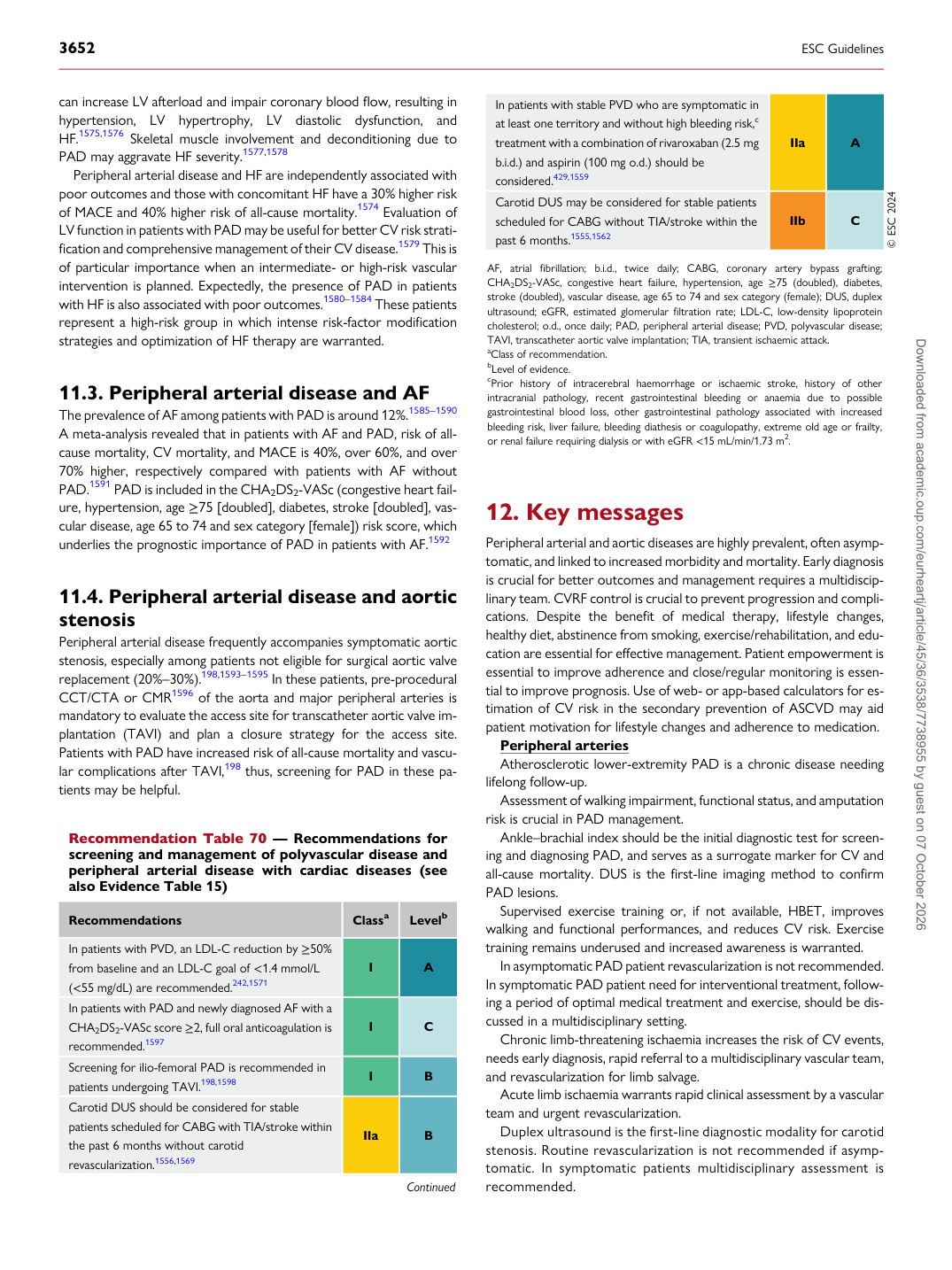
Recommendation Table 70 — Recommendations for screening and management of polyvascular disease and peripheral arterial disease with cardiac diseases (see also Evidence Table 15)

Recommendations Classa Levelb

In patients with PVD, an LDL-C reduction by ≥50% from baseline and an LDL-C goal of <1.4 mmol/L (<55 mg/dL) are recommended.242,1571 I A In patients with PAD and newly diagnosed AF with a CHA2DS2-VASc score ≥2, full oral anticoagulation is recommended.1597 I C Screening for ilio-femoral PAD is recommended in patients undergoing TAVI.198,1598 I B Carotid DUS should be considered for stable patients scheduled for CABG with TIA/stroke within the past 6 months without carotid revascularization.1556,1569 IIa B

Continued In patients with stable PVD who are symptomatic in

at least one territory and without high bleeding risk,c treatment with a combination of rivaroxaban (2.5 mg b.i.d.) and aspirin (100 mg o.d.) should be considered.429,1559 IIa A Carotid DUS may be considered for stable patients scheduled for CABG without TIA/stroke within the past 6 months.1555,1562 IIb C © ESC 2024

AF, atrial fibrillation; b.i.d., twice daily; CABG, coronary artery bypass grafting; CHA2DS2-VASc, congestive heart failure, hypertension, age ≥75 (doubled), diabetes, stroke (doubled), vascular disease, age 65 to 74 and sex category (female); DUS, duplex ultrasound; eGFR, estimated glomerular filtration rate; LDL-C, low-density lipoprotein cholesterol; o.d., once daily; PAD, peripheral arterial disease; PVD, polyvascular disease; TAVI, transcatheter aortic valve implantation; TIA, transient ischaemic attack. aClass of recommendation. bLevel of evidence. cPrior history of intracerebral haemorrhage or ischaemic stroke, history of other intracranial pathology, recent gastrointestinal bleeding or anaemia due to possible gastrointestinal blood loss, other gastrointestinal pathology associated with increased bleeding risk, liver failure, bleeding diathesis or coagulopathy, extreme old age or frailty, or renal failure requiring dialysis or with eGFR <15 mL/min/1.73 m2. Downloaded from academic.oup.com/eurheartj/article/45/36/3538/7738955 by guest on 07 October 2026