p.114 抽出テキスト
11.1.2.1 Screening for coronary artery disease in patients with

symptomatic peripheral arterial disease The morbidity and mortality of patients with PAD is high due to CV complications. Given high CAD event rates in patients with PAD, CAD screening may be helpful to optimize medical treatment and is not intended to increase the rate of coronary interventions.431 Evaluation can be performed by stress testing or CCT; however, there is no evidence that systematic screening for CAD in stable PAD improves outcomes. Coronary angiography is less suitable due to invasiveness. In patients requiring lower-limb revascularization, CAD management should be based on the 2022 ESC Guidelines on cardiovascular assessment and management of patients undergoing non-cardiac surgery.1080

11.1.2.2 Screening for peripheral arterial disease in patients with

coronary artery disease In high-risk CAD patients with three-vessel disease or recent ACS, systematic screening for multisite atherosclerotic disease through ABI and DUS of carotids, lower-extremity, and renal arteries did not improve outcomes.1563 However, a subgroup analysis of the COMPASS trial suggests potential benefits when adding vascular-dose rivaroxaban to aspirin in stable patients with CAD and PAD, raising the question of whether identifying PAD in stable CAD patients could be advantageous.429,1559 In patients undergoing CABG, the presence of concomitant PAD is associated with a three-fold risk of subsequent CV events after CABG.1560,1561 The GSV should be spared whenever possible, since the success of peripheral arterial revascularization in complex lesions is strongly associated with the availability of sufficient autologous venous segments.567,1564

11.1.2.3 Screening for coronary artery disease in patients with

carotid stenosis Due to the high prevalence of CAD among patients scheduled for elective CEA,1565,1566 pre-operative CAD screening, including coronary angiography, may be considered in suspected patients.1558 CAD requires prioritization of revascularization according to the patient’s clinical status and the severity of carotid disease and CAD. Coronary revascularization should generally be performed first; the exception is recently symptomatic patients with unstable neurological symptoms in whom carotid revascularization should be prioritized.680

11.1.2.4 Screening for carotid stenosis in patients with coronary

artery disease Carotid artery stenosis screening may be useful in patients undergoing elective CABG. Ischaemic stroke after CABG is multifactorial,1567 but also depends on the degree of carotid disease.1556 Two studies suggest that limiting DUS to patients with at least one risk factor (age >65 years, history of cerebrovascular disease, presence of a carotid bruit, multivessel CAD or PAD) identifies most patients with significant (≥70%) CS.1555,1562 Nevertheless, addition of CEA to CABG is unlikely to provide significant stroke reduction. In a study in patients with CAD with >80% CS undergoing staged or synchronous carotid procedures (two-thirds were neurologically asymptomatic and 73% had unilateral asymptomatic carotid stenosis), in-hospital stroke rates and 30 day mortality were similar in patients treated with CABG + CEA and in those treated with isolated CABG.1568 Another study suggests that selective use of DUS should be considered before CABG in patients with a history of neurological events or PAD.1569

11.1.3 Management of patients with polyvascular

disease Polyvascular disease requires proactive management of all modifiable risk factors through lifestyle changes and drug therapy. Scientific evidence suggests the benefit of intensified antithrombotic therapy, with no increase in risk of bleeding.1570 ILT offers comparable benefits for PVD patients and those with single arterial territory disease. However, the benefits of ILT in patients with PVD are not dependent on baseline LDL-C.1571 Revascularization should be reserved for symptomatic arterial territories, using the least invasive strategy in a multidisciplinary vascular team approach.

11.2 Peripheral arterial disease and heart

failure Left ventricular (LV) dysfunction is observed in 20%–30% of PAD patients,1572,1573 mostly associated with CAD.1574 High aortic stiffness

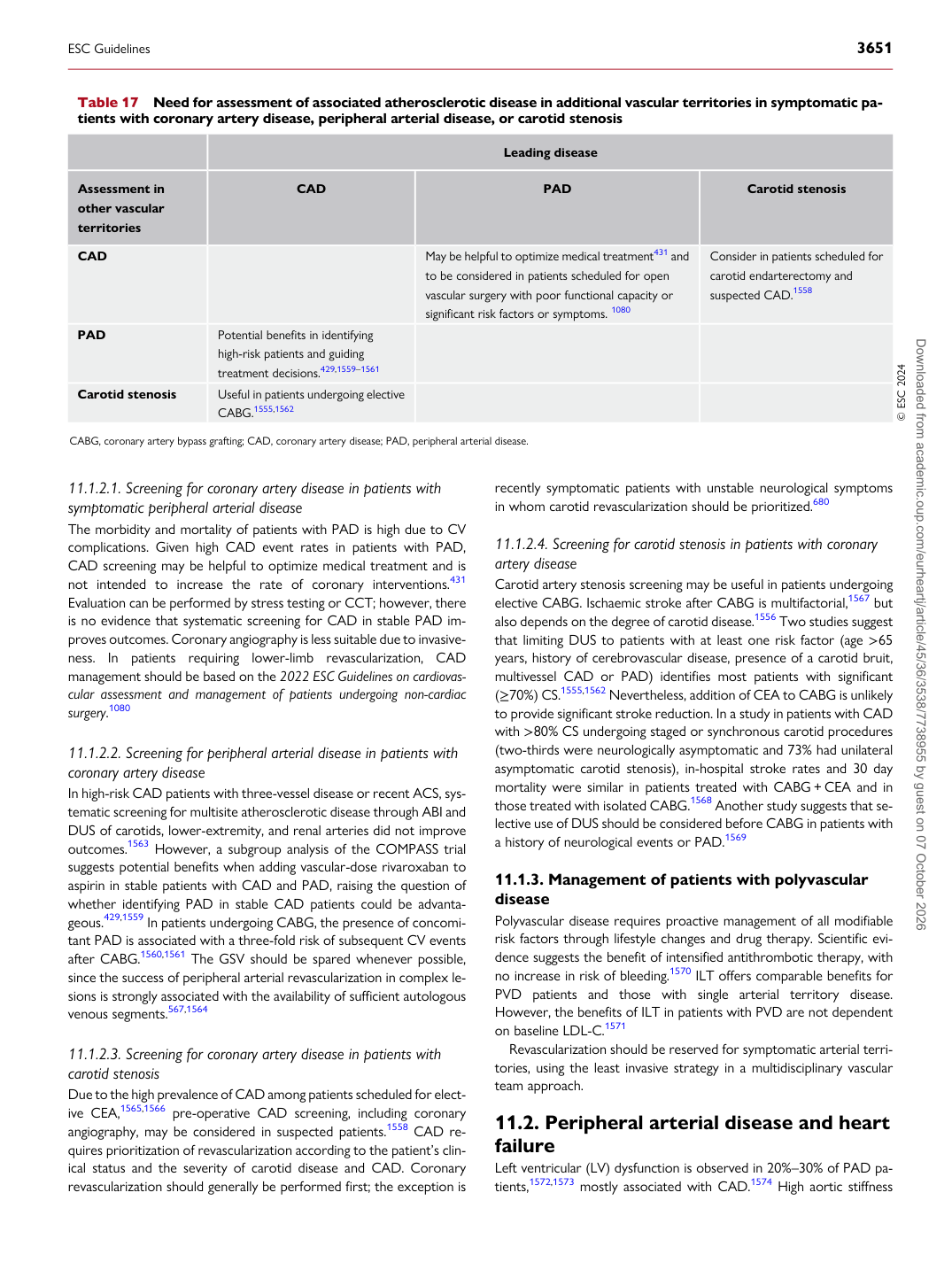
Table 17 Need for assessment of associated atherosclerotic disease in additional vascular territories in symptomatic patients with coronary artery disease, peripheral arterial disease, or carotid stenosis

Leading disease

Assessment in other vascular territories CAD PAD Carotid stenosis CAD May be helpful to optimize medical treatment431 and

to be considered in patients scheduled for open vascular surgery with poor functional capacity or significant risk factors or symptoms. 1080 Consider in patients scheduled for

carotid endarterectomy and suspected CAD.1558

PAD Potential benefits in identifying

high-risk patients and guiding treatment decisions.429,1559–1561

Carotid stenosis Useful in patients undergoing elective

CABG.1555,1562 © ESC 2024

CABG, coronary artery bypass grafting; CAD, coronary artery disease; PAD, peripheral arterial disease.

ESC Guidelines                                                                                                                                                                                          3651

Downloaded from academic.oup.com/eurheartj/article/45/36/3538/7738955 by guest on 07 October 2026