p.110 抽出テキスト
genetic testing is not indicated for isolated BAV disease, but reserved for patients with syndromic features, family history of aortic disease, or aneurysms/dissections of medium-sized arteries other than the thoracic aorta, and may be considered in patients with the root phenotype.1389,1508,1509 We recommend adopting a new international consensus nomenclature and classification, established by a panel of experts, to replace the previous various concurrent nomenclatures used1510 (Figure 43). Aneurysm prevalence reaches 40% in clinical series and 0.85 per 100 patient-years in population studies. AAEs are rare, but 8- to 10-fold more frequent than in the general population.1001,1511 The longest available follow-up of BAV subjects was recently reported,1512 showing a total lifetime morbidity burden as high as 86%, a predominant part of which was driven by valve-related complications (aortic stenosis, endocarditis, HF). When a BAV is first detected, a complete study of the thoracic aorta is necessary; vice versa, in every patient with ascending aortic dilatation, valve morphology should be ascertained.70,969 When TTE detects BAV-associated aortic dilatation, CCT or CMR is recommended to confirm measurements, exclude coarctation, and record baseline diameters at different levels for subsequent periodic assessments.137,1001 Surveillance by TTE becomes necessary when the maximum diameter exceeds 40 mm. In mixed tricuspid aortic valve (TAV) and BAV series, AAEs occurred in 2/10 000 patient-years with a diameter >40 mm (vs. 0.1–0.3/10 000 patient-years in the general population)894 (Figure 43). Considering average aortic diameter growth of 0.2–0.6 mm per year,893,1513 once fast progression is excluded, follow-up can be scheduled every 2–3 years (according to risk profile). In 5%–15% of cases, BAV patients have at least one FDR with either BAV or ascending aortic dilatation; root phenotype and aortic regurgitation in the proband predict ascending dilatation in FDRs.1514 FDR screening is considered costeffective, but the age at which relatives should undergo TTE remains to be determined.1515,1516 A diameter exceeding 55 mm at any level mandates surgery.70,969,1001 However, the historically known relation between diameter and acute complications has been recently reappraised. Both in large mixed153 and purely BAV series,981 an ascending diameter of about 52 mm already marked an AAE risk increase from ∼1% to 4%–5%. Additionally, early post-operative mortality for elective surgery of the proximal aorta ranges today between 0.25% and 2%.980,981 Therefore, aortic surgery in low surgical risk (<3%) patients with an ascending diameter >52 mm implies a lower risk than observed in the natural history of the disease. For aortic root dilatation in BAV patients, the ‘hinge point’ was at 50 mm;981 this phenotype is associated with faster growth rate,893 higher risk of events following isolated aortic valve replacement,1517 worse survival if not operated,1518 and higher risk of acute TAAD.976,1519 Surgery should be considered when the diameter is ≥50 mm in selected ascending phenotype patients (Figures 23, 24 and 43).70,1001 Among those factors, family history of AAEs, poorly controlled hypertension, aortic coarctation, and rapid (≥3 mm per year) diameter growth should be noted. Surgery at >50 mm may also be considered in a shared decision with the patient, taking lifestyle and psychological factors into consideration,70,1001 since 50 mm should correspond to an approximately 10-fold increase in the risk of AAEs.894 In a study of patients with aortic diameter ≥40 mm, those with diameters of 50 mm faced a 1% risk of AAEs within 5 years, compared with 0.1% for those with 40 mm diameters, explaining the 10-fold difference; however, this study did not exclusively involve BAV patients.894

Another recent study1520 specifically focused on BAV patients found a 0.4% incidence of AAEs per patient-year for diameters above 50 mm, in contrast to the general BAV population’s 0.03% incidence.1521 Previous guidelines also suggested aortic repair for a cross-sectional area-to-height ratio (CSA/h) >10 cm2/m;70 nevertheless, more recently, it has been suggested that the CSA/h threshold for the ascending tract in BAV should be 13 cm2/m.981 For the average height of male and female Europeans (1.8 m and 1.67 m, respectively), a CSA/h of 10 cm2/m would correspond to a diameter of 48 mm or 46 mm, respectively, whereas 13 cm2/m means 54 mm or 53 mm. It is reasonable to refer to the 13 cm2/m CSA/h cut-off for ascending aortic repair, especially in individuals ≤1.69 m in height (since 13 cm2/m corresponds to ≤52 mm diameter). Recently, besides dilatation, aortic elongation is also considered a risk factor,974 and a curvilinear length >11.5 cm at the vessel’s centreline increases the yearly risk of AAEs.155 Age is another factor to consider: at 50 years, a 40 mm ascending aorta corresponds to the upper normal limit for patients with large body size,149 and therefore the same diameter at a higher age could imply a lower risk of AAEs.

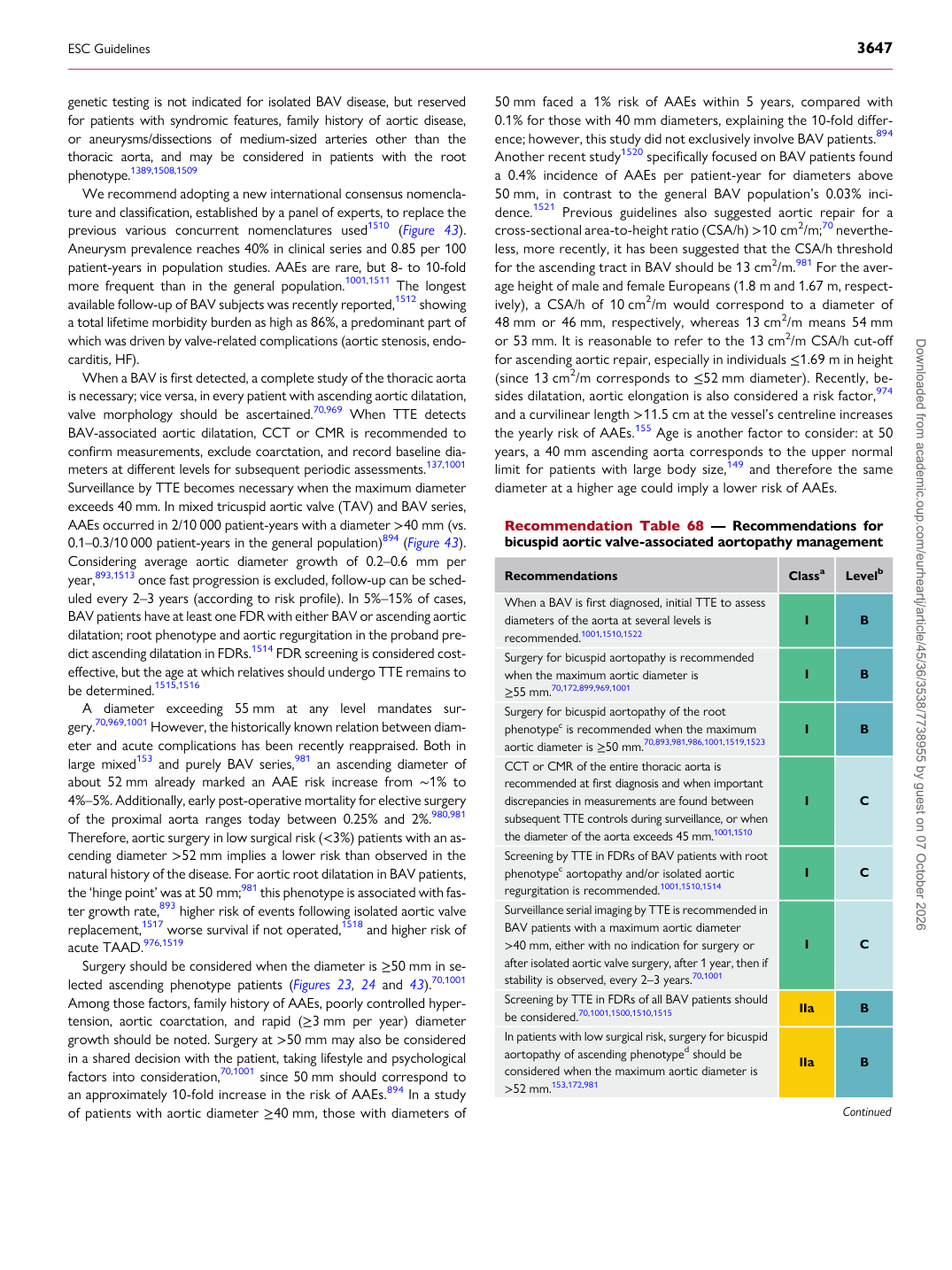
Recommendation Table 68 — Recommendations for bicuspid aortic valve-associated aortopathy management

Recommendations Classa Levelb

When a BAV is first diagnosed, initial TTE to assess diameters of the aorta at several levels is recommended.1001,1510,1522 I B Surgery for bicuspid aortopathy is recommended when the maximum aortic diameter is ≥55 mm.70,172,899,969,1001 I B Surgery for bicuspid aortopathy of the root phenotypec is recommended when the maximum aortic diameter is ≥50 mm.70,893,981,986,1001,1519,1523 I B CCT or CMR of the entire thoracic aorta is recommended at first diagnosis and when important discrepancies in measurements are found between subsequent TTE controls during surveillance, or when the diameter of the aorta exceeds 45 mm.1001,1510 I C Screening by TTE in FDRs of BAV patients with root phenotypec aortopathy and/or isolated aortic regurgitation is recommended.1001,1510,1514 I C Surveillance serial imaging by TTE is recommended in BAV patients with a maximum aortic diameter >40 mm, either with no indication for surgery or after isolated aortic valve surgery, after 1 year, then if stability is observed, every 2–3 years.70,1001 I C Screening by TTE in FDRs of all BAV patients should be considered.70,1001,1500,1510,1515 IIa B In patients with low surgical risk, surgery for bicuspid aortopathy of ascending phenotyped should be considered when the maximum aortic diameter is >52 mm.153,172,981 IIa B

Continued

ESC Guidelines                                                                                                                                                                                          3647

Downloaded from academic.oup.com/eurheartj/article/45/36/3538/7738955 by guest on 07 October 2026