p.11 抽出テキスト
revisions, the guidelines are signed off by all the experts in the task force. The finalized document is signed off by the CPG Committee for publication in the European Heart Journal. ESC Guidelines are based on analyses of published evidence, chiefly on clinical trials and meta-analyses of trials, but potentially including other types of studies. Evidence tables summarizing key information from relevant studies are generated early in the guideline development process to facilitate the formulation of recommendations, to enhance comprehension of recommendations after publication, and reinforce transparency in the guidelines development process. The tables are published in their own section of ESC Guidelines and reference specific recommendation tables. Off-label use of medication may be presented in this guideline if a sufficient level of evidence shows that it can be considered medically appropriate for a given condition. However, the final decisions concerning an individual patient must be made by the responsible health professional giving special consideration to: • The specific situation of the patient. Unless otherwise provided for by national regulations, off-label use of medication should be limited to situations where it is in the patient’s interest with regard to the quality, safety, and efficacy of care, and only after the patient has been informed and has provided consent. • Country-specific health regulations, indications by governmental drug regulatory agencies, and the ethical rules to which health professionals are subject, where applicable.

2 Introduction

Peripheral arterial and aortic diseases (PAAD) are highly prevalent and significantly increase cardiovascular (CV) mortality and morbidity in the general population,1,2 consequently, intensive preventive strategies are needed. However, patients with PAAD are generally underdiagnosed and undertreated3,4 compared with patients with coronary artery disease (CAD).5 Common risk factors in PAAD often coexist, requiring a multidisciplinary approach for effective management.5 Early diagnosis is crucial for better outcomes. These guidelines address PAAD, updating and merging the 2017 peripheral arterial diseases and 2014 aortic diseases guidelines. The focus is primarily on atherosclerotic arterial diseases, but they also address some non-atherosclerotic genetic conditions. While not exhaustive, these 2024 guidelines offer guidance on diagnosis, surveillance, and treatment. A number of new and revised recommendations are summarized in Tables 3 and 4, respectively. Readers should consider non-atherosclerotic conditions and refer to specific documents.6–9

A general approach to PAAD is provided in the central illustration (Figure 1). In the management of PAAD, the following aspects must be highlighted: • Shared decision-making to involve patients, explore treatment options, assess patient values, and reach decisions collaboratively. • Multidisciplinary approach (Figure 1) in expert and high-volume PAAD centres for complex patients or procedures. These centres provide diverse services, including diagnosis, treatment planning, minimally invasive procedures, open surgery, post-operative and outpatient care, and ideally, research and innovation. They should provide continuous clinical service (24/7) and have access to digital imaging. These guidelines recognize variations in healthcare systems, population sizes, and needs, impacting the definition of ‘high volume’ in PAAD care across countries.

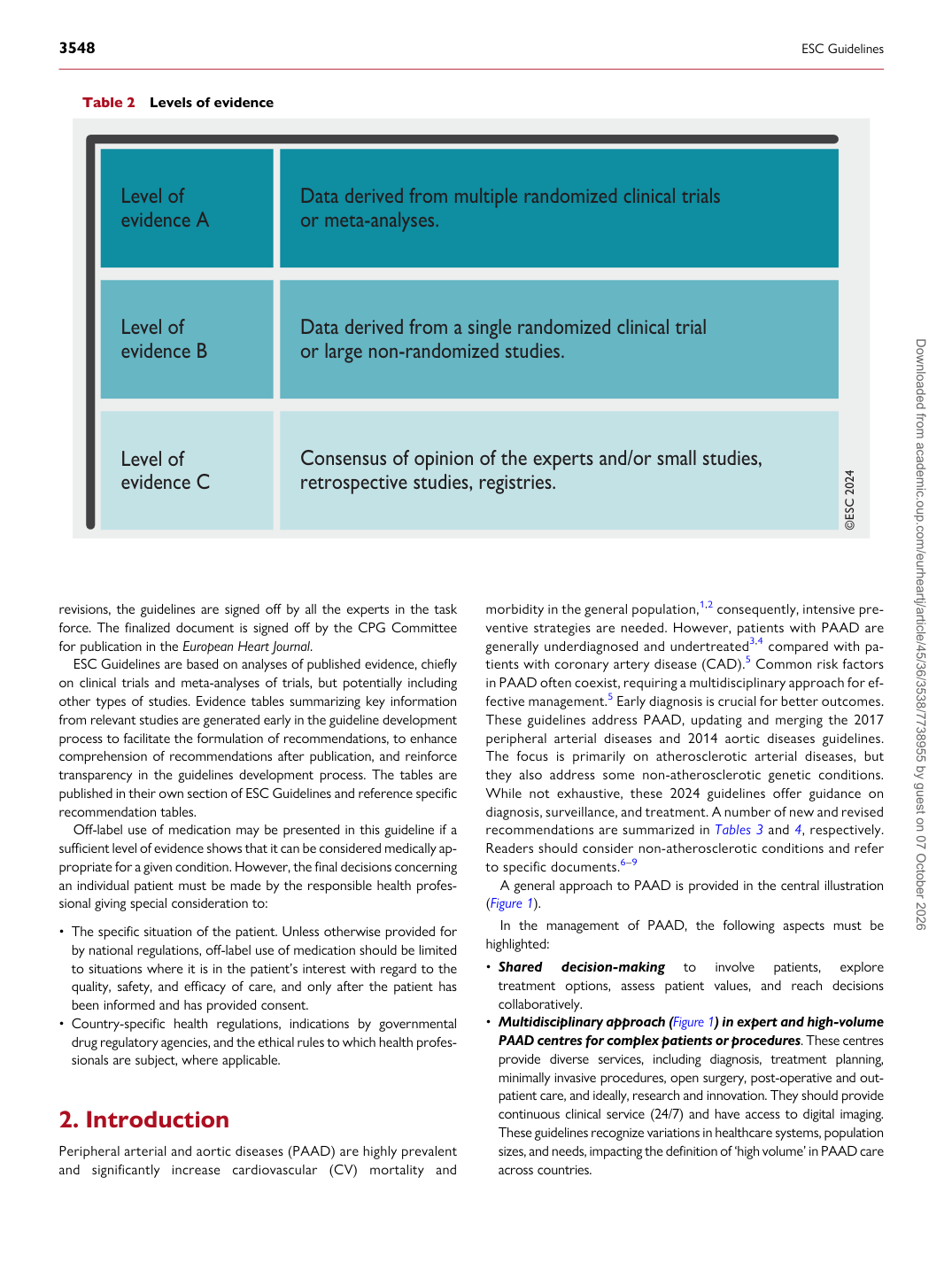
Table 2 Levels of evidence

Level of evidence A

Level of evidence B

Level of evidence C Data derived from multiple randomized clinical trials or meta-analyses.

Data derived from a single randomized clinical trial or large non-randomized studies.

Consensus of opinion of the experts and/or small studies, retrospective studies, registries. ©ESC 2024 Downloaded from academic.oup.com/eurheartj/article/45/36/3538/7738955 by guest on 07 October 2026