p.109 抽出テキスト
10.2 Aortic disease associated with

bicuspid aortic valves Bicuspid aortic valves, the most common congenital heart defect (0.5%–2% of live births), besides being a risk factor for aortic valve disease, is associated with a peculiar form of aortopathy, characterized by morphological and clinical heterogeneity (bicuspid valvulo-aortopathy). Its inheritance is high, with autosomal dominant transmission of BAV in a minority of cases, but no single-gene model clearly explaining BAV inheritance.1500–1502 Several genes, generally implicated in embryogenesis and cell differentiation, have been associated with BAV/BAV-related aortopathy, but each of them explained <5% of cases.1503–1507 Therefore,

1 2a 2b Ascending phenotype

(70–75%)

Fused BAV (90–95% of BAV) 3 phenotypes

2-sinus BAV (5–7% of BAV) 2 phenotypes

Partial-fusion BAV - short fusion of 1 commisure

Right - left cusp fusion

(70–80%) Right - non cusp fusion

(20–30%) Left - non cusp fusion

(3–6%)

Root phenotype

(15–20%)

Extended phenotype

(5–10%)

BAV morphologies Aortic phenotypes

L A A

P P L

Laterolateral Anteroposterior

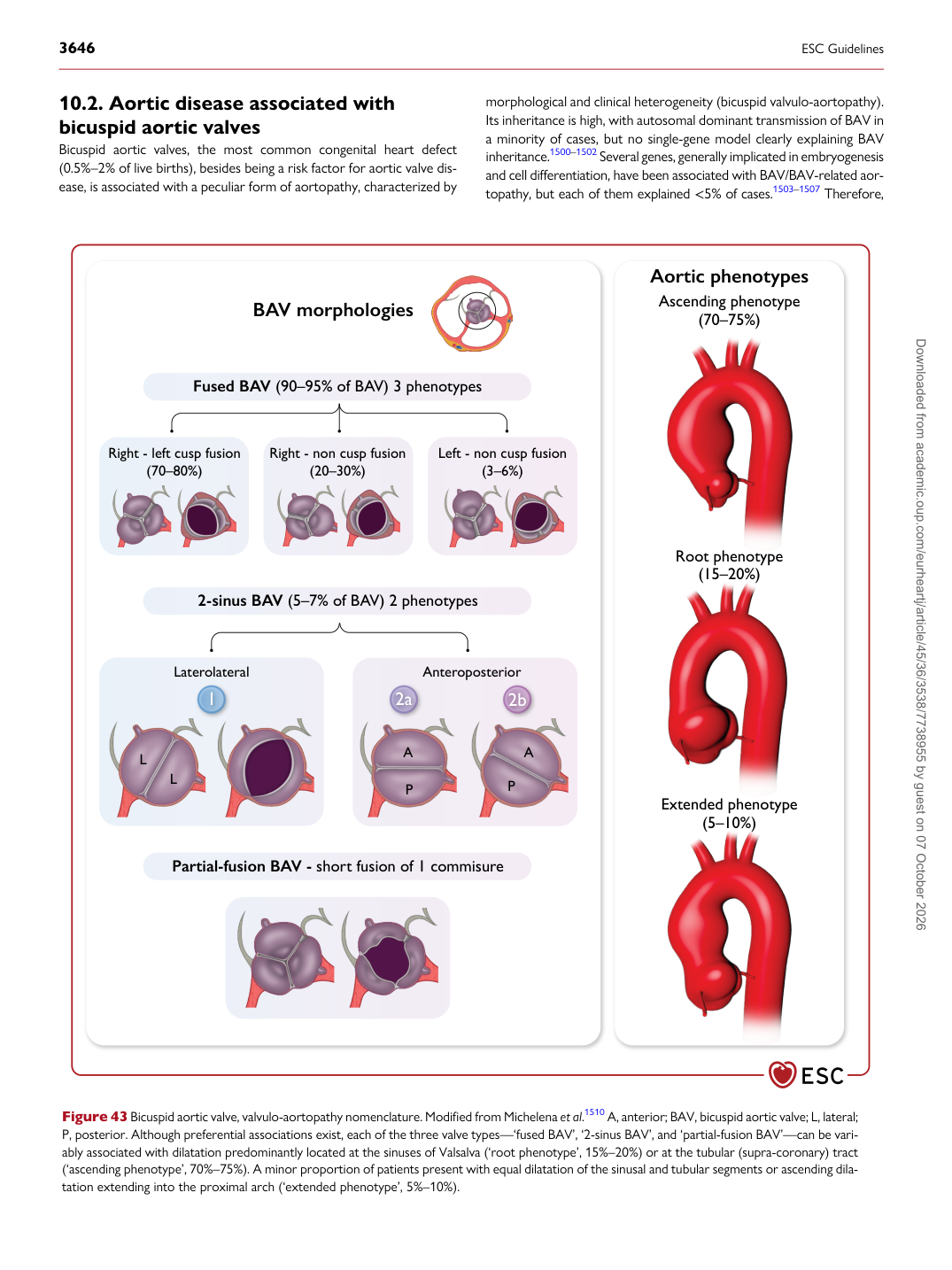
Figure 43 Bicuspid aortic valve, valvulo-aortopathy nomenclature. Modified from Michelena et al.1510 A, anterior; BAV, bicuspid aortic valve; L, lateral; P, posterior. Although preferential associations exist, each of the three valve types—‘fused BAV’, ‘2-sinus BAV’, and ‘partial-fusion BAV’—can be variably associated with dilatation predominantly located at the sinuses of Valsalva (‘root phenotype’, 15%–20%) or at the tubular (supra-coronary) tract (‘ascending phenotype’, 70%–75%). A minor proportion of patients present with equal dilatation of the sinusal and tubular segments or ascending dilatation extending into the proximal arch (‘extended phenotype’, 5%–10%). Downloaded from academic.oup.com/eurheartj/article/45/36/3538/7738955 by guest on 07 October 2026