p.106 抽出テキスト
10.1.3.5 Pregnancy and physical exercise

In pregnant MFS women, the risk of AD increases up to eight times relative to the general population.1470 The risk for TAAD is determined by the aortic diameter, but type B dissections tend to occur even more commonly and may occur without prior dilatation.1470,1471 Patients should be aware of the persisting risk of TBAD after aortic root replacement.1471 Women unaware of the diagnosis are at the highest risk of dissection.1470–1472 The Registry Of Pregnancy And Cardiac disease (ROPAC) indicates that women managed according to guidelines are at low risk of pregnancy-related complications and major effects of BBs on foetal growth were not shown, although this needs to be carefully monitored.70,1337,1435,1471,1472

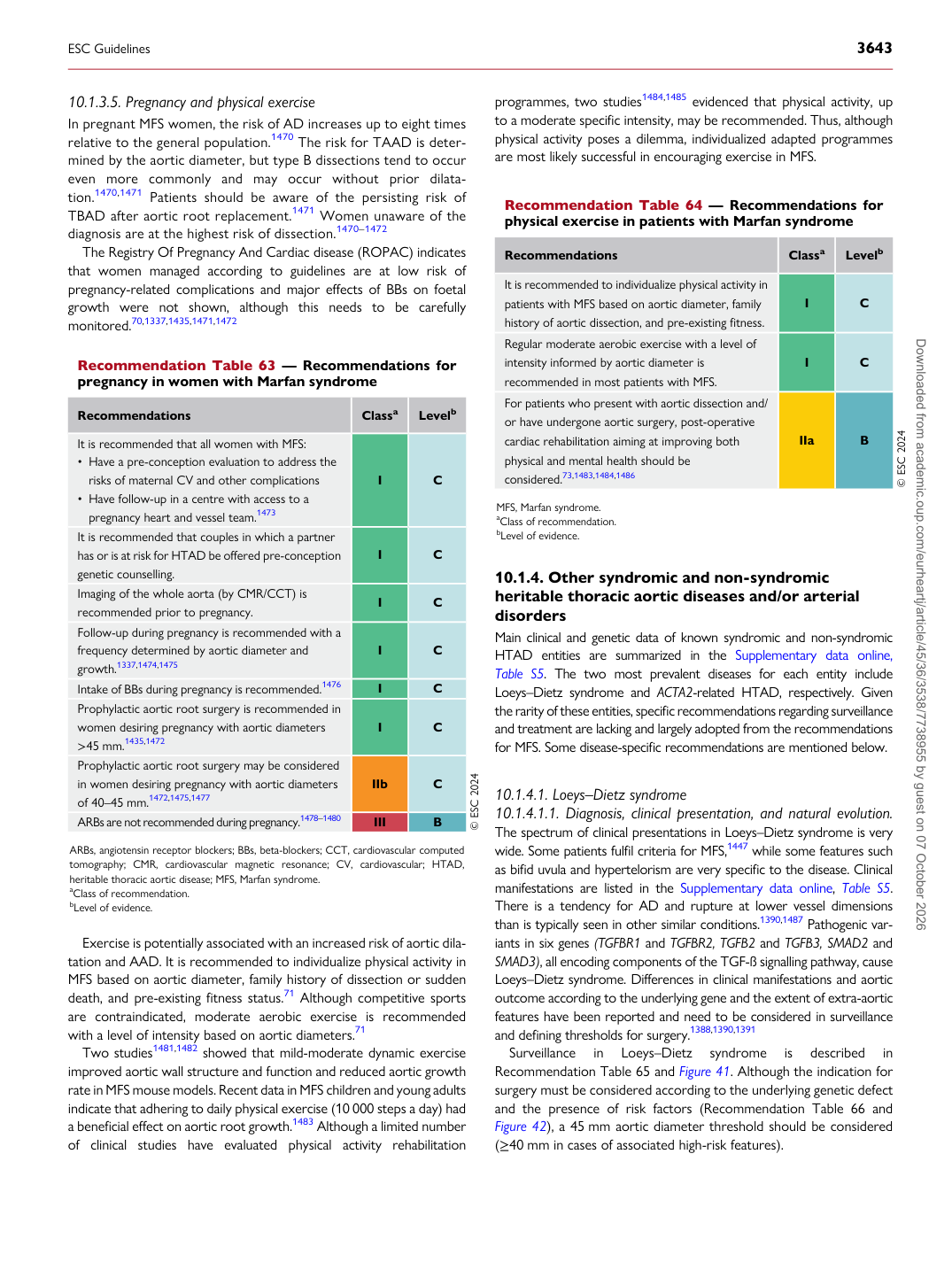
Exercise is potentially associated with an increased risk of aortic dilatation and AAD. It is recommended to individualize physical activity in MFS based on aortic diameter, family history of dissection or sudden death, and pre-existing fitness status.71 Although competitive sports are contraindicated, moderate aerobic exercise is recommended with a level of intensity based on aortic diameters.71 Two studies1481,1482 showed that mild-moderate dynamic exercise improved aortic wall structure and function and reduced aortic growth rate in MFS mouse models. Recent data in MFS children and young adults indicate that adhering to daily physical exercise (10 000 steps a day) had a beneficial effect on aortic root growth.1483 Although a limited number of clinical studies have evaluated physical activity rehabilitation programmes, two studies1484,1485 evidenced that physical activity, up to a moderate specific intensity, may be recommended. Thus, although physical activity poses a dilemma, individualized adapted programmes are most likely successful in encouraging exercise in MFS.

10.1.4 Other syndromic and non-syndromic

heritable thoracic aortic diseases and/or arterial disorders Main clinical and genetic data of known syndromic and non-syndromic HTAD entities are summarized in the Supplementary data online, Table S5. The two most prevalent diseases for each entity include Loeys–Dietz syndrome and ACTA2-related HTAD, respectively. Given the rarity of these entities, specific recommendations regarding surveillance and treatment are lacking and largely adopted from the recommendations for MFS. Some disease-specific recommendations are mentioned below.

10.1.4.1 Loeys–Dietz syndrome

10.1.4.1.1. Diagnosis, clinical presentation, and natural evolution. The spectrum of clinical presentations in Loeys–Dietz syndrome is very wide. Some patients fulfil criteria for MFS,1447 while some features such as bifid uvula and hypertelorism are very specific to the disease. Clinical manifestations are listed in the Supplementary data online, Table S5. There is a tendency for AD and rupture at lower vessel dimensions than is typically seen in other similar conditions.1390,1487 Pathogenic variants in six genes (TGFBR1 and TGFBR2, TGFB2 and TGFB3, SMAD2 and SMAD3), all encoding components of the TGF-ß signalling pathway, cause Loeys–Dietz syndrome. Differences in clinical manifestations and aortic outcome according to the underlying gene and the extent of extra-aortic features have been reported and need to be considered in surveillance and defining thresholds for surgery.1388,1390,1391 Surveillance in Loeys–Dietz syndrome is described in Recommendation Table 65 and Figure 41. Although the indication for surgery must be considered according to the underlying genetic defect and the presence of risk factors (Recommendation Table 66 and Figure 42), a 45 mm aortic diameter threshold should be considered (≥40 mm in cases of associated high-risk features).

Recommendation Table 63 — Recommendations for pregnancy in women with Marfan syndrome

Recommendations Classa Levelb

It is recommended that all women with MFS: • Have a pre-conception evaluation to address the risks of maternal CV and other complications • Have follow-up in a centre with access to a pregnancy heart and vessel team.1473 I C It is recommended that couples in which a partner has or is at risk for HTAD be offered pre-conception genetic counselling. I C Imaging of the whole aorta (by CMR/CCT) is recommended prior to pregnancy. I C Follow-up during pregnancy is recommended with a frequency determined by aortic diameter and growth.1337,1474,1475 I C Intake of BBs during pregnancy is recommended.1476 I C Prophylactic aortic root surgery is recommended in women desiring pregnancy with aortic diameters >45 mm.1435,1472 I C Prophylactic aortic root surgery may be considered in women desiring pregnancy with aortic diameters of 40–45 mm.1472,1475,1477 IIb C ARBs are not recommended during pregnancy.1478–1480 III B © ESC 2024

ARBs, angiotensin receptor blockers; BBs, beta-blockers; CCT, cardiovascular computed tomography; CMR, cardiovascular magnetic resonance; CV, cardiovascular; HTAD, heritable thoracic aortic disease; MFS, Marfan syndrome. aClass of recommendation. bLevel of evidence. Recommendation Table 64 — Recommendations for physical exercise in patients with Marfan syndrome

Recommendations Classa Levelb

It is recommended to individualize physical activity in patients with MFS based on aortic diameter, family history of aortic dissection, and pre-existing fitness. I C Regular moderate aerobic exercise with a level of intensity informed by aortic diameter is recommended in most patients with MFS. I C For patients who present with aortic dissection and/ or have undergone aortic surgery, post-operative cardiac rehabilitation aiming at improving both physical and mental health should be considered.73,1483,1484,1486 IIa B © ESC 2024

MFS, Marfan syndrome. aClass of recommendation. bLevel of evidence.

ESC Guidelines                                                                                                                                                                                          3643

Downloaded from academic.oup.com/eurheartj/article/45/36/3538/7738955 by guest on 07 October 2026