p.105 抽出テキスト
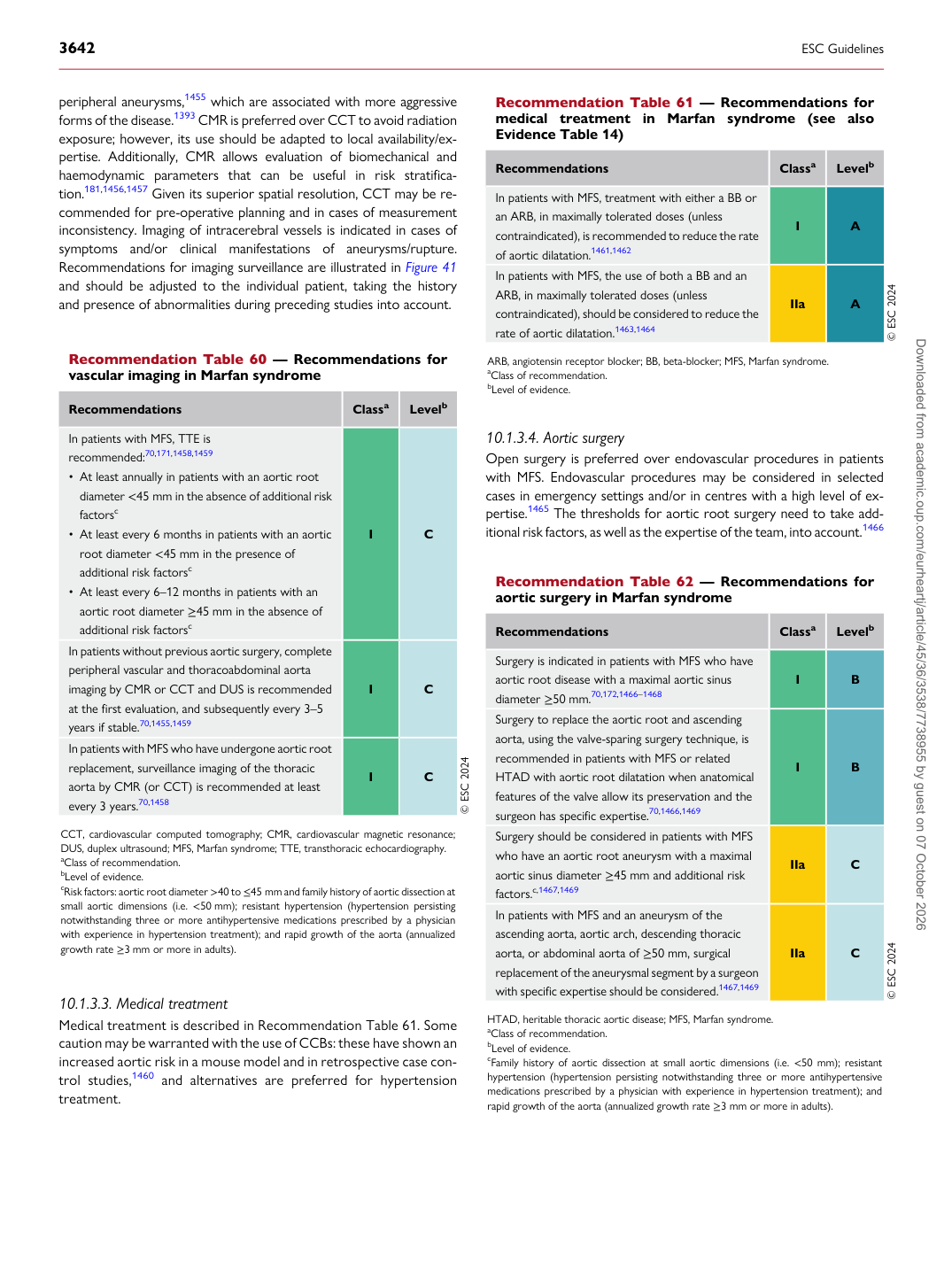
peripheral aneurysms,1455 which are associated with more aggressive forms of the disease.1393 CMR is preferred over CCT to avoid radiation exposure; however, its use should be adapted to local availability/expertise. Additionally, CMR allows evaluation of biomechanical and haemodynamic parameters that can be useful in risk stratification.181,1456,1457 Given its superior spatial resolution, CCT may be recommended for pre-operative planning and in cases of measurement inconsistency. Imaging of intracerebral vessels is indicated in cases of symptoms and/or clinical manifestations of aneurysms/rupture. Recommendations for imaging surveillance are illustrated in Figure 41 and should be adjusted to the individual patient, taking the history and presence of abnormalities during preceding studies into account.

10.1.3.3 Medical treatment

Medical treatment is described in Recommendation Table 61. Some caution may be warranted with the use of CCBs: these have shown an increased aortic risk in a mouse model and in retrospective case control studies,1460 and alternatives are preferred for hypertension treatment. 10.1.3.4 Aortic surgery

Open surgery is preferred over endovascular procedures in patients with MFS. Endovascular procedures may be considered in selected cases in emergency settings and/or in centres with a high level of expertise.1465 The thresholds for aortic root surgery need to take additional risk factors, as well as the expertise of the team, into account.1466

Recommendation Table 60 — Recommendations for vascular imaging in Marfan syndrome

Recommendations Classa Levelb

In patients with MFS, TTE is recommended:70,171,1458,1459 • At least annually in patients with an aortic root

diameter <45 mm in the absence of additional risk factorsc • At least every 6 months in patients with an aortic

root diameter <45 mm in the presence of additional risk factorsc • At least every 6–12 months in patients with an

aortic root diameter ≥45 mm in the absence of additional risk factorsc I C In patients without previous aortic surgery, complete peripheral vascular and thoracoabdominal aorta imaging by CMR or CCT and DUS is recommended at the first evaluation, and subsequently every 3–5 years if stable.70,1455,1459 I C In patients with MFS who have undergone aortic root replacement, surveillance imaging of the thoracic aorta by CMR (or CCT) is recommended at least every 3 years.70,1458 I C © ESC 2024

CCT, cardiovascular computed tomography; CMR, cardiovascular magnetic resonance; DUS, duplex ultrasound; MFS, Marfan syndrome; TTE, transthoracic echocardiography. aClass of recommendation. bLevel of evidence. cRisk factors: aortic root diameter >40 to ≤45 mm and family history of aortic dissection at small aortic dimensions (i.e. <50 mm); resistant hypertension (hypertension persisting notwithstanding three or more antihypertensive medications prescribed by a physician with experience in hypertension treatment); and rapid growth of the aorta (annualized growth rate ≥3 mm or more in adults). Recommendation Table 62 — Recommendations for aortic surgery in Marfan syndrome

Recommendations Classa Levelb

Surgery is indicated in patients with MFS who have aortic root disease with a maximal aortic sinus diameter ≥50 mm.70,172,1466–1468 I B Surgery to replace the aortic root and ascending aorta, using the valve-sparing surgery technique, is recommended in patients with MFS or related HTAD with aortic root dilatation when anatomical features of the valve allow its preservation and the surgeon has specific expertise.70,1466,1469 I B Surgery should be considered in patients with MFS who have an aortic root aneurysm with a maximal aortic sinus diameter ≥45 mm and additional risk factors.c,1467,1469 IIa C In patients with MFS and an aneurysm of the ascending aorta, aortic arch, descending thoracic aorta, or abdominal aorta of ≥50 mm, surgical replacement of the aneurysmal segment by a surgeon with specific expertise should be considered.1467,1469 IIa C © ESC 2024

HTAD, heritable thoracic aortic disease; MFS, Marfan syndrome. aClass of recommendation. bLevel of evidence. cFamily history of aortic dissection at small aortic dimensions (i.e. <50 mm); resistant hypertension (hypertension persisting notwithstanding three or more antihypertensive medications prescribed by a physician with experience in hypertension treatment); and rapid growth of the aorta (annualized growth rate ≥3 mm or more in adults).

Recommendation Table 61 — Recommendations for medical treatment in Marfan syndrome (see also Evidence Table 14)

Recommendations Classa Levelb

In patients with MFS, treatment with either a BB or an ARB, in maximally tolerated doses (unless contraindicated), is recommended to reduce the rate of aortic dilatation.1461,1462 I A In patients with MFS, the use of both a BB and an ARB, in maximally tolerated doses (unless contraindicated), should be considered to reduce the rate of aortic dilatation.1463,1464 IIa A © ESC 2024

ARB, angiotensin receptor blocker; BB, beta-blocker; MFS, Marfan syndrome. aClass of recommendation. bLevel of evidence. Downloaded from academic.oup.com/eurheartj/article/45/36/3538/7738955 by guest on 07 October 2026