p.102 抽出テキスト
≤ 60 years

HTN HTN

Patient with TAD

Aortic dilatation Aortic dissection

Aortic root/ascending

z-score ≥3 or any additional risk feature (see box below)

Aortic root/ascending z-score ≥3

or aortic dissection

Genetic testing

(Class I)

Re-evaluate genetic testing in the proband (after 3–5 years) Cascade screening

(Class I)

Gene-based management

(Class IIa) Reimaging of FDRs (after 5 years)

(Class IIa) Aortic imaginga screening of FDRs

(Class I)

No further investigation

for HTAD No further investigation

for HTAD

Referral to a centre with experience in the care of this patient group

(Class I)

Any additional risk feature (see box below)

Syndromic features of:

Y N

Y N

Y

N

Y

N Y

N

Marfan syndrome Loeys-Dietz syndrome Vascular Ehlers-Danlos syndrome Family history of (either one):

TAD Peripheral/intracranial artery aneurysm Unexplained Sudden death <60 years

Positive Negative

or VUS

Any additional risk feature

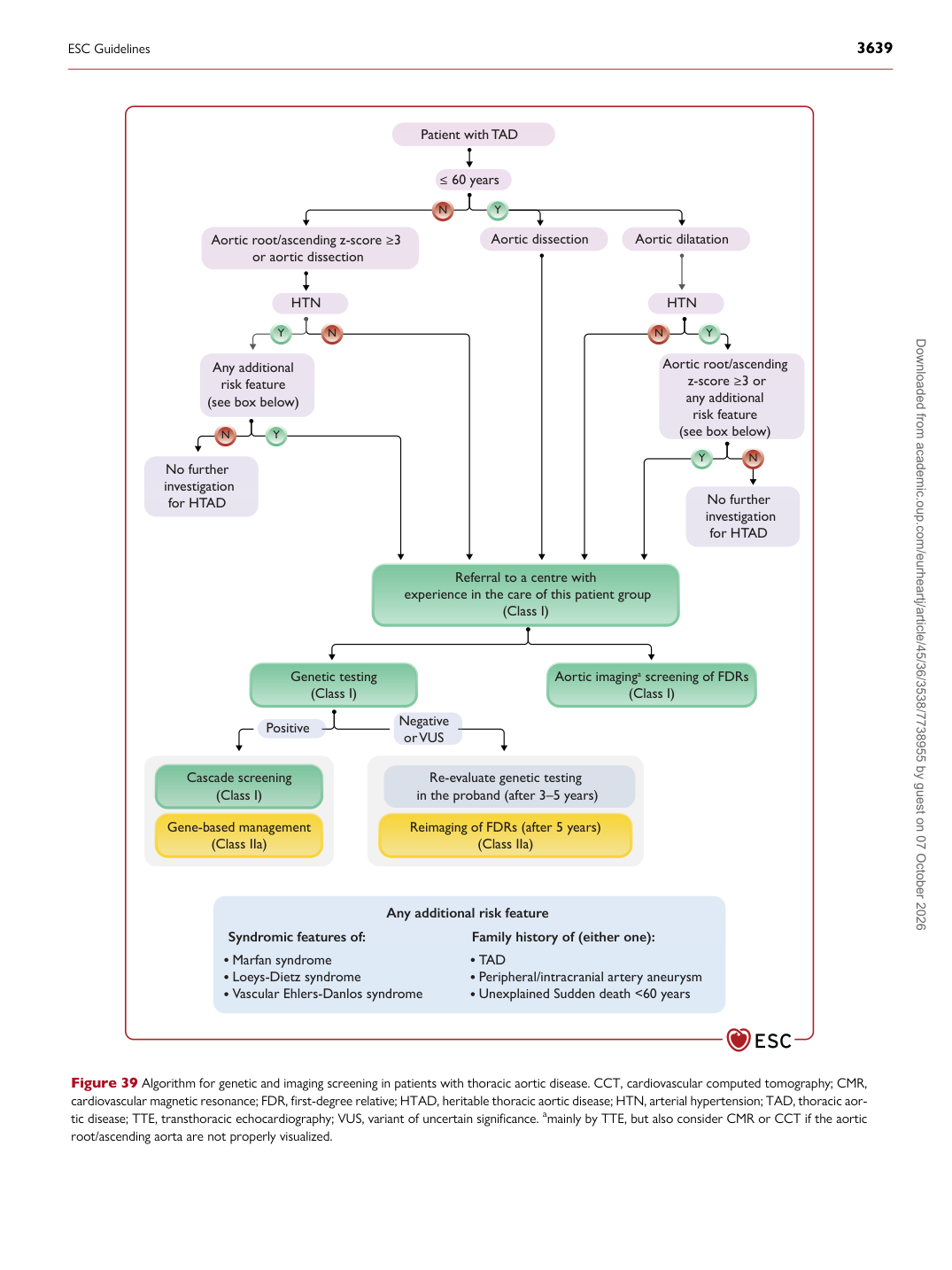
Figure 39 Algorithm for genetic and imaging screening in patients with thoracic aortic disease. CCT, cardiovascular computed tomography; CMR, cardiovascular magnetic resonance; FDR, first-degree relative; HTAD, heritable thoracic aortic disease; HTN, arterial hypertension; TAD, thoracic aortic disease; TTE, transthoracic echocardiography; VUS, variant of uncertain significance. amainly by TTE, but also consider CMR or CCT if the aortic root/ascending aorta are not properly visualized.

ESC Guidelines                                                                                                                                                                                          3639

Downloaded from academic.oup.com/eurheartj/article/45/36/3538/7738955 by guest on 07 October 2026