p.9 抽出テキスト
or limited life expectancy, and (iii) a strong emphasis on out-of-office BP measurement to confirm the systolic BP target of 120–129 mmHg is achieved. For those selected individual cases where a target systolic BP of 120–129 mmHg is not pursued, either due to intolerance or the existence of conditions that favour a more lenient BP target, we recommend targeting a BP that is as low as reasonably achievable. Personalized clinical decision-making and shared decisions with the patient are also emphasized. (4) Another important change in the 2024 Guidelines compared with earlier versions is the increased focus on evidence related to fatal and non-fatal CVD outcomes rather than surrogate outcomes such as BP lowering alone. Except for lifestyle interventions and low-risk non-pharmacological interventions aimed at implementation or care delivery, the current guidelines require that, for a Class I recommendation to be made for a drug or procedural intervention, the evidence must show benefit on CVD outcomes and not only BP lowering. (5) The task force comprised of a balanced representation of males and females. (6) The present guidelines consider sex and gender as an integral com-

ponent throughout the document, rather than in a separate section at the end. In this document, sex is the biological condition of being female or male from conception, based on genes, and gender is the socio-cultural dimension of being a woman or a man in a given society, based on gender roles, gender norms, gender identity, and gender relations valid in the respective society at a given timepoint.4,5 (7) The 2024 Guidelines are written to make them more ‘user friendly’.

Input from general practitioners (GPs) was obtained in this regard, and one task force member is a GP. Given the ageing population in Europe, there was also a focus on tailoring treatment with respect to frailty and into older age, which is addressed in multiple sections. Moreover, patient input and their lived experiences are considered throughout. We also now include evidence tables in the Supplementary section to provide improved transparency regarding our recommendations. As appropriate, readers who wish to seek additional details and information are referred to the Supplementary data online and to the

ESC CardioMed.6

(8) The task force recognized that a major challenge in guideline usage

is poor implementation. This likely contributes to suboptimal control of hypertension.7–9 To address this, a dedicated section on implementation is included in the Supplementary data online. Moreover, through a new initiative, we include information from national societies following a survey on guideline implementation completed during the national society peer review of the guidelines document. It is hoped this information may help inform national societies about potential barriers to implementation.

2.1 What is new

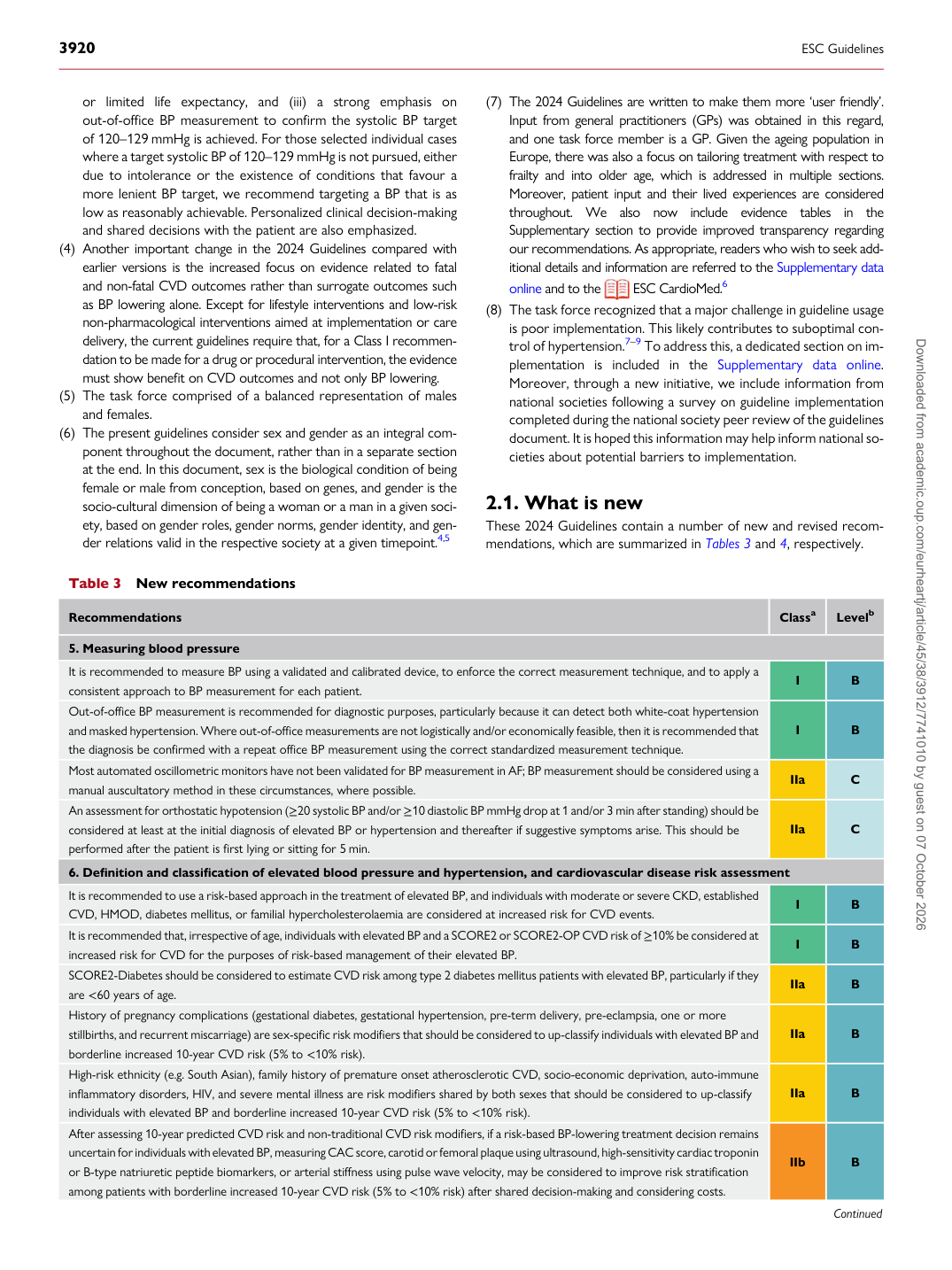
These 2024 Guidelines contain a number of new and revised recommendations, which are summarized in Tables 3 and 4, respectively.

Table 3 New recommendations

Recommendations Classa Levelb

5 Measuring blood pressure

It is recommended to measure BP using a validated and calibrated device, to enforce the correct measurement technique, and to apply a consistent approach to BP measurement for each patient. I B Out-of-office BP measurement is recommended for diagnostic purposes, particularly because it can detect both white-coat hypertension and masked hypertension. Where out-of-office measurements are not logistically and/or economically feasible, then it is recommended that the diagnosis be confirmed with a repeat office BP measurement using the correct standardized measurement technique. I B Most automated oscillometric monitors have not been validated for BP measurement in AF; BP measurement should be considered using a manual auscultatory method in these circumstances, where possible. IIa C An assessment for orthostatic hypotension (≥20 systolic BP and/or ≥10 diastolic BP mmHg drop at 1 and/or 3 min after standing) should be considered at least at the initial diagnosis of elevated BP or hypertension and thereafter if suggestive symptoms arise. This should be performed after the patient is first lying or sitting for 5 min. IIa C 6. Definition and classification of elevated blood pressure and hypertension, and cardiovascular disease risk assessment It is recommended to use a risk-based approach in the treatment of elevated BP, and individuals with moderate or severe CKD, established CVD, HMOD, diabetes mellitus, or familial hypercholesterolaemia are considered at increased risk for CVD events. I B It is recommended that, irrespective of age, individuals with elevated BP and a SCORE2 or SCORE2-OP CVD risk of ≥10% be considered at increased risk for CVD for the purposes of risk-based management of their elevated BP. I B SCORE2-Diabetes should be considered to estimate CVD risk among type 2 diabetes mellitus patients with elevated BP, particularly if they are <60 years of age. IIa B History of pregnancy complications (gestational diabetes, gestational hypertension, pre-term delivery, pre-eclampsia, one or more stillbirths, and recurrent miscarriage) are sex-specific risk modifiers that should be considered to up-classify individuals with elevated BP and borderline increased 10-year CVD risk (5% to <10% risk). IIa B High-risk ethnicity (e.g. South Asian), family history of premature onset atherosclerotic CVD, socio-economic deprivation, auto-immune inflammatory disorders, HIV, and severe mental illness are risk modifiers shared by both sexes that should be considered to up-classify individuals with elevated BP and borderline increased 10-year CVD risk (5% to <10% risk). IIa B After assessing 10-year predicted CVD risk and non-traditional CVD risk modifiers, if a risk-based BP-lowering treatment decision remains uncertain for individuals with elevated BP, measuring CAC score, carotid or femoral plaque using ultrasound, high-sensitivity cardiac troponin or B-type natriuretic peptide biomarkers, or arterial stiffness using pulse wave velocity, may be considered to improve risk stratification among patients with borderline increased 10-year CVD risk (5% to <10% risk) after shared decision-making and considering costs. IIb B

Continued Downloaded from academic.oup.com/eurheartj/article/45/38/3912/7741010 by guest on 07 October 2026