p.81 抽出テキスト
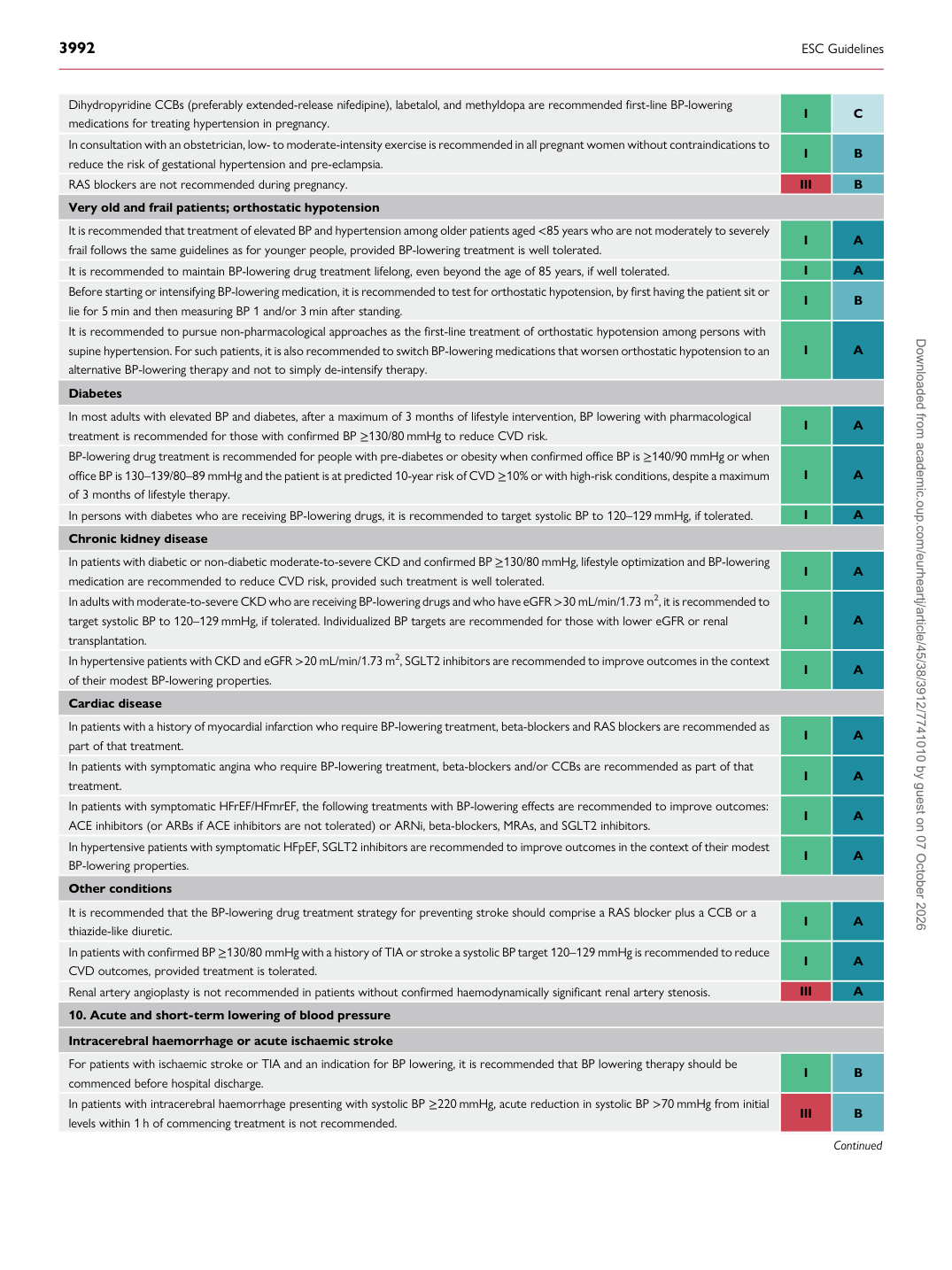
Dihydropyridine CCBs (preferably extended-release nifedipine), labetalol, and methyldopa are recommended first-line BP-lowering medications for treating hypertension in pregnancy. I C In consultation with an obstetrician, low- to moderate-intensity exercise is recommended in all pregnant women without contraindications to reduce the risk of gestational hypertension and pre-eclampsia. I B RAS blockers are not recommended during pregnancy. III B Very old and frail patients; orthostatic hypotension It is recommended that treatment of elevated BP and hypertension among older patients aged <85 years who are not moderately to severely frail follows the same guidelines as for younger people, provided BP-lowering treatment is well tolerated. I A It is recommended to maintain BP-lowering drug treatment lifelong, even beyond the age of 85 years, if well tolerated. I A Before starting or intensifying BP-lowering medication, it is recommended to test for orthostatic hypotension, by first having the patient sit or lie for 5 min and then measuring BP 1 and/or 3 min after standing. I B It is recommended to pursue non-pharmacological approaches as the first-line treatment of orthostatic hypotension among persons with supine hypertension. For such patients, it is also recommended to switch BP-lowering medications that worsen orthostatic hypotension to an alternative BP-lowering therapy and not to simply de-intensify therapy. I A Diabetes In most adults with elevated BP and diabetes, after a maximum of 3 months of lifestyle intervention, BP lowering with pharmacological treatment is recommended for those with confirmed BP ≥130/80 mmHg to reduce CVD risk. I A BP-lowering drug treatment is recommended for people with pre-diabetes or obesity when confirmed office BP is ≥140/90 mmHg or when office BP is 130–139/80–89 mmHg and the patient is at predicted 10-year risk of CVD ≥10% or with high-risk conditions, despite a maximum of 3 months of lifestyle therapy. I A In persons with diabetes who are receiving BP-lowering drugs, it is recommended to target systolic BP to 120–129 mmHg, if tolerated. I A Chronic kidney disease In patients with diabetic or non-diabetic moderate-to-severe CKD and confirmed BP ≥130/80 mmHg, lifestyle optimization and BP-lowering medication are recommended to reduce CVD risk, provided such treatment is well tolerated. I A In adults with moderate-to-severe CKD who are receiving BP-lowering drugs and who have eGFR >30 mL/min/1.73 m2, it is recommended to target systolic BP to 120–129 mmHg, if tolerated. Individualized BP targets are recommended for those with lower eGFR or renal transplantation. I A In hypertensive patients with CKD and eGFR >20 mL/min/1.73 m2, SGLT2 inhibitors are recommended to improve outcomes in the context of their modest BP-lowering properties. I A Cardiac disease In patients with a history of myocardial infarction who require BP-lowering treatment, beta-blockers and RAS blockers are recommended as part of that treatment. I A In patients with symptomatic angina who require BP-lowering treatment, beta-blockers and/or CCBs are recommended as part of that treatment. I A In patients with symptomatic HFrEF/HFmrEF, the following treatments with BP-lowering effects are recommended to improve outcomes: ACE inhibitors (or ARBs if ACE inhibitors are not tolerated) or ARNi, beta-blockers, MRAs, and SGLT2 inhibitors. I A In hypertensive patients with symptomatic HFpEF, SGLT2 inhibitors are recommended to improve outcomes in the context of their modest BP-lowering properties. I A Other conditions It is recommended that the BP-lowering drug treatment strategy for preventing stroke should comprise a RAS blocker plus a CCB or a thiazide-like diuretic. I A In patients with confirmed BP ≥130/80 mmHg with a history of TIA or stroke a systolic BP target 120–129 mmHg is recommended to reduce CVD outcomes, provided treatment is tolerated. I A Renal artery angioplasty is not recommended in patients without confirmed haemodynamically significant renal artery stenosis. III A

10 Acute and short-term lowering of blood pressure

Intracerebral haemorrhage or acute ischaemic stroke For patients with ischaemic stroke or TIA and an indication for BP lowering, it is recommended that BP lowering therapy should be commenced before hospital discharge. I B In patients with intracerebral haemorrhage presenting with systolic BP ≥220 mmHg, acute reduction in systolic BP >70 mmHg from initial levels within 1 h of commencing treatment is not recommended. III B

Continued Downloaded from academic.oup.com/eurheartj/article/45/38/3912/7741010 by guest on 07 October 2026