p.80 抽出テキスト
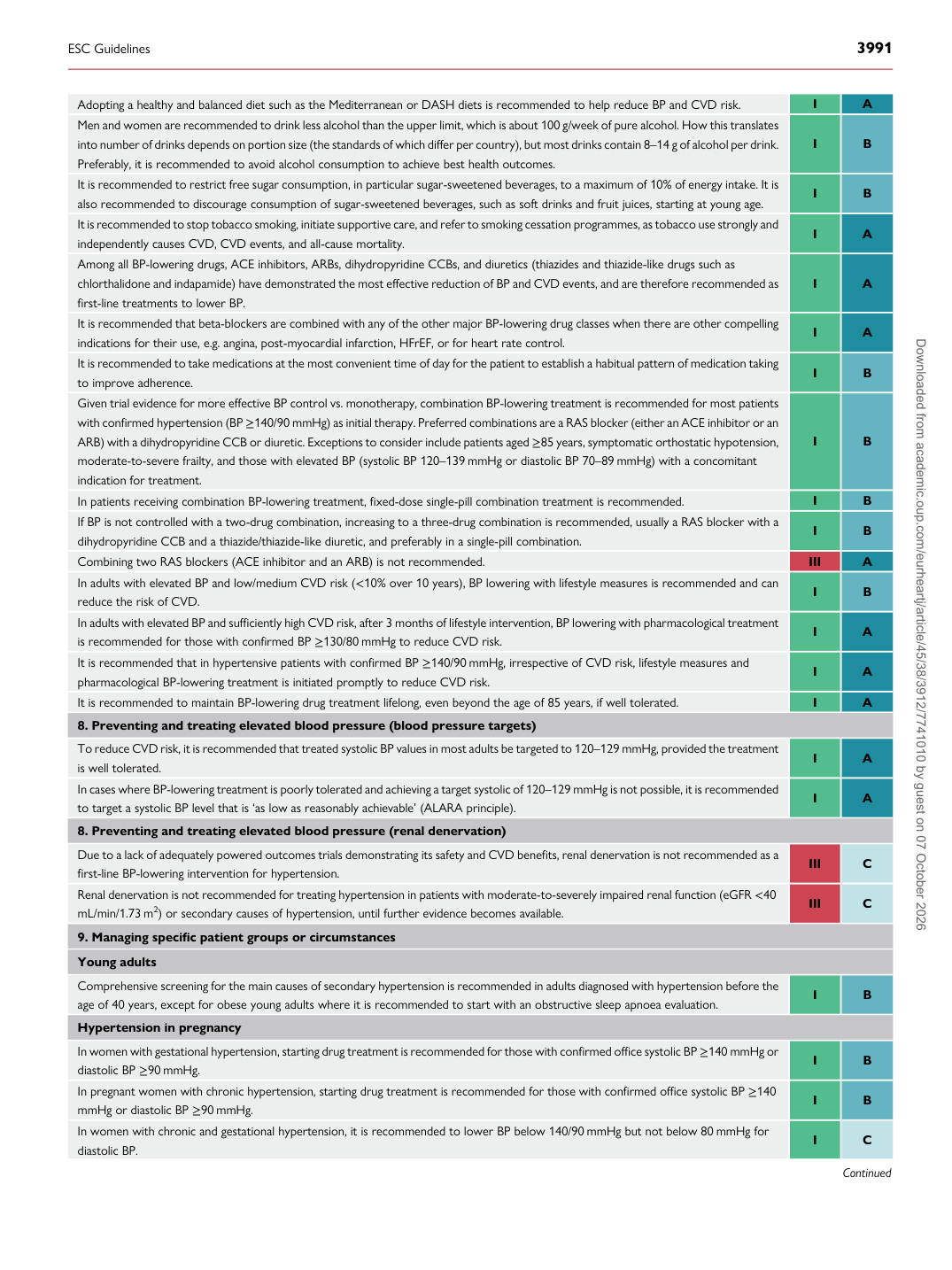
Adopting a healthy and balanced diet such as the Mediterranean or DASH diets is recommended to help reduce BP and CVD risk. I A Men and women are recommended to drink less alcohol than the upper limit, which is about 100 g/week of pure alcohol. How this translates into number of drinks depends on portion size (the standards of which differ per country), but most drinks contain 8–14 g of alcohol per drink. Preferably, it is recommended to avoid alcohol consumption to achieve best health outcomes. I B It is recommended to restrict free sugar consumption, in particular sugar-sweetened beverages, to a maximum of 10% of energy intake. It is also recommended to discourage consumption of sugar-sweetened beverages, such as soft drinks and fruit juices, starting at young age. I B It is recommended to stop tobacco smoking, initiate supportive care, and refer to smoking cessation programmes, as tobacco use strongly and independently causes CVD, CVD events, and all-cause mortality. I A Among all BP-lowering drugs, ACE inhibitors, ARBs, dihydropyridine CCBs, and diuretics (thiazides and thiazide-like drugs such as chlorthalidone and indapamide) have demonstrated the most effective reduction of BP and CVD events, and are therefore recommended as first-line treatments to lower BP. I A It is recommended that beta-blockers are combined with any of the other major BP-lowering drug classes when there are other compelling indications for their use, e.g. angina, post-myocardial infarction, HFrEF, or for heart rate control. I A It is recommended to take medications at the most convenient time of day for the patient to establish a habitual pattern of medication taking to improve adherence. I B Given trial evidence for more effective BP control vs. monotherapy, combination BP-lowering treatment is recommended for most patients with confirmed hypertension (BP ≥140/90 mmHg) as initial therapy. Preferred combinations are a RAS blocker (either an ACE inhibitor or an ARB) with a dihydropyridine CCB or diuretic. Exceptions to consider include patients aged ≥85 years, symptomatic orthostatic hypotension, moderate-to-severe frailty, and those with elevated BP (systolic BP 120–139 mmHg or diastolic BP 70–89 mmHg) with a concomitant indication for treatment. I B In patients receiving combination BP-lowering treatment, fixed-dose single-pill combination treatment is recommended. I B If BP is not controlled with a two-drug combination, increasing to a three-drug combination is recommended, usually a RAS blocker with a dihydropyridine CCB and a thiazide/thiazide-like diuretic, and preferably in a single-pill combination. I B Combining two RAS blockers (ACE inhibitor and an ARB) is not recommended. III A In adults with elevated BP and low/medium CVD risk (<10% over 10 years), BP lowering with lifestyle measures is recommended and can reduce the risk of CVD. I B In adults with elevated BP and sufficiently high CVD risk, after 3 months of lifestyle intervention, BP lowering with pharmacological treatment is recommended for those with confirmed BP ≥130/80 mmHg to reduce CVD risk. I A It is recommended that in hypertensive patients with confirmed BP ≥140/90 mmHg, irrespective of CVD risk, lifestyle measures and pharmacological BP-lowering treatment is initiated promptly to reduce CVD risk. I A It is recommended to maintain BP-lowering drug treatment lifelong, even beyond the age of 85 years, if well tolerated. I A

8 Preventing and treating elevated blood pressure (blood pressure targets)

To reduce CVD risk, it is recommended that treated systolic BP values in most adults be targeted to 120–129 mmHg, provided the treatment is well tolerated. I A In cases where BP-lowering treatment is poorly tolerated and achieving a target systolic of 120–129 mmHg is not possible, it is recommended to target a systolic BP level that is ‘as low as reasonably achievable’ (ALARA principle). I A

8 Preventing and treating elevated blood pressure (renal denervation)

Due to a lack of adequately powered outcomes trials demonstrating its safety and CVD benefits, renal denervation is not recommended as a first-line BP-lowering intervention for hypertension. III C Renal denervation is not recommended for treating hypertension in patients with moderate-to-severely impaired renal function (eGFR <40 mL/min/1.73 m2) or secondary causes of hypertension, until further evidence becomes available. III C

9 Managing specific patient groups or circumstances

Young adults Comprehensive screening for the main causes of secondary hypertension is recommended in adults diagnosed with hypertension before the age of 40 years, except for obese young adults where it is recommended to start with an obstructive sleep apnoea evaluation. I B Hypertension in pregnancy In women with gestational hypertension, starting drug treatment is recommended for those with confirmed office systolic BP ≥140 mmHg or diastolic BP ≥90 mmHg. I B In pregnant women with chronic hypertension, starting drug treatment is recommended for those with confirmed office systolic BP ≥140 mmHg or diastolic BP ≥90 mmHg. I B In women with chronic and gestational hypertension, it is recommended to lower BP below 140/90 mmHg but not below 80 mmHg for diastolic BP. I C

Continued

ESC Guidelines                                                                                                                                                                                          3991

Downloaded from academic.oup.com/eurheartj/article/45/38/3912/7741010 by guest on 07 October 2026