p.8 抽出テキスト
The ESC Clinical Practice Guidelines (CPG) Committee supervises and co-ordinates the preparation of new guidelines and is responsible for the approval process. In addition to review by the CPG Committee, ESC Guidelines undergo multiple rounds of double-blind peer review by external experts, including members from across the whole of the ESC region, all National Cardiac Societies of the ESC and from relevant ESC Subspecialty Communities. After appropriate revisions, the guidelines are signed off by all the experts in the task force. The finalized document is signed off by the CPG Committee for publication in the European Heart Journal. ESC Guidelines are based on analyses of published evidence, chiefly on clinical trials and meta-analyses of trials, but potentially including other types of studies. Evidence tables summarizing key information from relevant studies are generated early in the guideline development process to facilitate the formulation of recommendations, to enhance comprehension of recommendations after publication, and reinforce transparency in the guidelines development process. The tables are published in their own section of ESC Guidelines and reference specific recommendation tables. Off-label use of medication may be presented in these guidelines if a sufficient level of evidence shows that it can be considered medically appropriate for a given condition. However, the final decisions concerning an individual patient must be made by the responsible health professional giving special consideration to:

• The specific situation of the patient. Unless otherwise provided for by national regulations, off-label use of medication should be limited to situations where it is in the patient’s interest with regard to the quality, safety, and efficacy of care, and only after the patient has been informed and has provided consent; • Country-specific health regulations, indications by governmental drug regulatory agencies, and the ethical rules to which health professionals are subject, where applicable. 2 Introduction

This 2024 document updates the 2018 ESC/European Society of Hypertension (ESH) Guidelines on the management of arterial hypertension.1 While the current document builds on prior guidelines, it also incorporates important updates and new recommendations based on current evidence. For example:

(1) The title has changed from ‘Guidelines on the management of arterial hypertension’ to ‘Guidelines on the management of elevated blood pressure and hypertension’. This is based on evidence that the risk for cardiovascular disease (CVD) attributable to blood pressure (BP) is on a continuous exposure scale, not a binary scale of normotension vs. hypertension.2,3 Updated evidence also increasingly demonstrates the benefit on CVD outcomes of BP-lowering medications among persons with high CVD risk and BP levels that are elevated but that do not meet traditional thresholds used to define hypertension. The term ‘arterial’ is removed from the title of the 2024 Guidelines, as arterial hypertension can also occur in the pulmonary arteries, which is not a focus here. (2) The 2024 Guidelines continue to define hypertension as office systolic BP of ≥140 mmHg or diastolic BP of ≥90 mmHg. However, a new BP category called ‘Elevated BP’ is introduced. Elevated BP is defined as an office systolic BP of 120–139 mmHg or diastolic BP of 70–89 mmHg. (3) A major, evidence-based change in the 2024 Guidelines is the rec-

ommendation to pursue a target systolic BP of 120–129 mmHg among adults receiving BP-lowering medications. There are several important caveats to this recommendation, including: (i) the requirement that treatment to this BP target is well tolerated by the patient, (ii) the fact that more lenient BP targets can be considered in persons with symptomatic orthostatic hypotension, those aged 85 years or over, or those with moderate-to-severe frailty

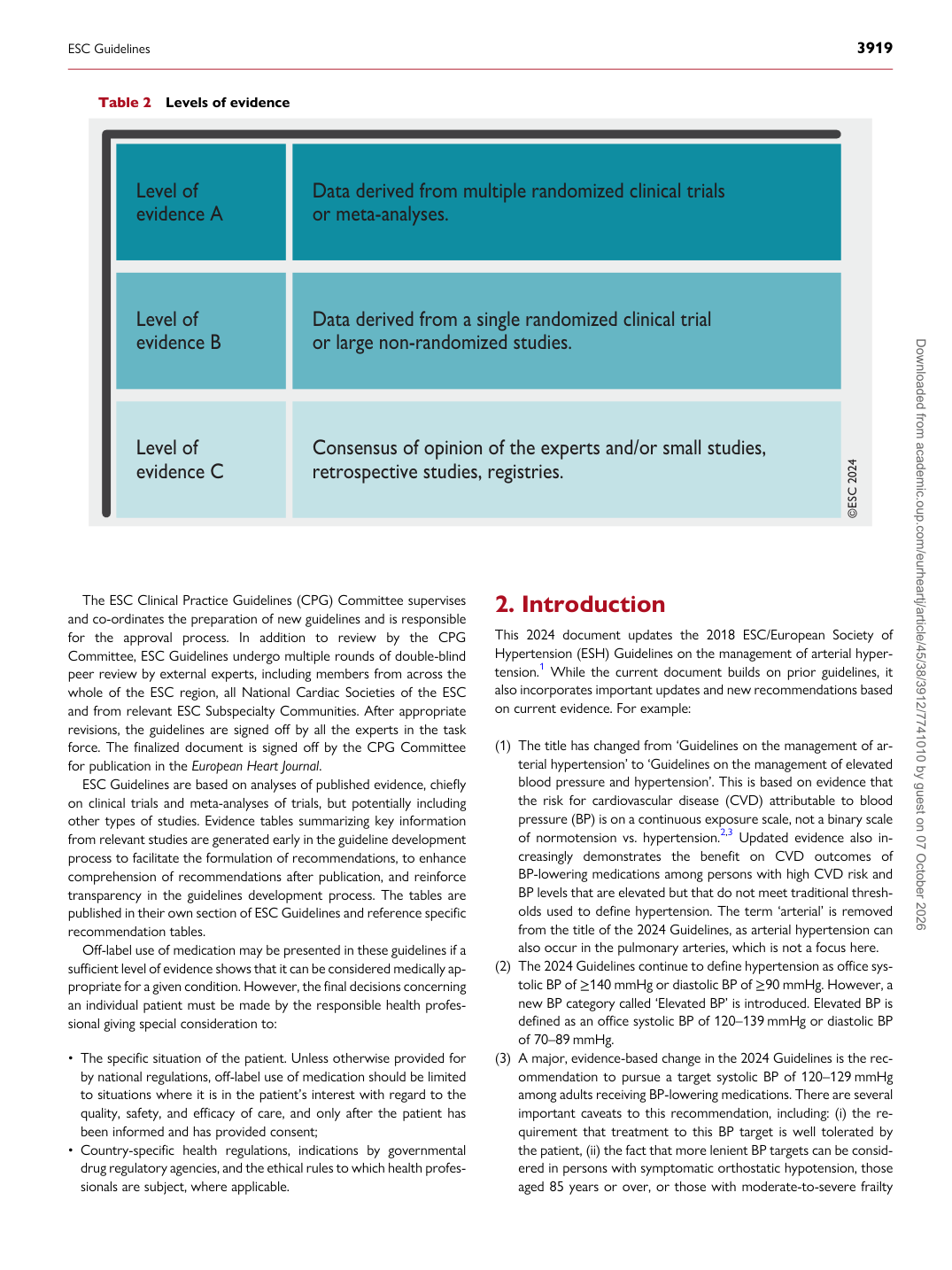
Table 2 Levels of evidence

Level of evidence A

Level of evidence B

Level of evidence C Data derived from multiple randomized clinical trials or meta-analyses.

Data derived from a single randomized clinical trial or large non-randomized studies.

Consensus of opinion of the experts and/or small studies, retrospective studies, registries. ©ESC 2024 © ESC 2024

ESC Guidelines                                                                                                                                                                                          3919

Downloaded from academic.oup.com/eurheartj/article/45/38/3912/7741010 by guest on 07 October 2026