p.79 抽出テキスト
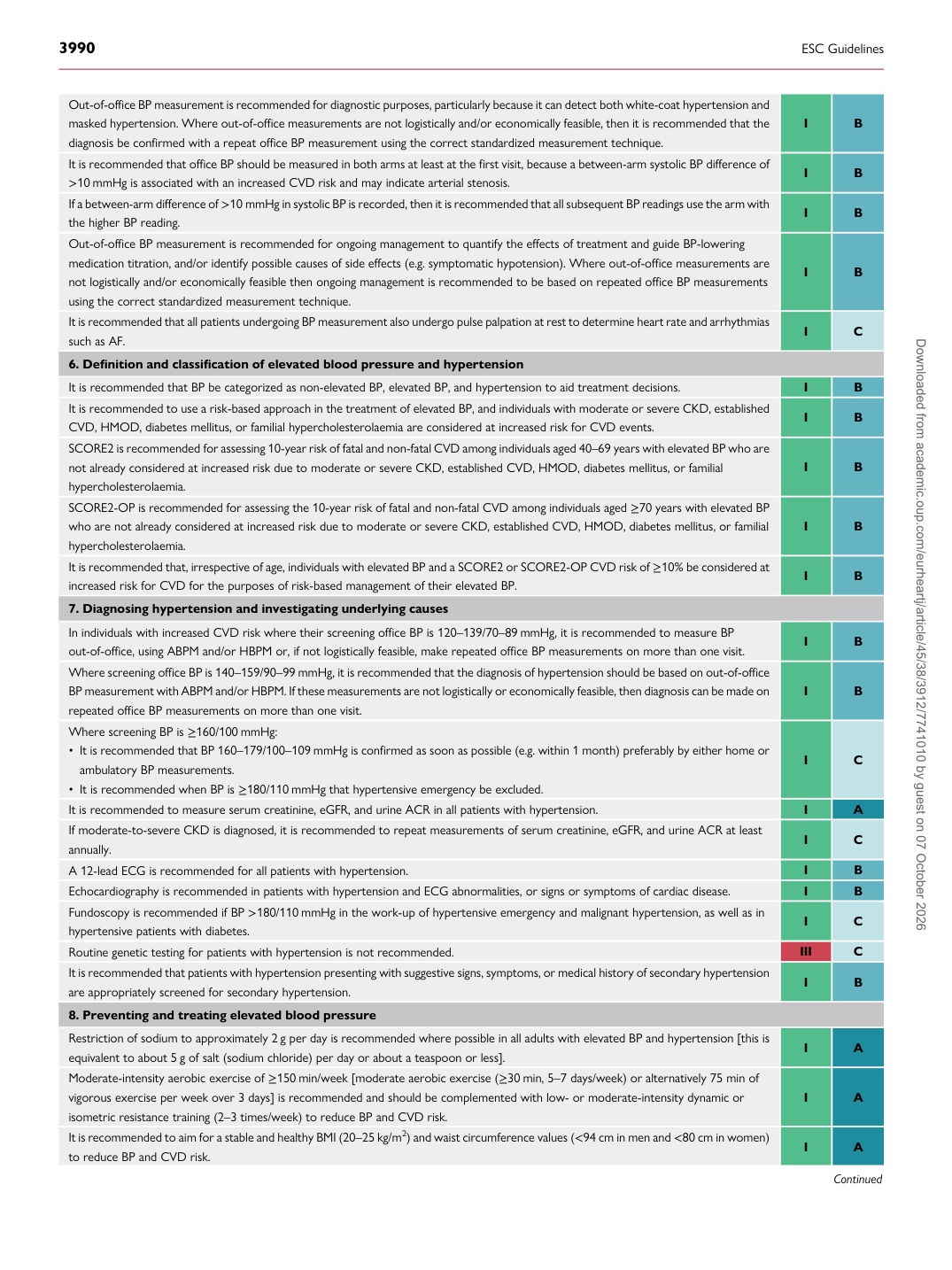
Out-of-office BP measurement is recommended for diagnostic purposes, particularly because it can detect both white-coat hypertension and masked hypertension. Where out-of-office measurements are not logistically and/or economically feasible, then it is recommended that the diagnosis be confirmed with a repeat office BP measurement using the correct standardized measurement technique. I B It is recommended that office BP should be measured in both arms at least at the first visit, because a between-arm systolic BP difference of >10 mmHg is associated with an increased CVD risk and may indicate arterial stenosis. I B If a between-arm difference of >10 mmHg in systolic BP is recorded, then it is recommended that all subsequent BP readings use the arm with the higher BP reading. I B Out-of-office BP measurement is recommended for ongoing management to quantify the effects of treatment and guide BP-lowering medication titration, and/or identify possible causes of side effects (e.g. symptomatic hypotension). Where out-of-office measurements are not logistically and/or economically feasible then ongoing management is recommended to be based on repeated office BP measurements using the correct standardized measurement technique. I B It is recommended that all patients undergoing BP measurement also undergo pulse palpation at rest to determine heart rate and arrhythmias such as AF. I C

6 Definition and classification of elevated blood pressure and hypertension

It is recommended that BP be categorized as non-elevated BP, elevated BP, and hypertension to aid treatment decisions. I B It is recommended to use a risk-based approach in the treatment of elevated BP, and individuals with moderate or severe CKD, established CVD, HMOD, diabetes mellitus, or familial hypercholesterolaemia are considered at increased risk for CVD events. I B SCORE2 is recommended for assessing 10-year risk of fatal and non-fatal CVD among individuals aged 40–69 years with elevated BP who are not already considered at increased risk due to moderate or severe CKD, established CVD, HMOD, diabetes mellitus, or familial hypercholesterolaemia. I B SCORE2-OP is recommended for assessing the 10-year risk of fatal and non-fatal CVD among individuals aged ≥70 years with elevated BP who are not already considered at increased risk due to moderate or severe CKD, established CVD, HMOD, diabetes mellitus, or familial hypercholesterolaemia. I B It is recommended that, irrespective of age, individuals with elevated BP and a SCORE2 or SCORE2-OP CVD risk of ≥10% be considered at increased risk for CVD for the purposes of risk-based management of their elevated BP. I B

7 Diagnosing hypertension and investigating underlying causes

In individuals with increased CVD risk where their screening office BP is 120–139/70–89 mmHg, it is recommended to measure BP out-of-office, using ABPM and/or HBPM or, if not logistically feasible, make repeated office BP measurements on more than one visit. I B Where screening office BP is 140–159/90–99 mmHg, it is recommended that the diagnosis of hypertension should be based on out-of-office BP measurement with ABPM and/or HBPM. If these measurements are not logistically or economically feasible, then diagnosis can be made on repeated office BP measurements on more than one visit. I B Where screening BP is ≥160/100 mmHg: • It is recommended that BP 160–179/100–109 mmHg is confirmed as soon as possible (e.g. within 1 month) preferably by either home or ambulatory BP measurements. • It is recommended when BP is ≥180/110 mmHg that hypertensive emergency be excluded. I C It is recommended to measure serum creatinine, eGFR, and urine ACR in all patients with hypertension. I A If moderate-to-severe CKD is diagnosed, it is recommended to repeat measurements of serum creatinine, eGFR, and urine ACR at least annually. I C A 12-lead ECG is recommended for all patients with hypertension. I B Echocardiography is recommended in patients with hypertension and ECG abnormalities, or signs or symptoms of cardiac disease. I B Fundoscopy is recommended if BP >180/110 mmHg in the work-up of hypertensive emergency and malignant hypertension, as well as in hypertensive patients with diabetes. I C Routine genetic testing for patients with hypertension is not recommended. III C It is recommended that patients with hypertension presenting with suggestive signs, symptoms, or medical history of secondary hypertension are appropriately screened for secondary hypertension. I B

8 Preventing and treating elevated blood pressure

Restriction of sodium to approximately 2 g per day is recommended where possible in all adults with elevated BP and hypertension [this is equivalent to about 5 g of salt (sodium chloride) per day or about a teaspoon or less]. I A Moderate-intensity aerobic exercise of ≥150 min/week [moderate aerobic exercise (≥30 min, 5–7 days/week) or alternatively 75 min of vigorous exercise per week over 3 days] is recommended and should be complemented with low- or moderate-intensity dynamic or isometric resistance training (2–3 times/week) to reduce BP and CVD risk. I A It is recommended to aim for a stable and healthy BMI (20–25 kg/m2) and waist circumference values (<94 cm in men and <80 cm in women) to reduce BP and CVD risk. I A

Continued Downloaded from academic.oup.com/eurheartj/article/45/38/3912/7741010 by guest on 07 October 2026