p.77 抽出テキスト
12 Key messages

(1) Given the demographic transition and the worldwide ageing of populations, the number of individuals with elevated BP or hypertension is increasing worldwide. (2) The trajectory of BP control appears to be worsening in North America, in some (but not all) European countries, and elsewhere around the world. (3) The risk for CVD attributable to BP is on a continuous log-linear exposure variable scale, not a binary scale of normotension vs. hypertension. (4) BP-lowering drugs can reduce CVD risk even among individuals

not traditionally classified as hypertensive. Accordingly, a new BP category called ‘elevated BP’ is introduced. Elevated BP is defined as an office systolic BP of 120–139 mmHg or diastolic BP of 70–89 mmHg. Hypertension remains defined as office BP of ≥140/90 mmHg. (5) Hypertension in women is under-studied in basic, clinical, and popu-

lation research. (6) HMOD suggests long-standing or severe hypertension and is associated with increased CVD risk. (7) Absolute CVD risk must be considered when assessing and managing elevated BP. (8) Despite the growing number of hypertension guidelines, the rates

of diagnosis, treatment, and control of hypertension (and elevated BP) remain suboptimal. A major factor underlying this is poor

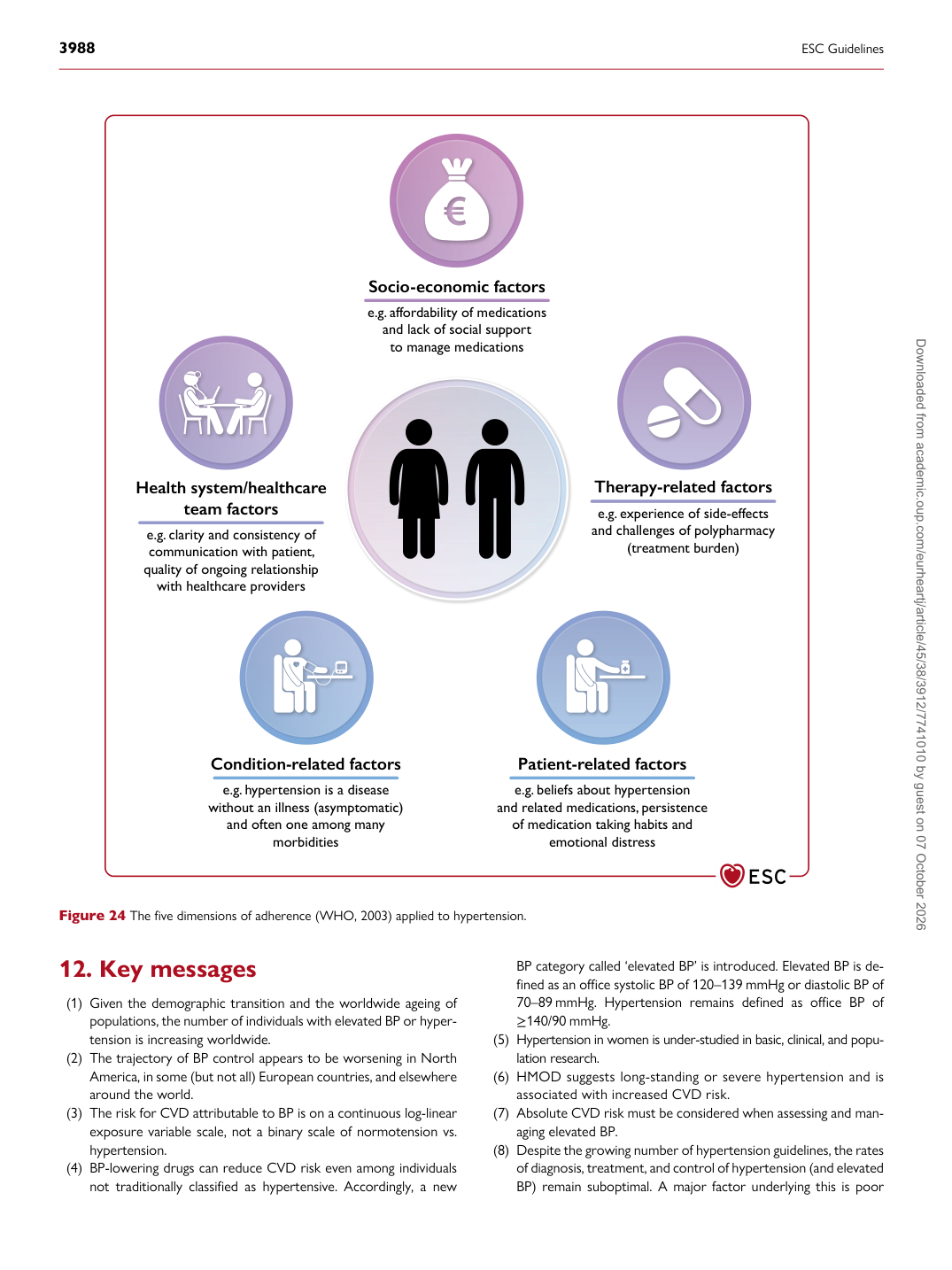
e.g. affordability of medications

and lack of social support to manage medications

Socio-economic factors

e.g. experience of side-effects and challenges of polypharmacy

(treatment burden)

Therapy-related factors

e.g. beliefs about hypertension and related medications, persistence

of medication taking habits and

emotional distress

Patient-related factors

e.g. hypertension is a disease without an illness (asymptomatic)

and often one among many

morbidities

Condition-related factors

e.g. clarity and consistency of communication with patient, quality of ongoing relationship

with healthcare providers

Health system/healthcare

team factors

Figure 24 The five dimensions of adherence (WHO, 2003) applied to hypertension. Downloaded from academic.oup.com/eurheartj/article/45/38/3912/7741010 by guest on 07 October 2026