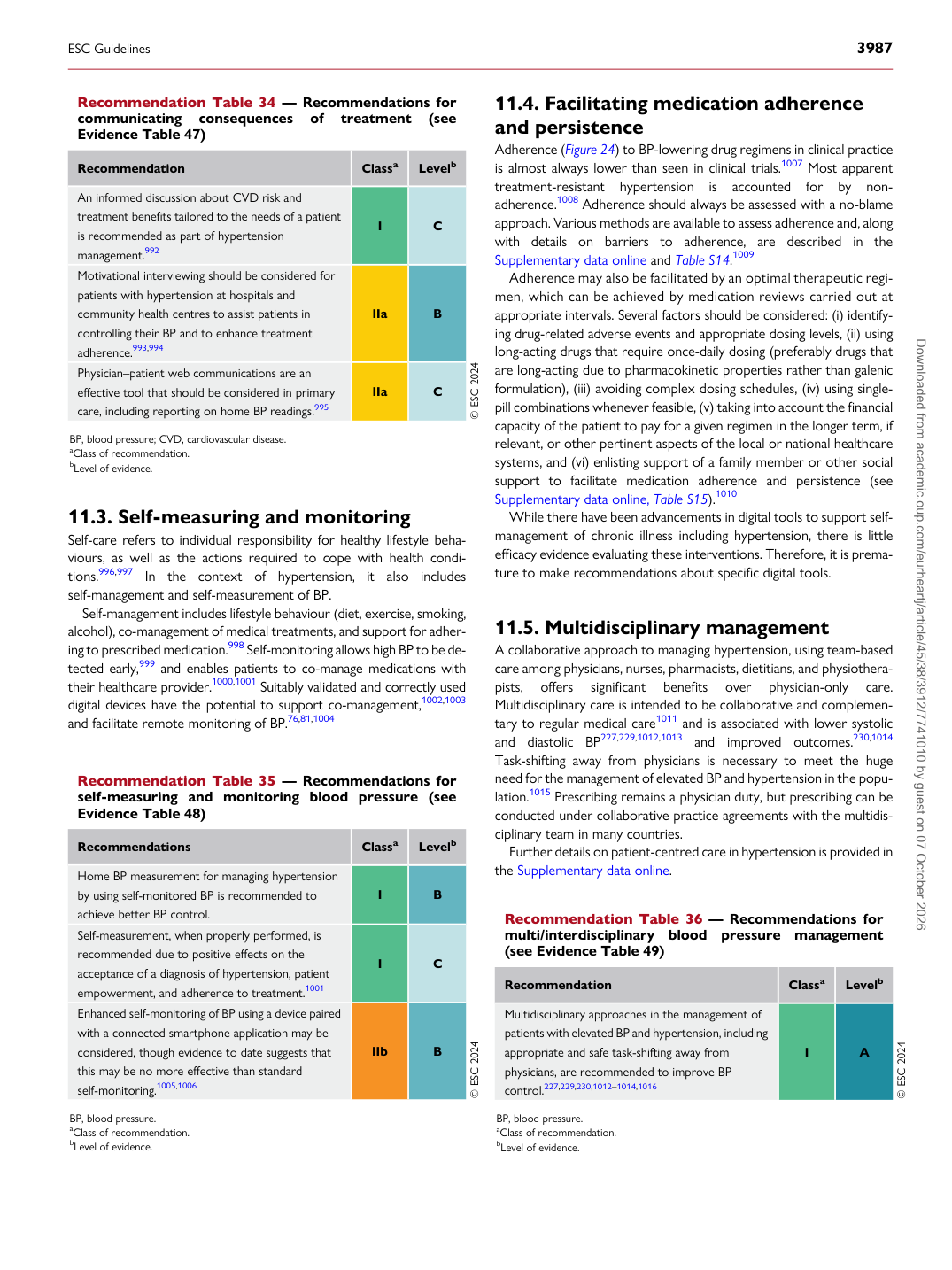
p.76 抽出テキスト
11.3 Self-measuring and monitoring

Self-care refers to individual responsibility for healthy lifestyle behaviours, as well as the actions required to cope with health conditions.996,997 In the context of hypertension, it also includes self-management and self-measurement of BP. Self-management includes lifestyle behaviour (diet, exercise, smoking, alcohol), co-management of medical treatments, and support for adhering to prescribed medication.998 Self-monitoring allows high BP to be detected early,999 and enables patients to co-manage medications with their healthcare provider.1000,1001 Suitably validated and correctly used digital devices have the potential to support co-management,1002,1003 and facilitate remote monitoring of BP.76,81,1004 11.4 Facilitating medication adherence

and persistence Adherence (Figure 24) to BP-lowering drug regimens in clinical practice is almost always lower than seen in clinical trials.1007 Most apparent treatment-resistant hypertension is accounted for by nonadherence.1008 Adherence should always be assessed with a no-blame approach. Various methods are available to assess adherence and, along with details on barriers to adherence, are described in the Supplementary data online and Table S14.1009 Adherence may also be facilitated by an optimal therapeutic regimen, which can be achieved by medication reviews carried out at appropriate intervals. Several factors should be considered: (i) identifying drug-related adverse events and appropriate dosing levels, (ii) using long-acting drugs that require once-daily dosing (preferably drugs that are long-acting due to pharmacokinetic properties rather than galenic formulation), (iii) avoiding complex dosing schedules, (iv) using singlepill combinations whenever feasible, (v) taking into account the financial capacity of the patient to pay for a given regimen in the longer term, if relevant, or other pertinent aspects of the local or national healthcare systems, and (vi) enlisting support of a family member or other social support to facilitate medication adherence and persistence (see Supplementary data online, Table S15).1010 While there have been advancements in digital tools to support selfmanagement of chronic illness including hypertension, there is little efficacy evidence evaluating these interventions. Therefore, it is premature to make recommendations about specific digital tools.

11.5 Multidisciplinary management

A collaborative approach to managing hypertension, using team-based care among physicians, nurses, pharmacists, dietitians, and physiotherapists, offers significant benefits over physician-only care. Multidisciplinary care is intended to be collaborative and complementary to regular medical care1011 and is associated with lower systolic and diastolic BP227,229,1012,1013 and improved outcomes.230,1014 Task-shifting away from physicians is necessary to meet the huge need for the management of elevated BP and hypertension in the population.1015 Prescribing remains a physician duty, but prescribing can be conducted under collaborative practice agreements with the multidisciplinary team in many countries. Further details on patient-centred care in hypertension is provided in the Supplementary data online.

Recommendation Table 34 — Recommendations for communicating consequences of treatment (see Evidence Table 47)

Recommendation Classa Levelb

An informed discussion about CVD risk and treatment benefits tailored to the needs of a patient is recommended as part of hypertension management.992 I C Motivational interviewing should be considered for patients with hypertension at hospitals and community health centres to assist patients in controlling their BP and to enhance treatment adherence.993,994 IIa B Physician–patient web communications are an effective tool that should be considered in primary care, including reporting on home BP readings.995 IIa C © ESC 2024

BP, blood pressure; CVD, cardiovascular disease. aClass of recommendation. bLevel of evidence.

Recommendation Table 35 — Recommendations for self-measuring and monitoring blood pressure (see Evidence Table 48)

Recommendations Classa Levelb

Home BP measurement for managing hypertension by using self-monitored BP is recommended to achieve better BP control. I B Self-measurement, when properly performed, is recommended due to positive effects on the acceptance of a diagnosis of hypertension, patient empowerment, and adherence to treatment.1001 I C Enhanced self-monitoring of BP using a device paired with a connected smartphone application may be considered, though evidence to date suggests that this may be no more effective than standard self-monitoring.1005,1006 IIb B © ESC 2024

BP, blood pressure. aClass of recommendation. bLevel of evidence. Recommendation Table 36 — Recommendations for multi/interdisciplinary blood pressure management (see Evidence Table 49)

Recommendation Classa Levelb

Multidisciplinary approaches in the management of patients with elevated BP and hypertension, including appropriate and safe task-shifting away from physicians, are recommended to improve BP control.227,229,230,1012–1014,1016 I A © ESC 2024

BP, blood pressure. aClass of recommendation. bLevel of evidence.

ESC Guidelines                                                                                                                                                                                          3987

Downloaded from academic.oup.com/eurheartj/article/45/38/3912/7741010 by guest on 07 October 2026