p.74 抽出テキスト
10.4 Acute blood pressure management in

pre-eclampsia and severe hypertension in pregnancy 10.4.1. Pre-eclampsia Pre-eclampsia is discussed in Section 9. Here we focus on its management in the acute setting. Pre-eclampsia is cured by delivery. Most international societies, including the ESC, recommend an intensive approach to BP lowering in pre-eclampsia.89,964,965 In women with pre-eclampsia and severe hypertension, immediately reducing systolic BP to <160 mmHg and diastolic BP to <105 mmHg using i.v. labetalol or nicardipine (with administration of magnesium sulfate if appropriate and consideration of delivery if appropriate) was recommended in the 2018 ESC/ESH Guidelines on the management of arterial hypertension and the 2022 ESC Guidelines for management of cardiovascular disease in pregnancy.1,89 The objective of treatment is to lower BP within 150–180 min. Magnesium sulfate [4 g i.v. over 5 min, then 1 g/h i.v.; or 5 g intramuscularly (i.m.) into each buttock, then 5 g i.m. every 4 h] is recommended for eclampsia treatment but also for women with pre-eclampsia who have severe hypertension and proteinuria or hypertension and neurological symptoms or signs.966 There is a risk of hypotension when magnesium is given concomitantly with nifedipine.967 If BP control is not achieved by 360 min despite two medications, consulting critical care is recommended for intensive care unit admission, stabilization, and delivery (if appropriate).966 Since plasma volume is reduced in preeclampsia, diuretic therapy should be avoided.

10.4.2 Severe acute hypertension in pregnancy

Severe hypertension in pregnancy (without pre-eclampsia) may necessitate acute BP-lowering therapies. Severe hypertension in pregnancy is defined in general as systolic BP of >160 mmHg and diastolic BP of >110 mmHg and is associated with adverse maternal and peri-natal outcomes independent of pre-eclampsia and potentially of the same magnitude as eclampsia itself.89,968 There are differences in rate of BP control between i.v. labetalol and i.v. hydralazine in severe hypertension in pregnancy.969 While evidence is conflicting,667,668 hydralazine may be associated with more peri-natal adverse events than other drugs.970 Nifedipine seems to provide lower BP with lower rates of neonatal complications than labetalol.971 10.5 Peri-operative acute management of

elevated blood pressure Details are provided in the ESC Guidelines on cardiovascular assessment and management of patients undergoing non-cardiac surgery.972 Peri-operative hypertension, hypotension, and BP variability are associated with haemodynamic instability and poor clinical outcomes for patients undergoing surgery.973 Pre-operative risk assessment for BP management, therefore, should involve assessing for underlying end-organ damage and comorbidities.974 Postponing necessary non-cardiac surgery is not usually warranted for patients with minor or moderate elevations in BP, as they are not at higher CVD risk.130,975 Avoiding large fluctuations in BP in the peri-operative course is important, and planning a strategy for a patient should account for the baseline office BP.974–977 There is insufficient evidence for reduced or increased perioperative BP targets compared to usual care BP targets to lower peri-operative events.978 No specific measure of BP appears better than any other for predicting risk of peri-operative events.975

10.5.1 Blood pressure-lowering drugs in the

peri-operative phase Routine initiation of a beta-blocker peri-operatively is not necessary.979 Pre-operative initiation of beta-blockers in advance of high-risk, non-cardiac surgery may be considered in patients who have known coronary artery disease or myocardial ischaemia980 or two or more significantly elevated clinical risk factors in order to reduce the incidence of peri-operative myocardial infarction.979 Peri-operative continuation of beta-blockers is recommended for patients currently taking beta-blockers.981 Some studies suggest that continued use of ACE inhibitors is associated with a higher risk of peri-operative hypotension and subsequent end-organ damage including kidney injury, myocardial infarction, and stroke.982 In the Prospective Randomized Evaluation of Preoperative Angiotensin-Converting Enzyme Inhibition (PREOP-ACEI) trial, transient pre-operative interruption of ACE inhibitor therapy was associated with a decreased risk of intra-operative hypotension.983 A subsequent systematic review also showed a decreased risk of intra-operative hypotension with withholding ACE inhibitors/ARBs before surgery, but no association

• In patients with ischaemic stroke not receiving

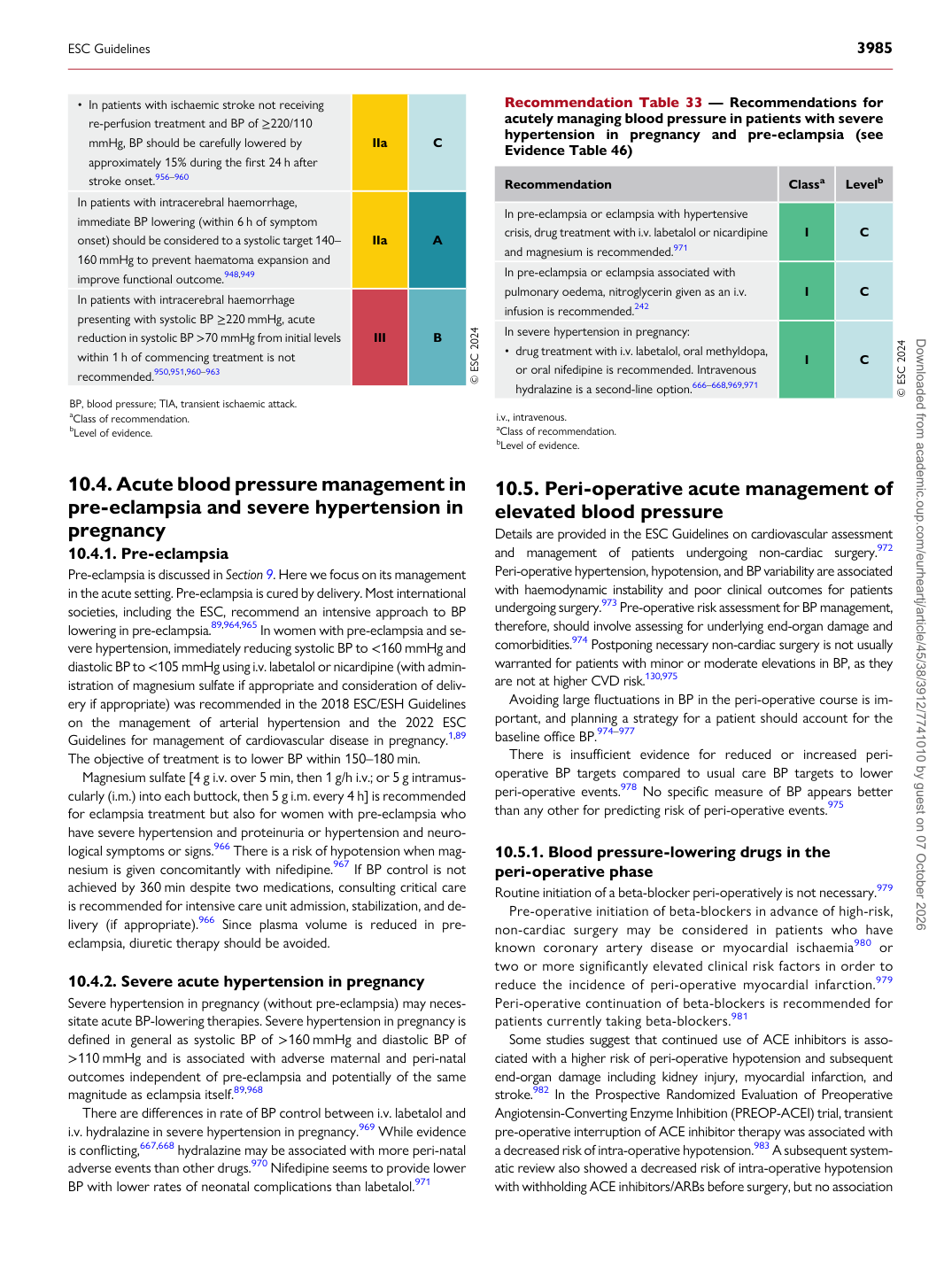
re-perfusion treatment and BP of ≥220/110 mmHg, BP should be carefully lowered by approximately 15% during the first 24 h after stroke onset.956–960 IIa C In patients with intracerebral haemorrhage, immediate BP lowering (within 6 h of symptom onset) should be considered to a systolic target 140– 160 mmHg to prevent haematoma expansion and improve functional outcome.948,949 IIa A In patients with intracerebral haemorrhage presenting with systolic BP ≥220 mmHg, acute reduction in systolic BP >70 mmHg from initial levels within 1 h of commencing treatment is not recommended.950,951,960–963 III B © ESC 2024

BP, blood pressure; TIA, transient ischaemic attack. aClass of recommendation. bLevel of evidence. Recommendation Table 33 — Recommendations for acutely managing blood pressure in patients with severe hypertension in pregnancy and pre-eclampsia (see Evidence Table 46)

Recommendation Classa Levelb

In pre-eclampsia or eclampsia with hypertensive crisis, drug treatment with i.v. labetalol or nicardipine and magnesium is recommended.971 I C In pre-eclampsia or eclampsia associated with pulmonary oedema, nitroglycerin given as an i.v. infusion is recommended.242 I C In severe hypertension in pregnancy: • drug treatment with i.v. labetalol, oral methyldopa, or oral nifedipine is recommended. Intravenous

hydralazine is a second-line option.666–668,969,971 I C © ESC 2024

i.v., intravenous. aClass of recommendation. bLevel of evidence.

ESC Guidelines                                                                                                                                                                                          3985

Downloaded from academic.oup.com/eurheartj/article/45/38/3912/7741010 by guest on 07 October 2026