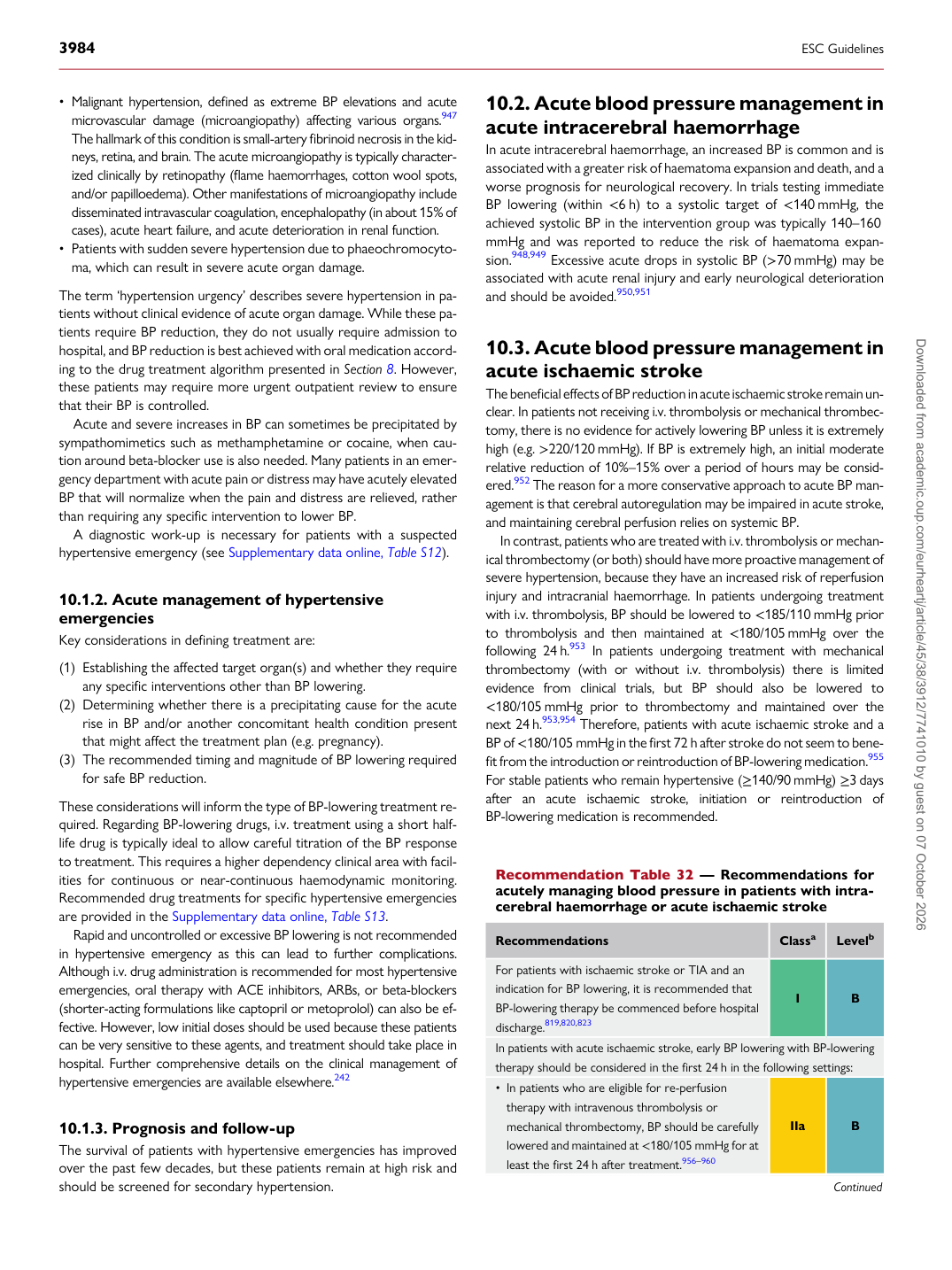
p.73 抽出テキスト
• Malignant hypertension, defined as extreme BP elevations and acute microvascular damage (microangiopathy) affecting various organs.947 The hallmark of this condition is small-artery fibrinoid necrosis in the kidneys, retina, and brain. The acute microangiopathy is typically characterized clinically by retinopathy (flame haemorrhages, cotton wool spots, and/or papilloedema). Other manifestations of microangiopathy include disseminated intravascular coagulation, encephalopathy (in about 15% of cases), acute heart failure, and acute deterioration in renal function. • Patients with sudden severe hypertension due to phaeochromocytoma, which can result in severe acute organ damage. The term ‘hypertension urgency’ describes severe hypertension in patients without clinical evidence of acute organ damage. While these patients require BP reduction, they do not usually require admission to hospital, and BP reduction is best achieved with oral medication according to the drug treatment algorithm presented in Section 8. However, these patients may require more urgent outpatient review to ensure that their BP is controlled. Acute and severe increases in BP can sometimes be precipitated by sympathomimetics such as methamphetamine or cocaine, when caution around beta-blocker use is also needed. Many patients in an emergency department with acute pain or distress may have acutely elevated BP that will normalize when the pain and distress are relieved, rather than requiring any specific intervention to lower BP. A diagnostic work-up is necessary for patients with a suspected hypertensive emergency (see Supplementary data online, Table S12).

10.1.2 Acute management of hypertensive

emergencies Key considerations in defining treatment are: (1) Establishing the affected target organ(s) and whether they require any specific interventions other than BP lowering. (2) Determining whether there is a precipitating cause for the acute rise in BP and/or another concomitant health condition present that might affect the treatment plan (e.g. pregnancy). (3) The recommended timing and magnitude of BP lowering required

for safe BP reduction. These considerations will inform the type of BP-lowering treatment required. Regarding BP-lowering drugs, i.v. treatment using a short halflife drug is typically ideal to allow careful titration of the BP response to treatment. This requires a higher dependency clinical area with facilities for continuous or near-continuous haemodynamic monitoring. Recommended drug treatments for specific hypertensive emergencies are provided in the Supplementary data online, Table S13. Rapid and uncontrolled or excessive BP lowering is not recommended in hypertensive emergency as this can lead to further complications. Although i.v. drug administration is recommended for most hypertensive emergencies, oral therapy with ACE inhibitors, ARBs, or beta-blockers (shorter-acting formulations like captopril or metoprolol) can also be effective. However, low initial doses should be used because these patients can be very sensitive to these agents, and treatment should take place in hospital. Further comprehensive details on the clinical management of hypertensive emergencies are available elsewhere.242

10.1.3 Prognosis and follow-up

The survival of patients with hypertensive emergencies has improved over the past few decades, but these patients remain at high risk and should be screened for secondary hypertension. 10.2 Acute blood pressure management in

acute intracerebral haemorrhage In acute intracerebral haemorrhage, an increased BP is common and is associated with a greater risk of haematoma expansion and death, and a worse prognosis for neurological recovery. In trials testing immediate BP lowering (within <6 h) to a systolic target of <140 mmHg, the achieved systolic BP in the intervention group was typically 140–160 mmHg and was reported to reduce the risk of haematoma expansion.948,949 Excessive acute drops in systolic BP (>70 mmHg) may be associated with acute renal injury and early neurological deterioration and should be avoided.950,951

10.3 Acute blood pressure management in

acute ischaemic stroke The beneficial effects of BP reduction in acute ischaemic stroke remain unclear. In patients not receiving i.v. thrombolysis or mechanical thrombectomy, there is no evidence for actively lowering BP unless it is extremely high (e.g. >220/120 mmHg). If BP is extremely high, an initial moderate relative reduction of 10%–15% over a period of hours may be considered.952 The reason for a more conservative approach to acute BP management is that cerebral autoregulation may be impaired in acute stroke, and maintaining cerebral perfusion relies on systemic BP. In contrast, patients who are treated with i.v. thrombolysis or mechanical thrombectomy (or both) should have more proactive management of severe hypertension, because they have an increased risk of reperfusion injury and intracranial haemorrhage. In patients undergoing treatment with i.v. thrombolysis, BP should be lowered to <185/110 mmHg prior to thrombolysis and then maintained at <180/105 mmHg over the following 24 h.953 In patients undergoing treatment with mechanical thrombectomy (with or without i.v. thrombolysis) there is limited evidence from clinical trials, but BP should also be lowered to <180/105 mmHg prior to thrombectomy and maintained over the next 24 h.953,954 Therefore, patients with acute ischaemic stroke and a BP of <180/105 mmHg in the first 72 h after stroke do not seem to benefit from the introduction or reintroduction of BP-lowering medication.955 For stable patients who remain hypertensive (≥140/90 mmHg) ≥3 days after an acute ischaemic stroke, initiation or reintroduction of BP-lowering medication is recommended.

Recommendation Table 32 — Recommendations for acutely managing blood pressure in patients with intracerebral haemorrhage or acute ischaemic stroke

Recommendations Classa Levelb

For patients with ischaemic stroke or TIA and an indication for BP lowering, it is recommended that BP-lowering therapy be commenced before hospital discharge.819,820,823 I B In patients with acute ischaemic stroke, early BP lowering with BP-lowering therapy should be considered in the first 24 h in the following settings: • In patients who are eligible for re-perfusion

therapy with intravenous thrombolysis or mechanical thrombectomy, BP should be carefully lowered and maintained at <180/105 mmHg for at least the first 24 h after treatment.956–960 IIa B

Continued Downloaded from academic.oup.com/eurheartj/article/45/38/3912/7741010 by guest on 07 October 2026