p.71 抽出テキスト
9.14 Management of specific causes

of secondary hypertension 9.14.1. General considerations These guidelines will describe only the general principles of managing the most common forms of secondary hypertension. For the rarer forms of secondary hypertension, patients should be referred to specialized hypertension centres. By definition, secondary hypertension should be, for the most part, cured when the underlying cause has been unambiguously identified and removed. However, in clinical practice, this is not always the case. Vascular remodelling, a common feature of a delayed diagnosis of secondary hypertension, affects renal function and can account for residual high BP in some patients with secondary hypertension. The rate of cure is higher when the diagnosis is made early in the course of the disease. Most common forms of secondary hypertension are listed in Table 13.

9.14.2 Primary aldosteronism

Primary aldosteronism (Conn syndrome) is the most common form of secondary hypertension. The management of primary aldosteronism depends on its subtype, particularly on adrenal lesions being unilateral or bilateral, because the unilateral forms are amenable to surgical treatment while the latter require lifelong medical treatment. In sporadic forms, unilateral primary aldosteronism is distinguished from bilateral primary aldosteronism by adrenal vein sampling or functional imaging with radiolabelled tracers.930–932 In the much less common familial forms (necessitating a family history be taken), genetic testing for germline mutations is necessary.933 For unilateral primary aldosteronism, surgical removal of the offending adrenal gland is typically considered, unless the patient is older or has comorbidities of concern. Surgery is not an option for bilateral primary aldosteronism. Medical treatment is currently based on MRAs. Among MRAs, spironolactone is the most widely available. The effective dose, usually 50–100 mg once daily, can be titrated up to 300–400 mg once daily, if necessary. Eplerenone is also used and, despite being less potent than spironolactone and requiring twice-daily administration, it has the advantage of causing less gynaecomastia and erectile dysfunction in men.934 Newer agents, such as the non-steroidal MRAs finerenone and exarenone, and the aldosterone synthase inhibitor baxdrostat, which lower BP in resistant hypertension,326,474 are also being tested for treating primary aldosteronism. Of the familial forms, only glucocorticoid-remediable primary aldosteronism, now reclassified as familial hyperaldosteronism type 1, can be corrected with dexamethasone,935 usually with low doses that are free of glucocorticoid effects and can be safely used during pregnancy.936 For detailed information, readers are referred to the latest primary aldosteronism guidelines.328,329

9.14.3 Renovascular hypertension

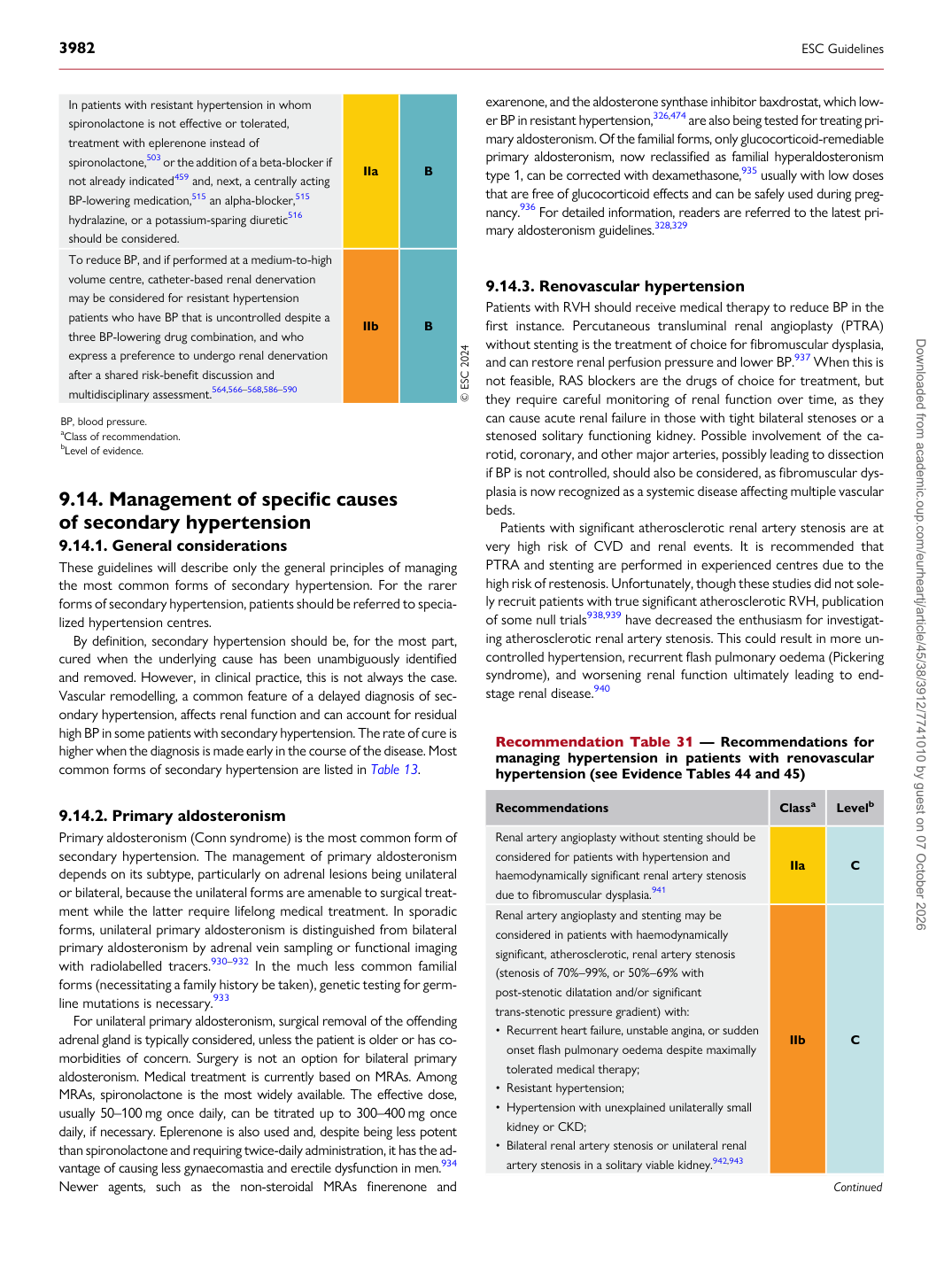
Patients with RVH should receive medical therapy to reduce BP in the first instance. Percutaneous transluminal renal angioplasty (PTRA) without stenting is the treatment of choice for fibromuscular dysplasia, and can restore renal perfusion pressure and lower BP.937 When this is not feasible, RAS blockers are the drugs of choice for treatment, but they require careful monitoring of renal function over time, as they can cause acute renal failure in those with tight bilateral stenoses or a stenosed solitary functioning kidney. Possible involvement of the carotid, coronary, and other major arteries, possibly leading to dissection if BP is not controlled, should also be considered, as fibromuscular dysplasia is now recognized as a systemic disease affecting multiple vascular beds. Patients with significant atherosclerotic renal artery stenosis are at very high risk of CVD and renal events. It is recommended that PTRA and stenting are performed in experienced centres due to the high risk of restenosis. Unfortunately, though these studies did not solely recruit patients with true significant atherosclerotic RVH, publication of some null trials938,939 have decreased the enthusiasm for investigating atherosclerotic renal artery stenosis. This could result in more uncontrolled hypertension, recurrent flash pulmonary oedema (Pickering syndrome), and worsening renal function ultimately leading to endstage renal disease.940

In patients with resistant hypertension in whom spironolactone is not effective or tolerated, treatment with eplerenone instead of spironolactone,503 or the addition of a beta-blocker if not already indicated459 and, next, a centrally acting BP-lowering medication,515 an alpha-blocker,515 hydralazine, or a potassium-sparing diuretic516 should be considered. IIa B To reduce BP, and if performed at a medium-to-high volume centre, catheter-based renal denervation may be considered for resistant hypertension patients who have BP that is uncontrolled despite a three BP-lowering drug combination, and who express a preference to undergo renal denervation after a shared risk-benefit discussion and multidisciplinary assessment.564,566–568,586–590 IIb B © ESC 2024

BP, blood pressure. aClass of recommendation. bLevel of evidence.

Recommendation Table 31 — Recommendations for managing hypertension in patients with renovascular hypertension (see Evidence Tables 44 and 45)

Recommendations Classa Levelb

Renal artery angioplasty without stenting should be considered for patients with hypertension and haemodynamically significant renal artery stenosis due to fibromuscular dysplasia.941 IIa C Renal artery angioplasty and stenting may be considered in patients with haemodynamically significant, atherosclerotic, renal artery stenosis (stenosis of 70%–99%, or 50%–69% with post-stenotic dilatation and/or significant trans-stenotic pressure gradient) with: • Recurrent heart failure, unstable angina, or sudden

onset flash pulmonary oedema despite maximally tolerated medical therapy; • Resistant hypertension; • Hypertension with unexplained unilaterally small kidney or CKD; • Bilateral renal artery stenosis or unilateral renal

artery stenosis in a solitary viable kidney.942,943 IIb C

Continued Downloaded from academic.oup.com/eurheartj/article/45/38/3912/7741010 by guest on 07 October 2026