p.70 抽出テキスト
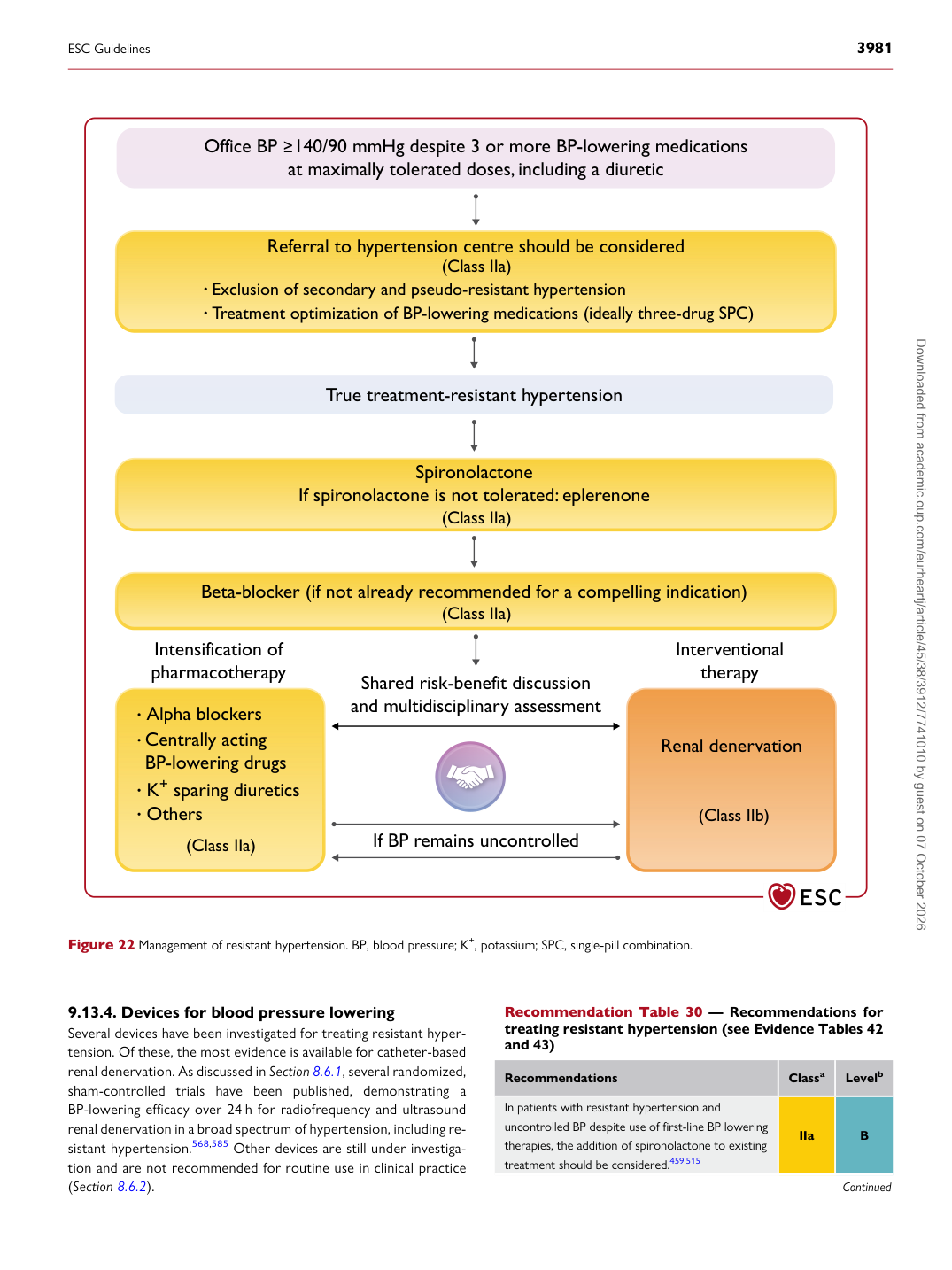
9.13.4 Devices for blood pressure lowering Several devices have been investigated for treating resistant hypertension. Of these, the most evidence is available for catheter-based renal denervation. As discussed in Section 8.6.1, several randomized, sham-controlled trials have been published, demonstrating a BP-lowering efficacy over 24 h for radiofrequency and ultrasound renal denervation in a broad spectrum of hypertension, including resistant hypertension.568,585 Other devices are still under investigation and are not recommended for routine use in clinical practice (Section 8.6.2). Intensification of pharmacotherapy If BP remains uncontrolled Renal denervation Interventional therapy Shared risk-benefit discussion and multidisciplinary assessment Beta-blocker (if not already recommended for a compelling indication) Spironolactone If spironolactone is not tolerated: eplerenone True treatment-resistant hypertension Office BP 140/90 mmHg despite 3 or more BP-lowering medications at maximally tolerated doses, including a diuretic Referral to hypertension centre should be considered Treatment optimization of BP-lowering medications (ideally three-drug SPC) Exclusion of secondary and pseudo-resistant hypertension Alpha blockers Centrally acting BP-lowering drugs K+ sparing diuretics Others (Class IIa) (Class IIa) (Class IIb) (Class IIa) (Class IIa) Figure 22 Management of resistant hypertension. BP, blood pressure; K+, potassium; SPC, single-pill combination. Recommendation Table 30 — Recommendations for treating resistant hypertension (see Evidence Tables 42 and 43) Recommendations Classa Levelb In patients with resistant hypertension and uncontrolled BP despite use of first-line BP lowering therapies, the addition of spironolactone to existing treatment should be considered.459,515 IIa B Continued ESC Guidelines 3981 Downloaded from academic.oup.com/eurheartj/article/45/38/3912/7741010 by guest on 07 October 2026