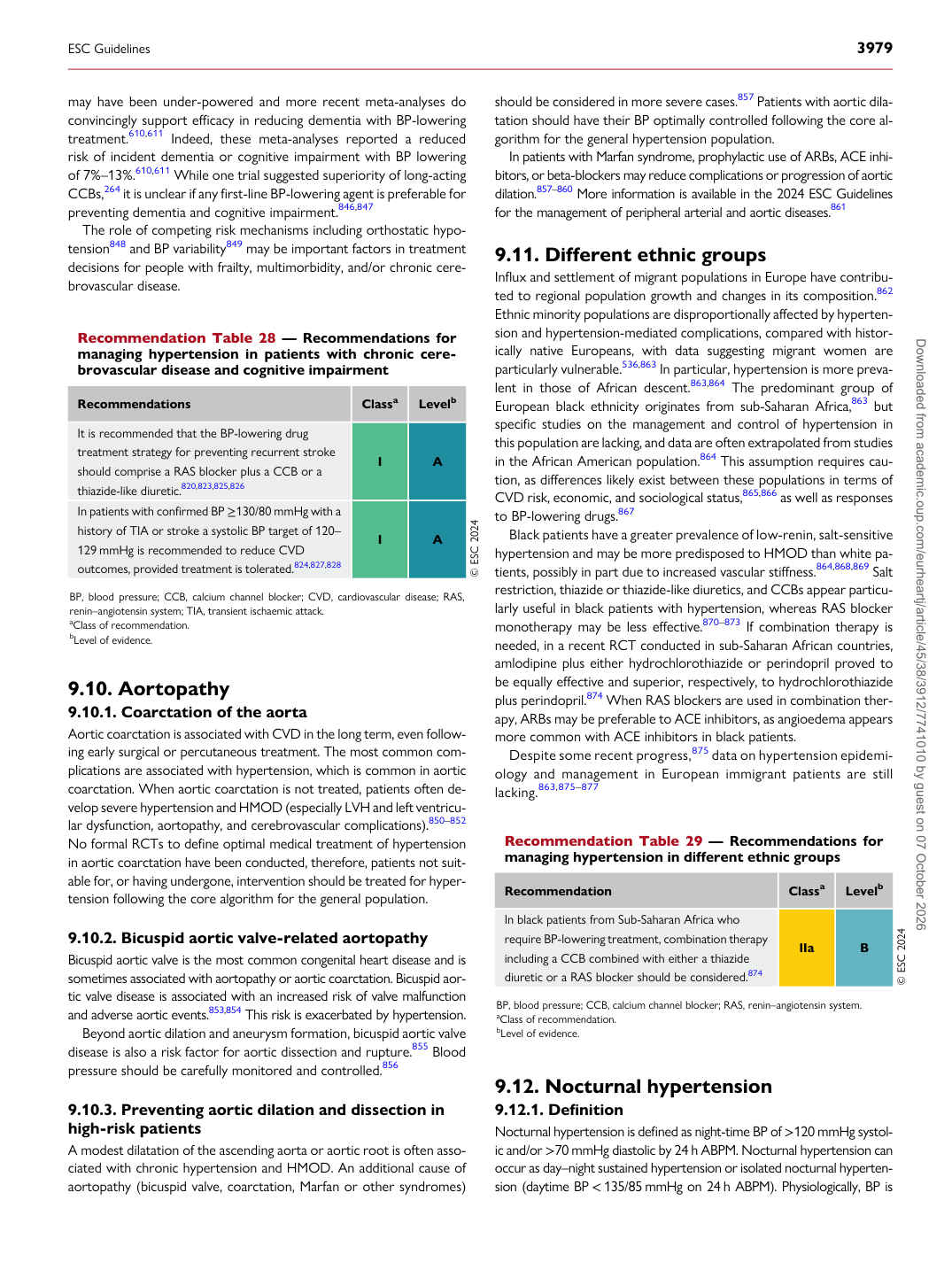
p.68 抽出テキスト
may have been under-powered and more recent meta-analyses do convincingly support efficacy in reducing dementia with BP-lowering treatment.610,611 Indeed, these meta-analyses reported a reduced risk of incident dementia or cognitive impairment with BP lowering of 7%–13%.610,611 While one trial suggested superiority of long-acting CCBs,264 it is unclear if any first-line BP-lowering agent is preferable for preventing dementia and cognitive impairment.846,847 The role of competing risk mechanisms including orthostatic hypotension848 and BP variability849 may be important factors in treatment decisions for people with frailty, multimorbidity, and/or chronic cerebrovascular disease.

9.10 Aortopathy

9.10.1. Coarctation of the aorta Aortic coarctation is associated with CVD in the long term, even following early surgical or percutaneous treatment. The most common complications are associated with hypertension, which is common in aortic coarctation. When aortic coarctation is not treated, patients often develop severe hypertension and HMOD (especially LVH and left ventricular dysfunction, aortopathy, and cerebrovascular complications).850–852 No formal RCTs to define optimal medical treatment of hypertension in aortic coarctation have been conducted, therefore, patients not suitable for, or having undergone, intervention should be treated for hypertension following the core algorithm for the general population.

9.10.2 Bicuspid aortic valve-related aortopathy

Bicuspid aortic valve is the most common congenital heart disease and is sometimes associated with aortopathy or aortic coarctation. Bicuspid aortic valve disease is associated with an increased risk of valve malfunction and adverse aortic events.853,854 This risk is exacerbated by hypertension. Beyond aortic dilation and aneurysm formation, bicuspid aortic valve disease is also a risk factor for aortic dissection and rupture.855 Blood pressure should be carefully monitored and controlled.856

9.10.3 Preventing aortic dilation and dissection in

high-risk patients A modest dilatation of the ascending aorta or aortic root is often associated with chronic hypertension and HMOD. An additional cause of aortopathy (bicuspid valve, coarctation, Marfan or other syndromes) should be considered in more severe cases.857 Patients with aortic dilatation should have their BP optimally controlled following the core algorithm for the general hypertension population.

In patients with Marfan syndrome, prophylactic use of ARBs, ACE inhibitors, or beta-blockers may reduce complications or progression of aortic dilation.857–860 More information is available in the 2024 ESC Guidelines for the management of peripheral arterial and aortic diseases.861

9.11 Different ethnic groups

Influx and settlement of migrant populations in Europe have contributed to regional population growth and changes in its composition.862 Ethnic minority populations are disproportionally affected by hypertension and hypertension-mediated complications, compared with historically native Europeans, with data suggesting migrant women are particularly vulnerable.536,863 In particular, hypertension is more prevalent in those of African descent.863,864 The predominant group of European black ethnicity originates from sub-Saharan Africa,863 but specific studies on the management and control of hypertension in this population are lacking, and data are often extrapolated from studies in the African American population.864 This assumption requires caution, as differences likely exist between these populations in terms of CVD risk, economic, and sociological status,865,866 as well as responses to BP-lowering drugs.867 Black patients have a greater prevalence of low-renin, salt-sensitive hypertension and may be more predisposed to HMOD than white patients, possibly in part due to increased vascular stiffness.864,868,869 Salt restriction, thiazide or thiazide-like diuretics, and CCBs appear particularly useful in black patients with hypertension, whereas RAS blocker monotherapy may be less effective.870–873 If combination therapy is needed, in a recent RCT conducted in sub-Saharan African countries, amlodipine plus either hydrochlorothiazide or perindopril proved to be equally effective and superior, respectively, to hydrochlorothiazide plus perindopril.874 When RAS blockers are used in combination therapy, ARBs may be preferable to ACE inhibitors, as angioedema appears more common with ACE inhibitors in black patients. Despite some recent progress,875 data on hypertension epidemiology and management in European immigrant patients are still lacking.863,875–877

9.12 Nocturnal hypertension

9.12.1. Definition Nocturnal hypertension is defined as night-time BP of >120 mmHg systolic and/or >70 mmHg diastolic by 24 h ABPM. Nocturnal hypertension can occur as day–night sustained hypertension or isolated nocturnal hypertension (daytime BP < 135/85 mmHg on 24 h ABPM). Physiologically, BP is

Recommendation Table 28 — Recommendations for managing hypertension in patients with chronic cerebrovascular disease and cognitive impairment

Recommendations Classa Levelb

It is recommended that the BP-lowering drug treatment strategy for preventing recurrent stroke should comprise a RAS blocker plus a CCB or a thiazide-like diuretic.820,823,825,826 I A In patients with confirmed BP ≥130/80 mmHg with a history of TIA or stroke a systolic BP target of 120– 129 mmHg is recommended to reduce CVD outcomes, provided treatment is tolerated.824,827,828 I A © ESC 2024

BP, blood pressure; CCB, calcium channel blocker; CVD, cardiovascular disease; RAS, renin–angiotensin system; TIA, transient ischaemic attack. aClass of recommendation. bLevel of evidence.

Recommendation Table 29 — Recommendations for managing hypertension in different ethnic groups

Recommendation Classa Levelb

In black patients from Sub-Saharan Africa who require BP-lowering treatment, combination therapy including a CCB combined with either a thiazide diuretic or a RAS blocker should be considered.874 IIa B © ESC 2024

BP, blood pressure; CCB, calcium channel blocker; RAS, renin–angiotensin system. aClass of recommendation. bLevel of evidence.

ESC Guidelines                                                                                                                                                                                          3979

Downloaded from academic.oup.com/eurheartj/article/45/38/3912/7741010 by guest on 07 October 2026