p.67 抽出テキスト
9.8.5 Heart rhythm disease (including AF)

Not all patients with heart rhythm disease, including those with AF, are at increased risk for CVD and, as such, the management of BP among patients with heart rhythm disease should be the same as for the general adult population.443 However, there is a close relationship between increased BP and AF risk, hence, ensuring good BP control is important.801,802 Management of heart rhythm disorders should follow recommendations in guidelines specific to these conditions.803

9.9 Chronic cerebrovascular disease

and/or cognitive impairment 9.9.1. Role of hypertension in chronic cerebrovascular disease Hypertension is a risk factor for chronic cerebrovascular disease through its direct effects on brain structure and microvasculature. This manifests as transient ischaemic attack (TIA) and stroke in the acute setting, but chronic hypertension can lead to covert stroke and white-matter ischaemic change over time, resulting in cognitive decline and progressive vascular dementia.804–808 Hypertension is also associated with increased risk of Alzheimer’s disease,809 and is a risk factor for developing AF, heart failure, and CKD, all of which are associated with increased risk of developing cognitive impairment and dementia.810–813 For the purposes of these guidelines, adults with a history of stroke or TIA and elevated BP are considered at sufficiently high risk to be considered for BP-lowering drug therapy as outlined in Section 8 and the Central Illustration (Figure 19).

9.9.2 Treatment in patients with history of prior

stroke or transient ischaemic attack In patients with a prior history of TIA and ischaemic stroke, BP-lowering treatment reduces the risk of any recurrent stroke by 20%.814–817 The aetiology of stroke can affect the degree of risk reduction with pharmacological treatment, with greater reductions observed for intracerebral haemorrhage and lacunar ischaemic stroke syndromes.818–820 Most prior guidelines recommend an intensive BP target in patients with a prior history of stroke, typically using combination treatment (ACE inhibitor/ARB plus either a calcium channel antagonist or a thiazide/thiazide-like diuretic), with therapy commencing immediately after TIA and within a few days of ischaemic stroke (see Supplementary data online and see Section 10.3 for acute BP management during hospitalization for stroke).814,815,821–824 Regimens containing an ACE inhibitor and thiazide/thiazide-like diuretic may be superior to beta-blockers in terms of stroke risk reduction.825,826 Regarding intensive BP control after stroke, typically targeting a systolic BP of <130 mmHg, individual trials were somewhat inconclusive, but a meta-analysis showed a reduced risk of recurrent stroke of 22% in the intensive treatment group randomized to a target systolic BP as low as 120 mmHg.543,824,827,828 Caveats to this recommendation would be for frail patients, who have a much higher rate of stroke and recurrent stroke than the general population, and who are more sensitive to adverse effects of BP-lowering agents (see Section 9.3).596,606,607,829

9.9.3 Treatment in patients with chronic

cerebrovascular disease and cognitive impairment Treatment of hypertension represents a key mechanism for reducing the global burden of dementia at the population level.830 Epidemiological studies have reported associations between mid-life hypertension and development of cognitive decline in later life, with, e.g. mid-life hypertension increasing relative risk of lifetime dementia by 20%–54%.831–837 In one observational meta-analysis, an increased risk for dementia emerged with systolic BP of >130 mmHg.831 Evidence for lowering BP to reduce the risk of dementia is limited due to heterogeneity in populations studied, cognitive testing methods used, and the varied use of dementia or cognitive impairment or both as a primary outcome.838,839 Findings from individual studies have mixed results (see Supplementary data online).264,839–843 Studies on effects of BP-lowering treatment on white-matter intensities concluded that patients in the intensive-control arm had less white-matter intensity accumulation than in the standard-treatment arm.841,844 Studies in which people with stroke and TIA were included reported a reduced risk of dementia and cognitive decline for the active-treatment group, but a mixed signal for dementia alone.841,845 However, individual studies

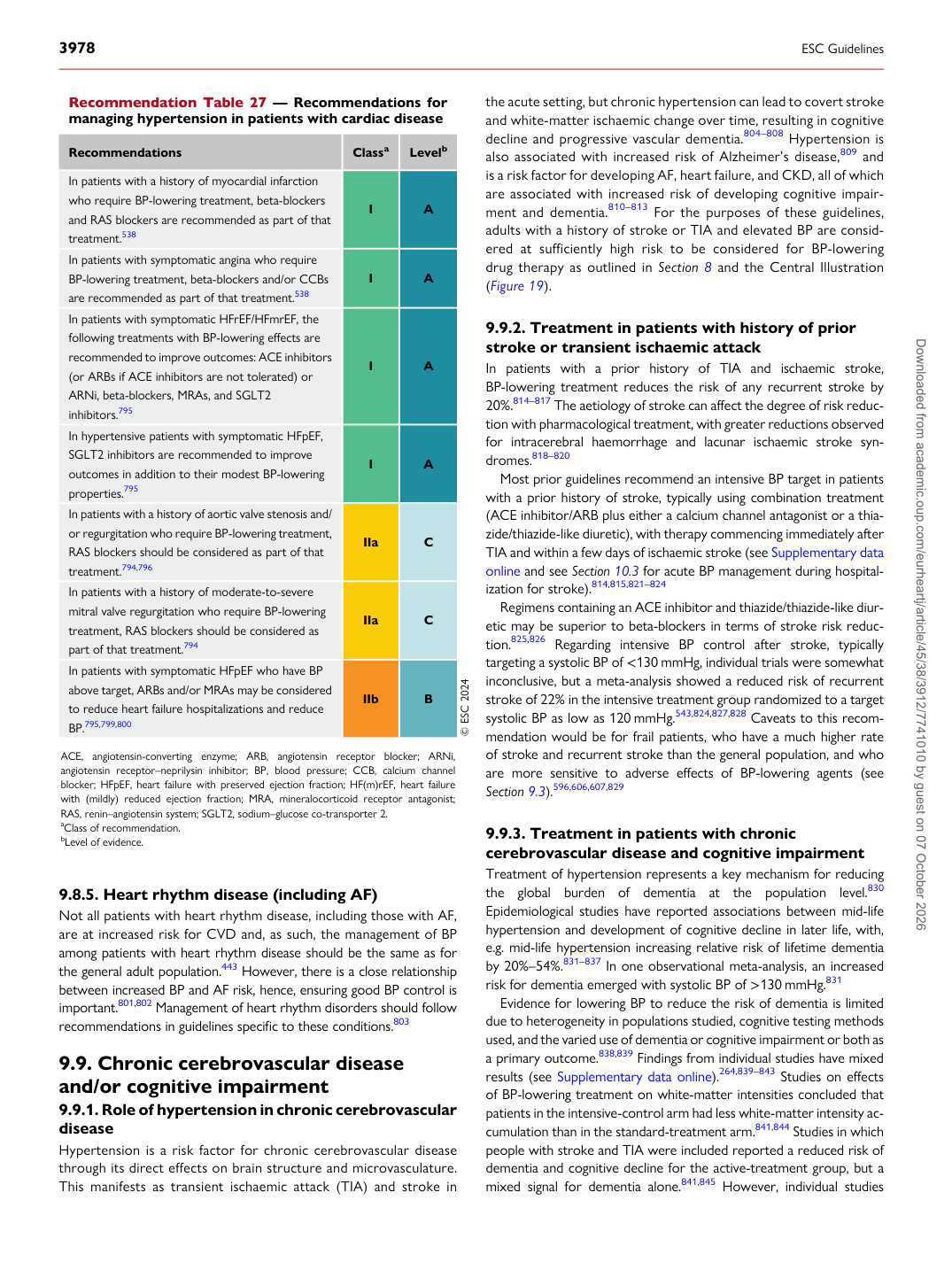
Recommendation Table 27 — Recommendations for managing hypertension in patients with cardiac disease

Recommendations Classa Levelb

In patients with a history of myocardial infarction who require BP-lowering treatment, beta-blockers and RAS blockers are recommended as part of that treatment.538 I A In patients with symptomatic angina who require BP-lowering treatment, beta-blockers and/or CCBs are recommended as part of that treatment.538 I A In patients with symptomatic HFrEF/HFmrEF, the following treatments with BP-lowering effects are recommended to improve outcomes: ACE inhibitors (or ARBs if ACE inhibitors are not tolerated) or ARNi, beta-blockers, MRAs, and SGLT2 inhibitors.795 I A In hypertensive patients with symptomatic HFpEF, SGLT2 inhibitors are recommended to improve outcomes in addition to their modest BP-lowering properties.795 I A In patients with a history of aortic valve stenosis and/ or regurgitation who require BP-lowering treatment, RAS blockers should be considered as part of that treatment.794,796 IIa C In patients with a history of moderate-to-severe mitral valve regurgitation who require BP-lowering treatment, RAS blockers should be considered as part of that treatment.794 IIa C In patients with symptomatic HFpEF who have BP above target, ARBs and/or MRAs may be considered to reduce heart failure hospitalizations and reduce BP.795,799,800 IIb B © ESC 2024

ACE, angiotensin-converting enzyme; ARB, angiotensin receptor blocker; ARNi, angiotensin receptor–neprilysin inhibitor; BP, blood pressure; CCB, calcium channel blocker; HFpEF, heart failure with preserved ejection fraction; HF(m)rEF, heart failure with (mildly) reduced ejection fraction; MRA, mineralocorticoid receptor antagonist; RAS, renin–angiotensin system; SGLT2, sodium–glucose co-transporter 2. aClass of recommendation. bLevel of evidence. Downloaded from academic.oup.com/eurheartj/article/45/38/3912/7741010 by guest on 07 October 2026