p.65 抽出テキスト
by 2025.756–759 The pathogeneses of hypertension and CKD are closely entwined.760 Resistant hypertension, masked hypertension, HMOD, and higher night-time BP are common in patients with CKD.761 CVD is one of the largest contributors to mortality in patients with CKD, with hypertension being a major risk factor.760,762 For the purposes of these guidelines, adults with moderate-to-severe CKD and elevated BP are at sufficiently high risk to be considered for BP-lowering drug therapy as outlined in Section 8 and the Central Illustration (Figure 19). We use Kidney Disease: Improving Global Outcomes (KDIGO) categories to define CKD-based risk, and our definition of moderate-to-severe CKD comprises persons with an eGFR of <60 mL/min/1.73 m2 and/or albuminuria of ≥30 mg/g (≥3 mg/mmol).19 For persons with mild CKD and elevated BP, a CVD risk assessment should be conducted before deciding on BP-lowering treatment.

9.7.2 Blood pressure lowering in chronic kidney

disease BP lowering in patients with CKD is associated with beneficial effect on CVD events and mortality.275,763–766 BP lowering reduces progression of CKD and the incidence of end-stage renal disease, but this tends to be only in those with significant proteinuria at baseline.766,767

9.7.3 Managing blood pressure in chronic kidney

disease Patients with CKD should receive lifestyle advice, especially regarding reducing sodium intake. Dietary potassium supplementation recommendations are provided in Section 8, with caution required among persons with moderate-to-severe CKD. While exercise appears to have little effect on improving BP in patients with CKD768 or patients on dialysis,769 those with CKD on ACE inhibitor monotherapy have protection against adverse kidney outcomes, CVD events, cardiovascular death, and all-cause death.770,771 Both ACE inhibitors and ARBs reduce the risk of CVD events and kidney failure compared with placebo; however, ACE inhibitors appear to do so with higher probability than ARBs.772,773 Patients with CKD usually require combination therapy, and this should be initiated as a combination of a RAS inhibitor and a CCB or diuretic. In patients with eGFR < 30 mL/min/1.73 m2, an adequately up-titrated loop diuretic is necessary to define resistant hypertension. Chlorthalidone, typically added to a loop diuretic, also effectively lowers BP and reduces microalbuminuria in patients with resistant hypertension with stage 4 CKD (eGFR of 15–30 mL/min/1.73 m2).774 The combination of an ACE inhibitor and an ARB is not recommended in CKD or any other BP-treatment scenario.

9.7.4 Blood pressure targets in chronic kidney

disease Evidence regarding BP targets in patients with CKD is complex and controversial. The 2021 KDIGO Guideline suggested that adults with elevated BP and CKD be treated to a target systolic BP of <120 mmHg, when tolerated, using standardized office BP measurement (Class of Recommendation IIb).19 This suggestion was based, in part, on the SPRINT trial.545 It should be noted that patients with 24 h urine protein excretion ≥ 1 g/day or eGFR < 20 mL/min/1.73 m2 were excluded from SPRINT. In patients with CKD, after a median follow-up of 3.3 years, the hazard ratio for the primary composite cardiovascular outcome was 0.81 (95% CI 0.63–1.05) and for all-cause death it was 0.72 (95% CI 0.53–0.99). Although intensive BP lowering in SPRINT resulted in greater early decline in eGFR, there was no evidence that this reduction in eGFR attenuated the beneficial effects of the SPRINT intervention on CVD events or death.775

Several systematic reviews have examined the benefit of intensive BP control in patients with CKD (see Supplementary data online). Some have shown no benefit of intensive BP control on renal outcomes,764,767 while others showed lower mortality in intensively treated vs. non-intensively treated patients.275 Highlighting the beneficial effects of SGLT2 inhibitors in persons with CKD776,777 and finerenone in persons with CKD and diabetes460–462,778 is relevant, though these drugs are not currently marketed for BP-lowering effects alone.

9.8 Cardiac disease

9.8.1. Blood pressure thresholds and targets in patients with cardiac disease Recommended BP thresholds for initiating BP-lowering therapy and recommended BP targets in patients receiving therapy are provided in Sections 6 and 8. All patients with a history of CVD (including coronary artery disease) are at increased risk of recurrent CVD. As such, these patients are recommended to be treated with BP-lowering therapy for confirmed baseline BP of ≥130/80 mmHg and the recommended treatment target BP of 120–129/70–79 mmHg, provided treatment is tolerated (see Sections 6 and 8). As stated in Section 8, it should be remembered that a systolic BP of 120 mmHg (especially by out-of-office assessment) is likely the optimal point in the target range recommended in these guidelines. In addition to considering patients with known CVD at sufficiently high risk for more intensive BP treatment targets, the

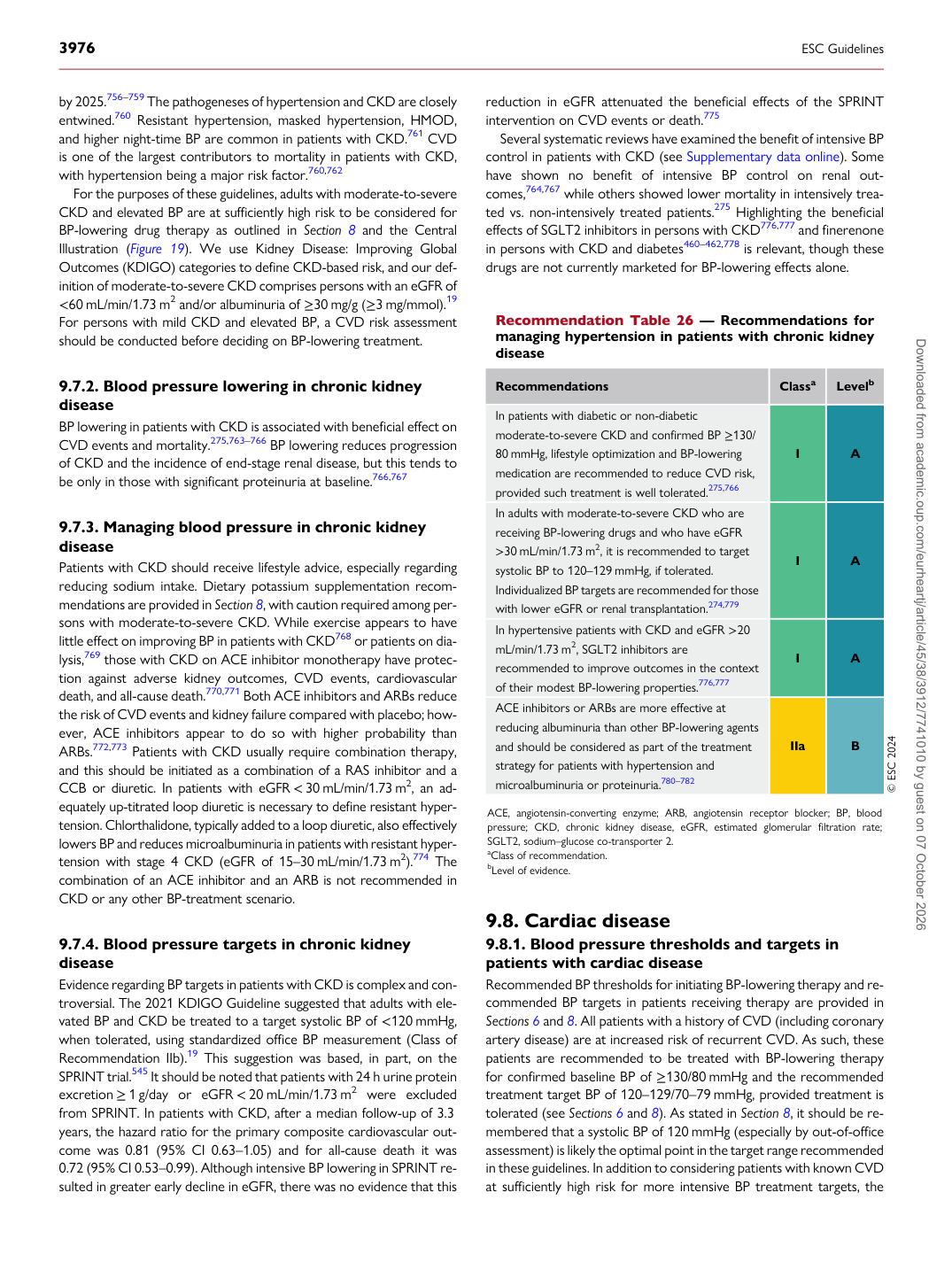
Recommendation Table 26 — Recommendations for managing hypertension in patients with chronic kidney disease

Recommendations Classa Levelb

In patients with diabetic or non-diabetic moderate-to-severe CKD and confirmed BP ≥130/ 80 mmHg, lifestyle optimization and BP-lowering medication are recommended to reduce CVD risk, provided such treatment is well tolerated.275,766 I A In adults with moderate-to-severe CKD who are receiving BP-lowering drugs and who have eGFR >30 mL/min/1.73 m2, it is recommended to target systolic BP to 120–129 mmHg, if tolerated. Individualized BP targets are recommended for those with lower eGFR or renal transplantation.274,779 I A In hypertensive patients with CKD and eGFR >20 mL/min/1.73 m2, SGLT2 inhibitors are recommended to improve outcomes in the context of their modest BP-lowering properties.776,777 I A ACE inhibitors or ARBs are more effective at reducing albuminuria than other BP-lowering agents and should be considered as part of the treatment strategy for patients with hypertension and microalbuminuria or proteinuria.780–782 IIa B © ESC 2024

ACE, angiotensin-converting enzyme; ARB, angiotensin receptor blocker; BP, blood pressure; CKD, chronic kidney disease, eGFR, estimated glomerular filtration rate; SGLT2, sodium–glucose co-transporter 2. aClass of recommendation. bLevel of evidence. Downloaded from academic.oup.com/eurheartj/article/45/38/3912/7741010 by guest on 07 October 2026