p.64 抽出テキスト
9.6 Diabetes

9.6.1. Diabetes and elevated blood pressure/ hypertension Patients with diabetes (both type 1 and type 2) often have elevated BP or hypertension, and are about twice as likely to suffer a major CVD event over the medium to long term compared with those without diabetes.737 Diabetes is also a major cause of microvascular events, such as retinopathy and nephropathy.738,739 Although the risk of CVD in patients with diabetes varies by screening and diagnostic methods,740,741 as well as with the presence of other CVD risk factors,740,742 on average, patients with diabetes are at ≥10% 10-year risk for CVD. However, formal risk estimation with the use of SCORE2-Diabetes among type 2 diabetes mellitus patients should be considered if they are aged <60 years (see Section 6).164,739

9.6.2 J-shaped curve of blood pressure and risk of

cardiovascular disease in patients with diabetes Evidence on the BP threshold and target for treatment in patients with diabetes has been subject to debate. Reports of a J-shaped association between BP and risk of CVD in diabetes,743 and the lack of a clear benefit of treatment on cardiac outcomes at lower BP in some meta-analyses,744–746 has led to some cautious recommendations for intensive treatment in this patient population. An individual patient data meta-analysis by the Blood Pressure Lowering Treatment Trialists’ Collaboration tested treatment effects in 103 325 patients with diabetes and provided evidence against effect modification by categories of baseline BP down to a systolic BP of 120 mmHg.445 BP reduction in patients with diabetes is expected to reduce the risk of diabetes-associated complications including retinopathy, vasculopathy, and nephropathy (albuminuria and end-stage renal disease), which adds weight to the importance of reducing BP in these patients (see Supplementary data online).745–747 This task force also considered the fact that a proportion of patients with diabetes have orthostatic hypotension due to diabetic neuropathy,748 which might affect the tolerability of BP lowering. 9.6.3 Managing blood pressure in diabetes

We recommend that all patients with diabetes are offered pharmacological BP-lowering treatment with a BP target of 120–129/70–79 mmHg, if feasible and tolerated.136,146,445,747,749–752 The task force further sees no strong evidence for a differential BP treatment targets in patients with diabetes and those without.136,146,445,746,747 While the Action to Control Cardiovascular Risk in Diabetes (ACCORD) trial reported a null primary endpoint for more intensive BP targets in diabetes, stroke was marginally reduced.137 Furthermore, extended follow-up of ACCORD,750 as well as analyses of intensive BP reduction in those randomized to the standard glycaemic arm,749 provide evidence suggesting benefit consistent with the SPRINT, STEP, and Effects of intensive Systolic blood Pressure lowering treatment in reducing RIsk of vascular evenTs (ESPRIT) trials.136,146,545 Overall, all major BP-lowering medication classes are effective in preventing CVD in people with or without diabetes. Of note, however, albuminuria is more common in diabetes and, for this reason, ACE inhibitors and ARBs have potential advantages that may warrant consideration for BP-lowering in patients with diabetes (see Supplementary data online, Table S10).753 Evidence for modifying BP-lowering treatment in patients with pre-diabetes is somewhat limited. Furthermore, the relative effect of BP lowering is relatively consistent across different categories of BMI as a measure of obesity.754,755 It is also noteworthy that elevated BP itself may increase the risk of diabetes,755 emphasizing the potential role of BP lowering in preventing diabetes in addition to preventing CVD. Among the major classes of BP-lowering drugs, ACE inhibitors and ARBs are effective in preventing new-onset diabetes and can be considered in patients at risk of diabetes and who are indicated for BP-lowering therapy.164,755

9.7 Chronic kidney disease

9.7.1. Relationship between hypertension and chronic kidney disease Approximately 850 million people worldwide have CKD, with >80% of them hypertensive, and the prevalence is expected to rise to 1.56 billion

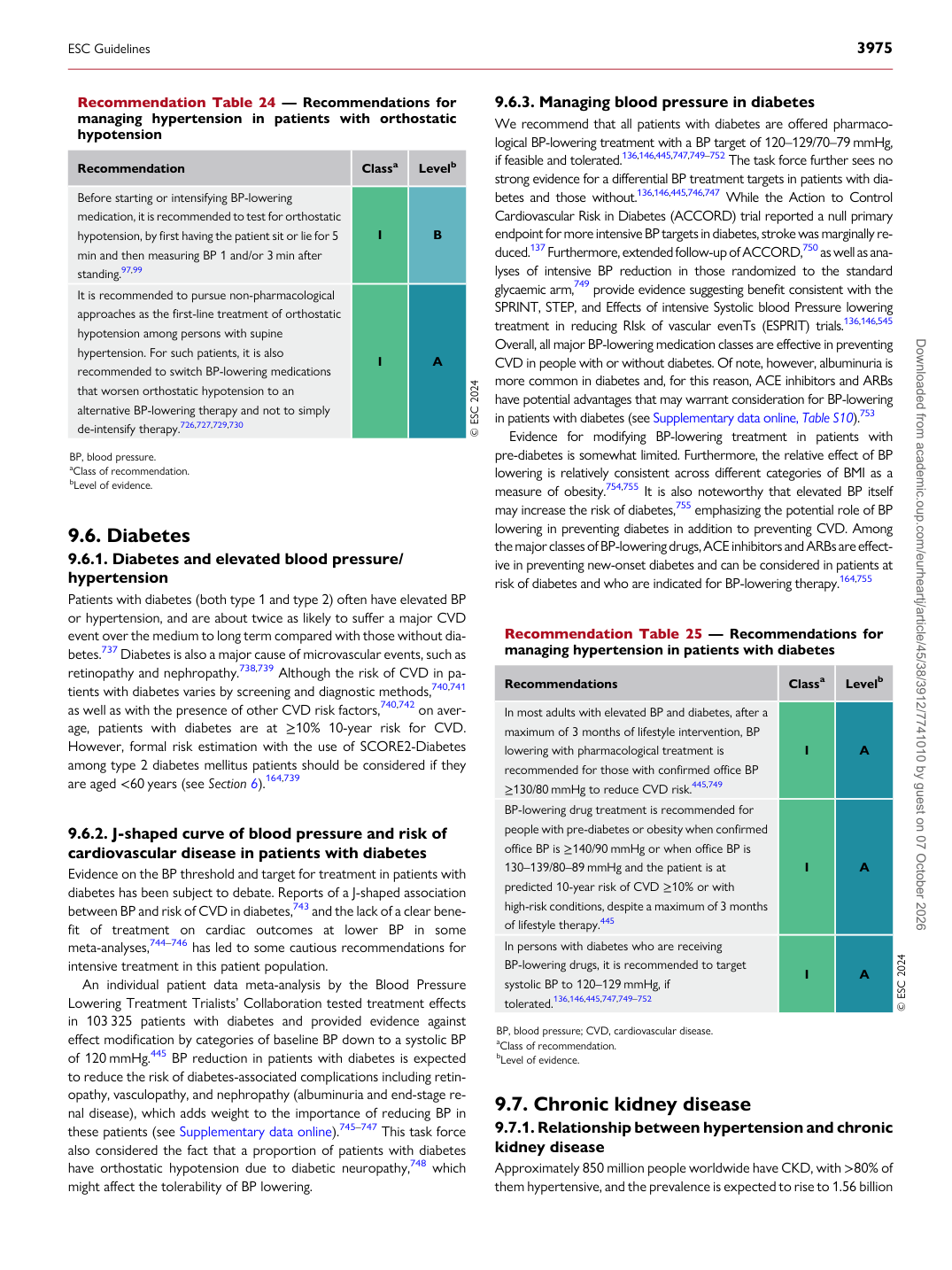
Recommendation Table 24 — Recommendations for managing hypertension in patients with orthostatic hypotension

Recommendation Classa Levelb

Before starting or intensifying BP-lowering medication, it is recommended to test for orthostatic hypotension, by first having the patient sit or lie for 5 min and then measuring BP 1 and/or 3 min after standing.97,99 I B It is recommended to pursue non-pharmacological approaches as the first-line treatment of orthostatic hypotension among persons with supine hypertension. For such patients, it is also recommended to switch BP-lowering medications that worsen orthostatic hypotension to an alternative BP-lowering therapy and not to simply de-intensify therapy.726,727,729,730 I A © ESC 2024

BP, blood pressure. aClass of recommendation. bLevel of evidence.

Recommendation Table 25 — Recommendations for managing hypertension in patients with diabetes

Recommendations Classa Levelb

In most adults with elevated BP and diabetes, after a maximum of 3 months of lifestyle intervention, BP lowering with pharmacological treatment is recommended for those with confirmed office BP ≥130/80 mmHg to reduce CVD risk.445,749 I A BP-lowering drug treatment is recommended for people with pre-diabetes or obesity when confirmed office BP is ≥140/90 mmHg or when office BP is 130–139/80–89 mmHg and the patient is at predicted 10-year risk of CVD ≥10% or with high-risk conditions, despite a maximum of 3 months of lifestyle therapy.445 I A In persons with diabetes who are receiving BP-lowering drugs, it is recommended to target systolic BP to 120–129 mmHg, if tolerated.136,146,445,747,749–752 I A © ESC 2024

BP, blood pressure; CVD, cardiovascular disease. aClass of recommendation. bLevel of evidence.

ESC Guidelines                                                                                                                                                                                          3975

Downloaded from academic.oup.com/eurheartj/article/45/38/3912/7741010 by guest on 07 October 2026