p.62 抽出テキスト
making should be a priority in the very old and frail. Together with management of BP, a major consideration should also be whether reversible causes of frailty can be addressed,609 e.g. by treating underlying comorbidities or undergoing supervised muscle-strengthening physiotherapy or supervised exercise and co-ordination and balance training.703

9.3.3 Starting blood pressure-lowering treatment in

very old or frail patients All patients must be fully informed about the benefits and risks of starting BP-lowering treatment, so that their preference is considered. Among 34 hypertension guidelines, 18 recommended 150 mmHg as the systolic goal in frailer and/or older patients, but four endorsed systolic targets <130 mmHg or <120 mmHg.704 Treatment can be started with a long-acting dihydropyridine calcium channel antagonist.596,705 To achieve BP control, an ACE inhibitor, or if contraindicated, an ARB, can also be used. Thereafter, low-dose thiazides or thiazide-like diuretics are preferred unless there is a specific contraindication, such as gout, orthostatic hypotension, or disturbed micturition (including micturition syncope).596,705 Beta-blockers are less desirable as they reduce heart rate, cause fatigue, and increase the systolic pulse wave amplitude, which is insufficiently buffered in stiff central elastic arteries. Vasodilating beta-blockers and direct vasodilators (e.g. hydralazine and minoxidil) are associated with increased risk of orthostasis. Though data are conflicting,706 alpha-blockers are also considered less desirable as they appear to be associated with an increased risk of orthostasis and falls in very old patients (aged ≥85 years).707,708 Alpha-1 blockers, such as doxazosin, prazosin, terazosin (also used to treat prostate symptoms), are particularly prone to causing orthostasis.98 Once the appropriate combination is found, a combination tablet with variable composition of two agents may optimize adherence. Starting with combination therapy is not advised in most very old and/or frail patients, unless BP is very high.

9.3.4 Maintaining blood pressure lowering in very old

or frail patients If very old and frail patients tolerate BP-lowering treatment well, there is no automatic need to deprescribe or discontinue treatment; however, this should be kept under review. In the case of progressive frailty, systolic BP tends to drop,709 such that deprescription of a BP-lowering drug might become necessary. To identify candidate drugs for deprescribing, a patient’s current medications should be reviewed to identify BP-lowering drugs that may have become contraindicated due to concomitant prescriptions or newly developed comorbidities.705 To help guide deprescription of BP-lowering agents, ABPM can be used to detect orthostatic hypotension or a highly variable BP not buffered by autonomic nervous reflexes.687,688 9.4 Isolated systolic and diastolic

hypertension 9.4.1. Definition of isolated systolic hypertension Isolated systolic hypertension is typically defined as systolic BP of ≥140 mmHg with a diastolic BP of <90 mmHg. While isolated systolic hypertension is uncommon in younger patients,713 it is the most common type of hypertension in older patients; >80% of untreated patients with hypertension aged >60 years have isolated systolic hypertension.714

9.4.2 Isolated systolic hypertension, risk factors, and

ageing Systolic BP increases with age in men and women until the eighth decade of life, while diastolic BP gradually increases up until the fifth or sixth decade of life, after which it either plateaus or decreases. As a result, the pulse pressure (the difference between the systolic and diastolic BP) gradually widens from middle age.34 These BP changes are related to increased aortic stiffening with age.715,716 Since most older patients with hypertension have isolated systolic hypertension, and since with advancing age, risk of CVD events is driven by systolic rather than diastolic BP,717 management of isolated systolic hypertension in older adults is broadly in line with that of combined systolic-diastolic hypertension seen in younger adults.718 Early isolated

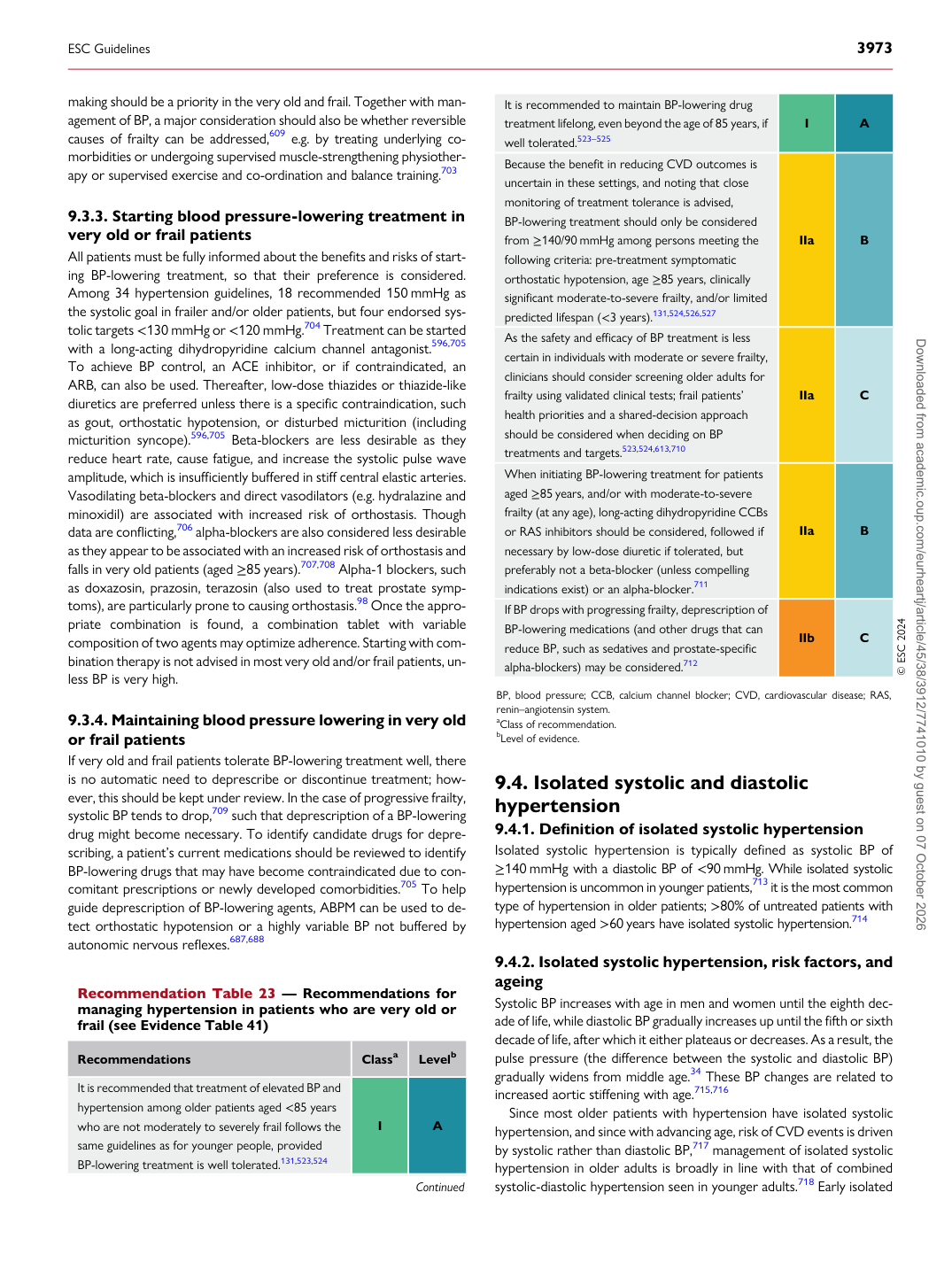
Recommendation Table 23 — Recommendations for managing hypertension in patients who are very old or frail (see Evidence Table 41)

Recommendations Classa Levelb

It is recommended that treatment of elevated BP and hypertension among older patients aged <85 years who are not moderately to severely frail follows the same guidelines as for younger people, provided BP-lowering treatment is well tolerated.131,523,524 I A

Continued It is recommended to maintain BP-lowering drug

treatment lifelong, even beyond the age of 85 years, if well tolerated.523–525 I A Because the benefit in reducing CVD outcomes is uncertain in these settings, and noting that close monitoring of treatment tolerance is advised, BP-lowering treatment should only be considered from ≥140/90 mmHg among persons meeting the following criteria: pre-treatment symptomatic orthostatic hypotension, age ≥85 years, clinically significant moderate-to-severe frailty, and/or limited predicted lifespan (<3 years).131,524,526,527 IIa B As the safety and efficacy of BP treatment is less certain in individuals with moderate or severe frailty, clinicians should consider screening older adults for frailty using validated clinical tests; frail patients’ health priorities and a shared-decision approach should be considered when deciding on BP treatments and targets.523,524,613,710 IIa C When initiating BP-lowering treatment for patients aged ≥85 years, and/or with moderate-to-severe frailty (at any age), long-acting dihydropyridine CCBs or RAS inhibitors should be considered, followed if necessary by low-dose diuretic if tolerated, but preferably not a beta-blocker (unless compelling indications exist) or an alpha-blocker.711 IIa B If BP drops with progressing frailty, deprescription of BP-lowering medications (and other drugs that can reduce BP, such as sedatives and prostate-specific alpha-blockers) may be considered.712 IIb C © ESC 2024

BP, blood pressure; CCB, calcium channel blocker; CVD, cardiovascular disease; RAS, renin–angiotensin system. aClass of recommendation. bLevel of evidence.

ESC Guidelines                                                                                                                                                                                          3973

Downloaded from academic.oup.com/eurheartj/article/45/38/3912/7741010 by guest on 07 October 2026