p.61 抽出テキスト
9.3.2 Randomized controlled trials of blood pressure

lowering in frail older patients Few adults aged ≥85 years have been included in trials.131 In addition, generalizing data from RCTs to very frail patients may not be possible.692,694–697 However, the currently available evidence from RCTs has not demonstrated weakening of the benefits of BP-lowering treatment (i.e. no effect modification) among frailer patients enrolled in these trials, although these participants likely had no more than mild frailty (see Supplementary data online).523,694,698 In the absence of robust randomized evidence, several observational studies have suggested that lowering BP might not be warranted or even be harmful in patients with significant frailty or multimorbidity, particularly when BP is not very high. For instance, a systematic review and meta-analysis of non-randomized studies that investigated associations between BP and risk of mortality in older patients found evidence for interaction by frailty status, suggesting that lowering BP might be harmful in this patient group.699 However, as noted above and in Section 9.8, these observational J-curve findings are unreliable when guiding clinical care, as unidentified biases potentially confound the results. For instance, in addition to reverse causality, stiffness of the large arteries is associated with both low diastolic BP and increased mortality.697 In addition, absolute CVD risk increases with age, indicating that fewer older than younger patients with hypertension may need to be treated to prevent one adverse health outcome.700

Therefore, given the totality of evidence from clinical trials,523,694,701,702 very old and frail patients with hypertension should not be denied the potential benefits of BP-lowering treatment down to a target of 120–129/70–79 mmHg. However, personalized decision-

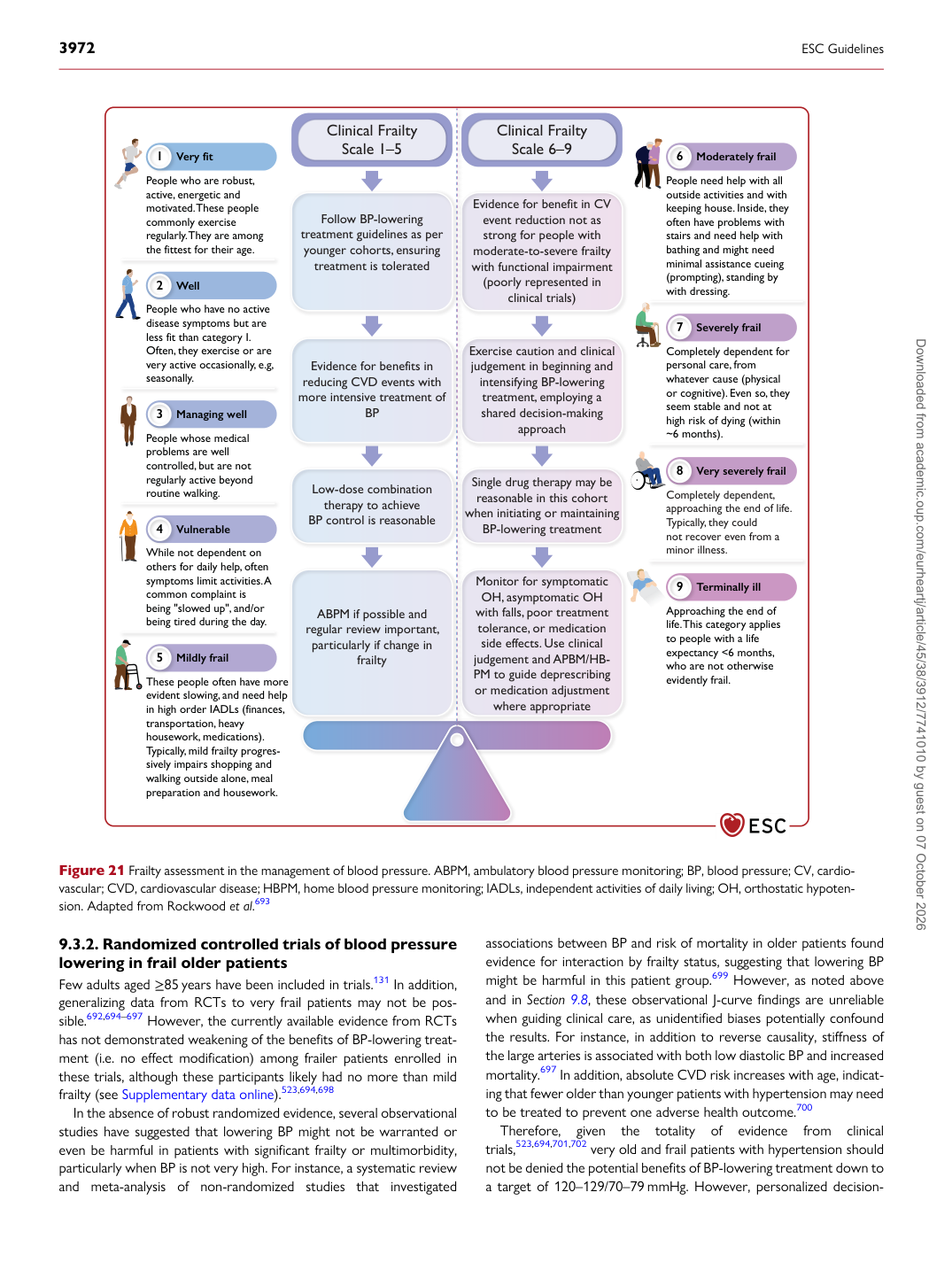
Very fit 1 People who are robust, active, energetic and motivated. These people commonly exercise regularly. They are among the fittest for their age. Follow BP-lowering treatment guidelines as per

younger cohorts, ensuring

treatment is tolerated Evidence for benefit in CV

event reduction not as strong for people with moderate-to-severe frailty with functional impairment

(poorly represented in

clinical trials)

Evidence for benefits in reducing CVD events with more intensive treatment of

BP Exercise caution and clinical

judgement in beginning and

intensifying BP-lowering treatment, employing a shared decision-making

approach

Low-dose combination therapy to achieve BP control is reasonable Single drug therapy may be

reasonable in this cohort when initiating or maintaining

BP-lowering treatment

ABPM if possible and regular review important, particularly if change in

frailty Monitor for symptomatic

OH, asymptomatic OH with falls, poor treatment tolerance, or medication side effects. Use clinical judgement and APBM/HB- PM to guide deprescribing or medication adjustment

where appropriate

Well 2 People who have no active disease symptoms but are less fit than category I. Often, they exercise or are very active occasionally, e.g, seasonally.

Managing well 3 People whose medical problems are well controlled, but are not regularly active beyond routine walking.

Vulnerable 4 While not dependent on others for daily help, often symptoms limit activities. A common complaint is being "slowed up", and/or being tired during the day.

Mildly frail 5 These people often have more evident slowing, and need help in high order IADLs (finances, transportation, heavy housework, medications). Typically, mild frailty progressively impairs shopping and walking outside alone, meal preparation and housework. Moderately frail 6

People need help with all outside activities and with keeping house. Inside, they often have problems with stairs and need help with bathing and might need minimal assistance cueing (prompting), standing by with dressing.

Severely frail 7 Completely dependent for personal care, from whatever cause (physical or cognitive). Even so, they seem stable and not at high risk of dying (within ~6 months).

Very severely frail 8 Completely dependent, approaching the end of life. Typically, they could not recover even from a minor illness.

Terminally ill 9 Approaching the end of life. This category applies to people with a life expectancy <6 months, who are not otherwise evidently frail.

Clinical Frailty

Scale 1–5 Clinical Frailty

Scale 6–9

Figure 21 Frailty assessment in the management of blood pressure. ABPM, ambulatory blood pressure monitoring; BP, blood pressure; CV, cardiovascular; CVD, cardiovascular disease; HBPM, home blood pressure monitoring; IADLs, independent activities of daily living; OH, orthostatic hypotension. Adapted from Rockwood et al.693 Downloaded from academic.oup.com/eurheartj/article/45/38/3912/7741010 by guest on 07 October 2026