p.60 抽出テキスト
Hydralazine can be particularly effective for severe hypertension in pregnancy and can be administered intravenously in hypertensive admissions (Section 10).666–668 While thiazide diuretics in pregnancy have limited safety data and should be used with caution, other diuretics such as furosemide are not contraindicated and may be necessary in some situations (see Supplementary data online).669

9.2.8 Managing severe hypertension in pregnancy

(>160/110 mmHg) Acute onset of severe hypertension persisting for more than 15 min is considered a hypertensive emergency in pregnancy and is covered in Section 10.4.2.

9.2.9 Managing blood pressure post-partum

For women with hypertension during pregnancy, BP should be measured within 6 h of delivery and, if possible, daily for at least a week after discharge from the hospital.637 Post-partum hypertension is common in the first week and associated with prolonged hospitalization.670 Women with hypertension in pregnancy are at increased risk of chronic hypertension,671 CKD,672 and CVD.177,223,640 The relative risk of chronic hypertension is highest in the first 6 months following delivery, motivating regular screening in these women.673 Women with gestational hypertension, especially those with pre-eclampsia, have higher risk of masked hypertension.674 BP measurements, ideally including out-of-office measurements, urine analyses, and CVD risk assessment, should at least be performed 6–12 weeks, 6 months, and 12 months post-partum and, after that, annually. Recent data indicate the potential utility of self-monitoring of BP during the busy early postpartum period.675 All BP-lowering drugs are excreted into breast milk.637 Except for propranolol, atenolol, acebutolol, and nifedipine, most drugs are excreted in very low concentrations in breast milk (see Supplementary data online, Table S11).637

9.2.10 Risk of recurrence of hypertensive disorders

in a subsequent pregnancy About 20%–30% of women with hypertensive disorders in a previous pregnancy will experience recurrence in a subsequent pregnancy.676,677 The earlier the onset of hypertension in the first pregnancy, the higher the risk of recurrence in a subsequent pregnancy.677 Further details on managing hypertension and other cardiovascular disorders in pregnancy are available elsewhere.89,637 9.3. Very old age (≥85 years), frailty, multimorbidity, and polypharmacy 9.3.1. Definition of frailty The most common definition of frailty is an age-associated, biological syndrome characterized by decreased biological reserves, due to dysregulation of several physiological systems.682 This puts an individual at risk when facing physiological stressors, and is associated with poor outcomes, such as disability, hospitalization, and death.683 The estimated prevalence of frailty in people aged >65 years is 7%–16% and is greater in women than in men.684,685 Although the main determinant of frailty is age, chronological age must be differentiated from biological age.686 An older patient can be fit and robust while a multimorbid young patient can be frail. Using multiple drugs may have more unpredictable effects on BP in older patients, because of increased competition for underlying mechanisms responsible for their degradation and elimination, and because the ability of the baro-687 and chemo-reflex688

systems in maintaining a steady treated BP level can decline with ageing. With respect to BP, two issues compound interpretation of the frailty literature. First, frailty on its own is a strong predictor of mortality and cardiovascular complications689 and is accompanied by a decrease in systolic BP.690 This raises the issue of the so-called BP J-curve (see Section 9.8) and reverse causality, with frailty rather than excessive BP lowering being the root cause of adverse health outcomes. Only properly randomized and controlled clinical trials can differentiate between the effects of frailty vs. overly intensive BP-lowering treatment, but unfortunately, few BP-lowering trials have included a substantial proportion of frail patients. Second, there is no consensus on how to grade frailty in day-to-day clinical practice.606 Complex frailty scales exist for application in research,523,691 but unless they are electronically generated,692 they are typically not practical in routine clinical care. Nonetheless, the clinical frailty scale (Figure 21) is intuitive and easy to administer and has been validated against 5-year risk of death.596,693

Recommendation Table 22 — Recommendations for managing hypertension in pregnancy (see Evidence Tables 38–40)

Recommendations Classa Levelb

In women with gestational hypertension, starting drug treatment is recommended for those with confirmed office systolic BP ≥140 mmHg or diastolic BP ≥90 mmHg.661 I B In pregnant women with chronic hypertension, starting drug treatment is recommended for those with confirmed office systolic BP ≥140 mmHg or diastolic BP ≥90 mmHg.88,660,661,678 I B

Continued In women with chronic and gestational hypertension,

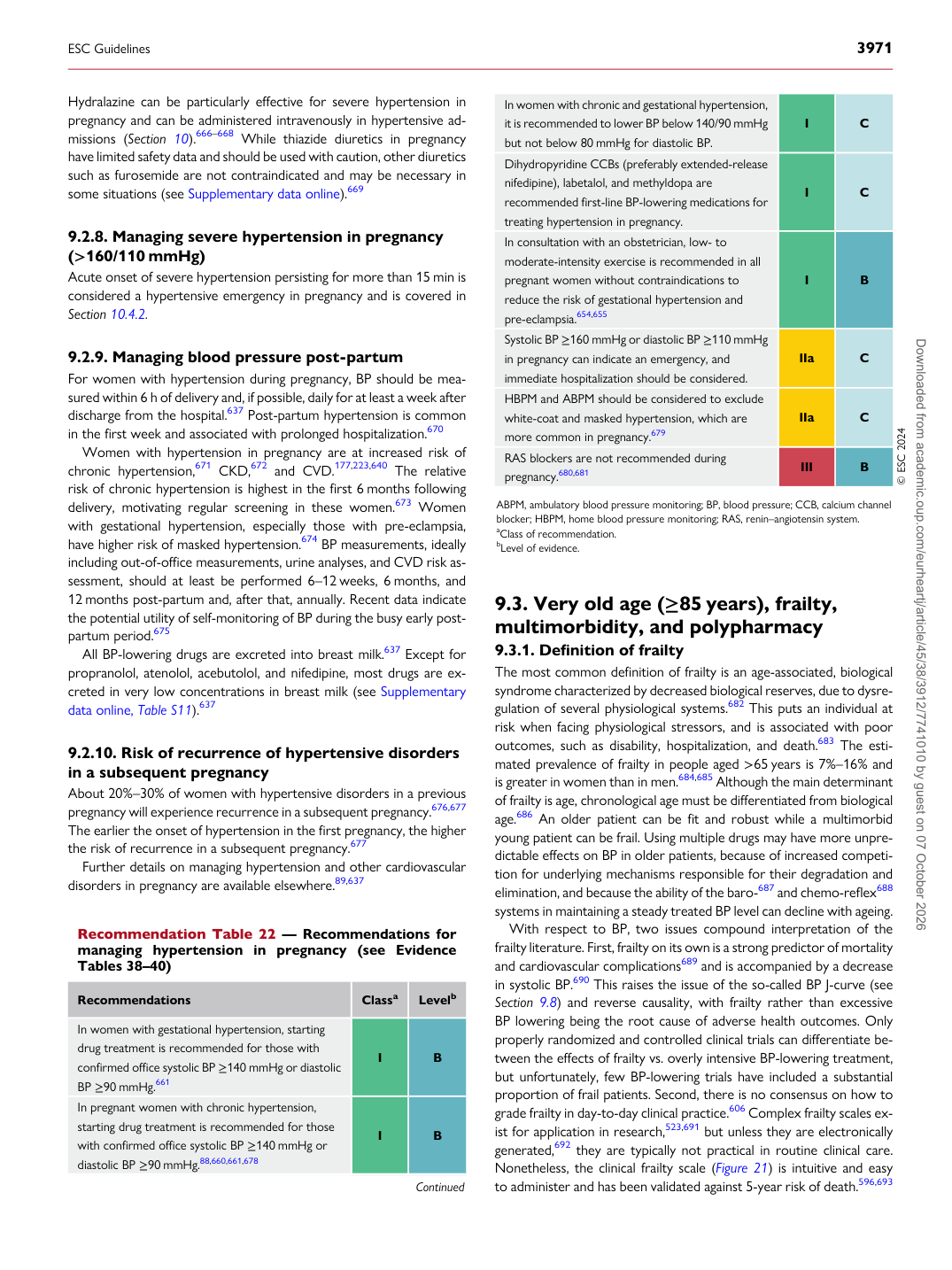
it is recommended to lower BP below 140/90 mmHg but not below 80 mmHg for diastolic BP. I C Dihydropyridine CCBs (preferably extended-release nifedipine), labetalol, and methyldopa are recommended first-line BP-lowering medications for treating hypertension in pregnancy. I C In consultation with an obstetrician, low- to moderate-intensity exercise is recommended in all pregnant women without contraindications to reduce the risk of gestational hypertension and pre-eclampsia.654,655 I B Systolic BP ≥160 mmHg or diastolic BP ≥110 mmHg in pregnancy can indicate an emergency, and immediate hospitalization should be considered. IIa C HBPM and ABPM should be considered to exclude white-coat and masked hypertension, which are more common in pregnancy.679 IIa C RAS blockers are not recommended during pregnancy.680,681 III B © ESC 2024

ABPM, ambulatory blood pressure monitoring; BP, blood pressure; CCB, calcium channel blocker; HBPM, home blood pressure monitoring; RAS, renin–angiotensin system. aClass of recommendation. bLevel of evidence.

ESC Guidelines                                                                                                                                                                                          3971

Downloaded from academic.oup.com/eurheartj/article/45/38/3912/7741010 by guest on 07 October 2026