p.58 抽出テキスト
9 Managing specific patient groups

or circumstances

9.1 Young adulthood (18–40 years)

9.1.1. Definition and epidemiology In the present guidelines ‘young adulthood’ is defined as age 18–40 years. The prevalence of hypertension in young adults is increasing in men and women.616–618 Unhealthy lifestyle, gender, obesity, and socio-economic factors contribute.617,619–621 Hypertension-attributable CVD burden in young adults, evaluated as mortality or years of living with disability, has increased in the last decades, especially in low- and middle-income countries and in men.622 Hypertension awareness, treatment, and control in young adults is lower than in other age categories, a result driven by worse control in young men.623 Systolic and diastolic hypertension and isolated diastolic hypertension are associated with increased CVD risk in the young (see Supplementary data online).624 Isolated systolic hypertension in the young is discussed in Section 9.4.

9.1.2 Secondary hypertension in young adulthood

Secondary hypertension is more frequent in younger than in lateronset hypertension, with a prevalence of 15%–30% in hypertensive young adults reported from some referral centres.625,626 Major causes of secondary hypertension include drug-induced hypertension (e.g. oestrogen-progesterone oral contraceptives; cold medication) and primary aldosteronism. The use of recreational drugs/substances, as well as supplements and energy drinks should be investigated (see Section 7). Combined oestrogen-progesterone contraceptives are among the most common causes of drug-induced hypertension in young women,627,628 and should not be used in hypertensive women unless there is no other method available or acceptable to the patient.629 Conversely, progestin-only contraceptives are generally considered safe in women with hypertension.89,630,631 Fibromuscular dysplasia should be considered as a cause of secondary hypertension in young women,626,632 whereas primary aldosteronism, the most common form of secondary hypertension, is equally common in different age classes.316 Screening for secondary hypertension is thus recommended in young adults with hypertension. However, in obese young adults, primary hypertension is more common, though OSAS should also be considered in this instance.633

9.1.3 Measurement and management of blood

pressure in young adults Out-of-office BP measurement is recommended in young adults for confirming diagnosis, since the white-coat phenomenon occurs in the young.634 Because of the lower absolute CVD risk in this age category compared with older adults, hard-endpoint randomized trials of BP lowering in young adults have not been performed. However, since relative risk reduction by BP-lowering treatment is homogeneous in any age group, including those <55 years old,131 young adults with suitable indications are also expected to benefit from BP-lowering therapy. The hypertension management algorithm based on CVD risk proposed in Section 6 is not fully applicable in young adults, since SCORE2 has not been validated for individuals <40 years old. Even risk stratification based on lifetime risk assessment does not apply to very young adults (e.g. 20–30 years of age).128 In the absence of established CVD, diabetes mellitus, familial hypercholesterolaemia, and moderate or severe CKD a BP-lowering treatment initiation threshold of office 140/90 mmHg is appropriate in most young adults. However, HMOD assessment may be considered in patients aged <40 years to stratify individuals with elevated BP into a higher risk category. For example, arterial stiffness better reclassifies CVD risk in individuals aged <50 years than in older individuals.28,215 Echocardiographic left ventricular mass also maintains its added reclassification and discrimination on top of risk scores in young adults (see Section 6 for discussion of risk modifiers).289

Irrespective of cardiovascular risk, all young adults with elevated BP are recommended to follow lifestyle guidance for BP lowering. A discussion about family planning should be taken with young women of childbearing potential at each visit.635,636 Adherence to treatment is low in young adults, <50% in some studies.251 Therefore, communicating the importance of adherence, education, and follow-up clinics is important. (see Sections 7 and 11).

9.2 Pregnancy

9.2.1. Definition and epidemiology Hypertension in pregnancy is typically defined as systolic BP of ≥140 mmHg and/or diastolic BP of ≥90 mmHg, measured using repeated BP readings in the office or hospital on two separate occasions or ≥15 min apart in severe hypertension (≥160/110 mmHg).1,637,638 Hypertension in pregnancy is the second leading cause of maternal death after maternal peri-partum haemorrhage.639 Approximately 7% of pregnancies are complicated by hypertension, of which 3% are due to pre-eclampsia and around 1% are chronic or pre-existing hypertension.640 Women with a history of hypertensive disorders during pregnancy are at increased risk of subsequent hypertension and CVD.640–642

9.2.2 Classifying hypertension in pregnancy

Hypertension in pregnancy includes: • Chronic hypertension: precedes pregnancy, develops before 20 weeks of gestation, persists for >6 weeks post-partum, and may be associated with proteinuria. • Gestational hypertension: develops after 20 weeks of gestation and usually resolves within 6 weeks post-partum.

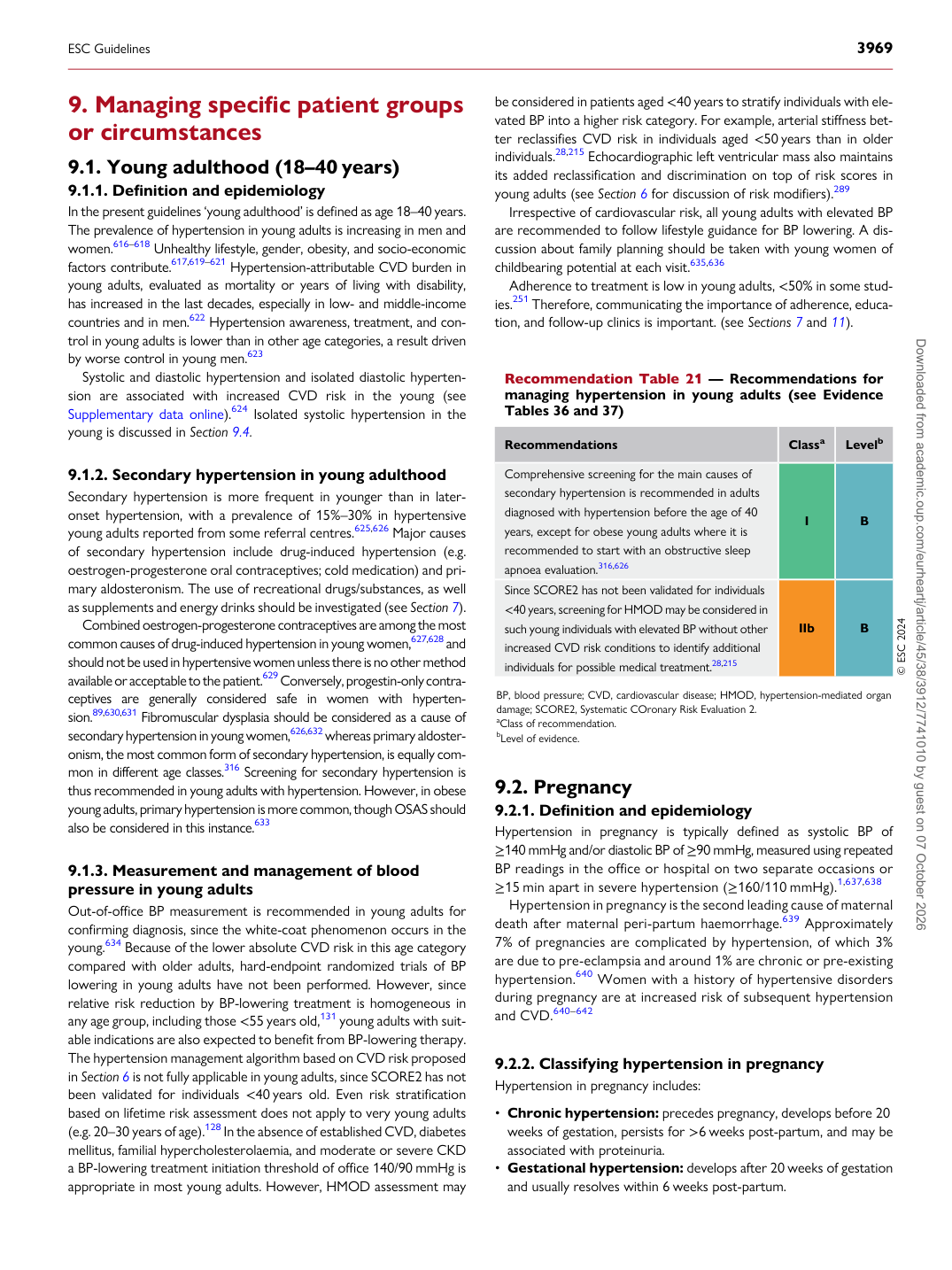
Recommendation Table 21 — Recommendations for managing hypertension in young adults (see Evidence Tables 36 and 37)

Recommendations Classa Levelb

Comprehensive screening for the main causes of secondary hypertension is recommended in adults diagnosed with hypertension before the age of 40 years, except for obese young adults where it is recommended to start with an obstructive sleep apnoea evaluation.316,626 I B Since SCORE2 has not been validated for individuals <40 years, screening for HMOD may be considered in such young individuals with elevated BP without other increased CVD risk conditions to identify additional individuals for possible medical treatment.28,215 IIb B © ESC 2024

BP, blood pressure; CVD, cardiovascular disease; HMOD, hypertension-mediated organ damage; SCORE2, Systematic COronary Risk Evaluation 2. aClass of recommendation. bLevel of evidence.

ESC Guidelines                                                                                                                                                                                          3969

Downloaded from academic.oup.com/eurheartj/article/45/38/3912/7741010 by guest on 07 October 2026