p.56 抽出テキスト
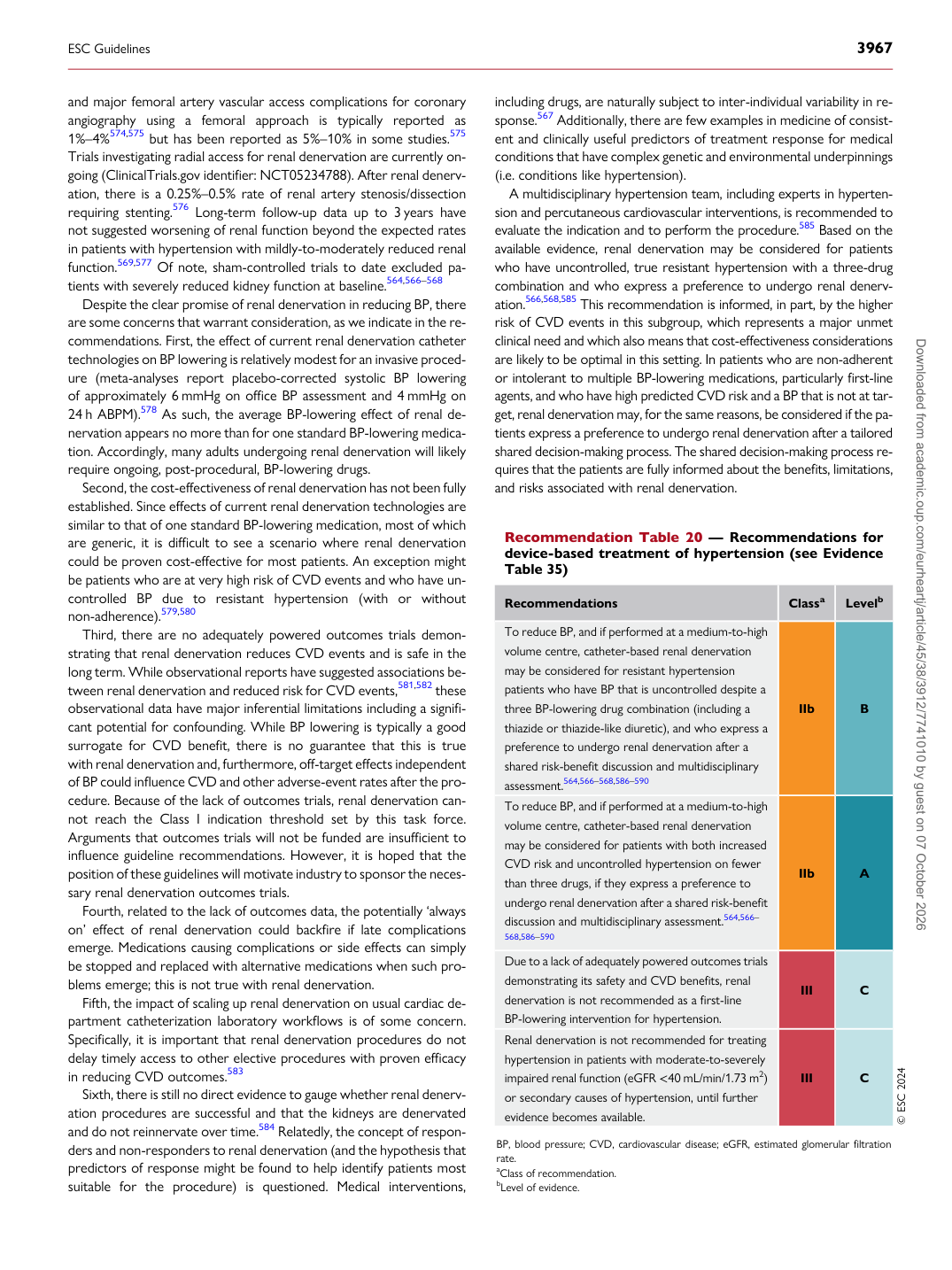
and major femoral artery vascular access complications for coronary angiography using a femoral approach is typically reported as 1%–4%574,575 but has been reported as 5%–10% in some studies.575 Trials investigating radial access for renal denervation are currently ongoing (ClinicalTrials.gov identifier: NCT05234788). After renal denervation, there is a 0.25%–0.5% rate of renal artery stenosis/dissection requiring stenting.576 Long-term follow-up data up to 3 years have not suggested worsening of renal function beyond the expected rates in patients with hypertension with mildly-to-moderately reduced renal function.569,577 Of note, sham-controlled trials to date excluded patients with severely reduced kidney function at baseline.564,566–568 Despite the clear promise of renal denervation in reducing BP, there are some concerns that warrant consideration, as we indicate in the recommendations. First, the effect of current renal denervation catheter technologies on BP lowering is relatively modest for an invasive procedure (meta-analyses report placebo-corrected systolic BP lowering of approximately 6 mmHg on office BP assessment and 4 mmHg on 24 h ABPM).578 As such, the average BP-lowering effect of renal denervation appears no more than for one standard BP-lowering medication. Accordingly, many adults undergoing renal denervation will likely require ongoing, post-procedural, BP-lowering drugs. Second, the cost-effectiveness of renal denervation has not been fully established. Since effects of current renal denervation technologies are similar to that of one standard BP-lowering medication, most of which are generic, it is difficult to see a scenario where renal denervation could be proven cost-effective for most patients. An exception might be patients who are at very high risk of CVD events and who have uncontrolled BP due to resistant hypertension (with or without non-adherence).579,580 Third, there are no adequately powered outcomes trials demonstrating that renal denervation reduces CVD events and is safe in the long term. While observational reports have suggested associations between renal denervation and reduced risk for CVD events,581,582 these observational data have major inferential limitations including a significant potential for confounding. While BP lowering is typically a good surrogate for CVD benefit, there is no guarantee that this is true with renal denervation and, furthermore, off-target effects independent of BP could influence CVD and other adverse-event rates after the procedure. Because of the lack of outcomes trials, renal denervation cannot reach the Class I indication threshold set by this task force. Arguments that outcomes trials will not be funded are insufficient to influence guideline recommendations. However, it is hoped that the position of these guidelines will motivate industry to sponsor the necessary renal denervation outcomes trials. Fourth, related to the lack of outcomes data, the potentially ‘always on’ effect of renal denervation could backfire if late complications emerge. Medications causing complications or side effects can simply be stopped and replaced with alternative medications when such problems emerge; this is not true with renal denervation. Fifth, the impact of scaling up renal denervation on usual cardiac department catheterization laboratory workflows is of some concern. Specifically, it is important that renal denervation procedures do not delay timely access to other elective procedures with proven efficacy in reducing CVD outcomes.583 Sixth, there is still no direct evidence to gauge whether renal denervation procedures are successful and that the kidneys are denervated and do not reinnervate over time.584 Relatedly, the concept of responders and non-responders to renal denervation (and the hypothesis that predictors of response might be found to help identify patients most suitable for the procedure) is questioned. Medical interventions, including drugs, are naturally subject to inter-individual variability in response.567 Additionally, there are few examples in medicine of consistent and clinically useful predictors of treatment response for medical conditions that have complex genetic and environmental underpinnings (i.e. conditions like hypertension).

A multidisciplinary hypertension team, including experts in hypertension and percutaneous cardiovascular interventions, is recommended to evaluate the indication and to perform the procedure.585 Based on the available evidence, renal denervation may be considered for patients who have uncontrolled, true resistant hypertension with a three-drug combination and who express a preference to undergo renal denervation.566,568,585 This recommendation is informed, in part, by the higher risk of CVD events in this subgroup, which represents a major unmet clinical need and which also means that cost-effectiveness considerations are likely to be optimal in this setting. In patients who are non-adherent or intolerant to multiple BP-lowering medications, particularly first-line agents, and who have high predicted CVD risk and a BP that is not at target, renal denervation may, for the same reasons, be considered if the patients express a preference to undergo renal denervation after a tailored shared decision-making process. The shared decision-making process requires that the patients are fully informed about the benefits, limitations, and risks associated with renal denervation.

Recommendation Table 20 — Recommendations for device-based treatment of hypertension (see Evidence Table 35)

Recommendations Classa Levelb

To reduce BP, and if performed at a medium-to-high volume centre, catheter-based renal denervation may be considered for resistant hypertension patients who have BP that is uncontrolled despite a three BP-lowering drug combination (including a thiazide or thiazide-like diuretic), and who express a preference to undergo renal denervation after a shared risk-benefit discussion and multidisciplinary assessment.564,566–568,586–590 IIb B To reduce BP, and if performed at a medium-to-high volume centre, catheter-based renal denervation may be considered for patients with both increased CVD risk and uncontrolled hypertension on fewer than three drugs, if they express a preference to undergo renal denervation after a shared risk-benefit discussion and multidisciplinary assessment.564,566– 568,586–590 IIb A

Due to a lack of adequately powered outcomes trials demonstrating its safety and CVD benefits, renal denervation is not recommended as a first-line BP-lowering intervention for hypertension. III C Renal denervation is not recommended for treating hypertension in patients with moderate-to-severely impaired renal function (eGFR <40 mL/min/1.73 m2) or secondary causes of hypertension, until further evidence becomes available. III C © ESC 2024

BP, blood pressure; CVD, cardiovascular disease; eGFR, estimated glomerular filtration rate. aClass of recommendation. bLevel of evidence.

ESC Guidelines                                                                                                                                                                                          3967

Downloaded from academic.oup.com/eurheartj/article/45/38/3912/7741010 by guest on 07 October 2026