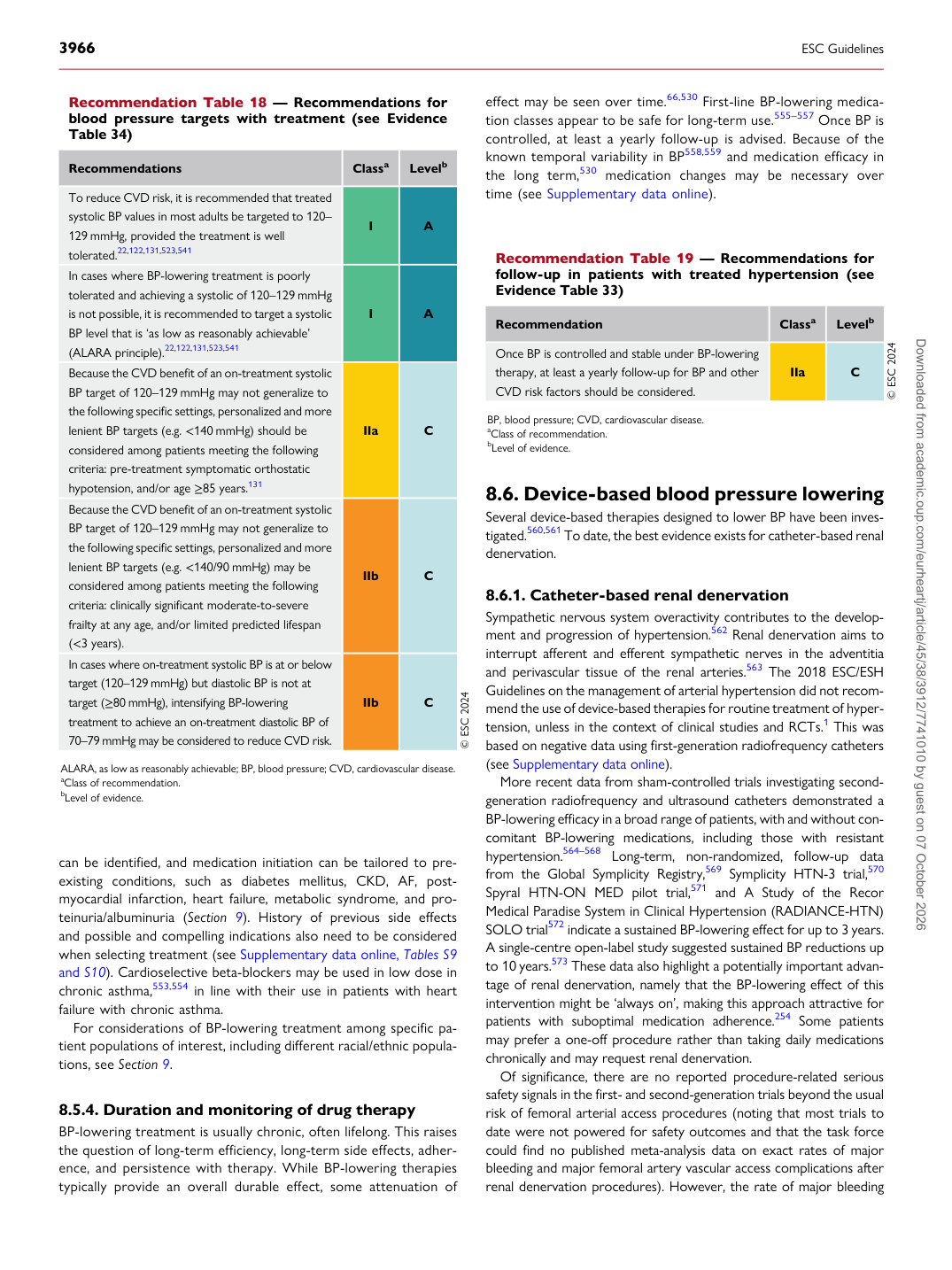
p.55 抽出テキスト
can be identified, and medication initiation can be tailored to preexisting conditions, such as diabetes mellitus, CKD, AF, postmyocardial infarction, heart failure, metabolic syndrome, and proteinuria/albuminuria (Section 9). History of previous side effects and possible and compelling indications also need to be considered when selecting treatment (see Supplementary data online, Tables S9 and S10). Cardioselective beta-blockers may be used in low dose in chronic asthma,553,554 in line with their use in patients with heart failure with chronic asthma. For considerations of BP-lowering treatment among specific patient populations of interest, including different racial/ethnic populations, see Section 9.

8.5.4 Duration and monitoring of drug therapy

BP-lowering treatment is usually chronic, often lifelong. This raises the question of long-term efficiency, long-term side effects, adherence, and persistence with therapy. While BP-lowering therapies typically provide an overall durable effect, some attenuation of effect may be seen over time.66,530 First-line BP-lowering medication classes appear to be safe for long-term use.555–557 Once BP is controlled, at least a yearly follow-up is advised. Because of the known temporal variability in BP558,559 and medication efficacy in the long term,530 medication changes may be necessary over time (see Supplementary data online).

8.6 Device-based blood pressure lowering

Several device-based therapies designed to lower BP have been investigated.560,561 To date, the best evidence exists for catheter-based renal denervation.

8.6.1 Catheter-based renal denervation

Sympathetic nervous system overactivity contributes to the development and progression of hypertension.562 Renal denervation aims to interrupt afferent and efferent sympathetic nerves in the adventitia and perivascular tissue of the renal arteries.563 The 2018 ESC/ESH Guidelines on the management of arterial hypertension did not recommend the use of device-based therapies for routine treatment of hypertension, unless in the context of clinical studies and RCTs.1 This was based on negative data using first-generation radiofrequency catheters (see Supplementary data online). More recent data from sham-controlled trials investigating secondgeneration radiofrequency and ultrasound catheters demonstrated a BP-lowering efficacy in a broad range of patients, with and without concomitant BP-lowering medications, including those with resistant hypertension.564–568 Long-term, non-randomized, follow-up data from the Global Symplicity Registry,569 Symplicity HTN-3 trial,570 Spyral HTN-ON MED pilot trial,571 and A Study of the Recor Medical Paradise System in Clinical Hypertension (RADIANCE-HTN) SOLO trial572 indicate a sustained BP-lowering effect for up to 3 years. A single-centre open-label study suggested sustained BP reductions up to 10 years.573 These data also highlight a potentially important advantage of renal denervation, namely that the BP-lowering effect of this intervention might be ‘always on’, making this approach attractive for patients with suboptimal medication adherence.254 Some patients may prefer a one-off procedure rather than taking daily medications chronically and may request renal denervation. Of significance, there are no reported procedure-related serious safety signals in the first- and second-generation trials beyond the usual risk of femoral arterial access procedures (noting that most trials to date were not powered for safety outcomes and that the task force could find no published meta-analysis data on exact rates of major bleeding and major femoral artery vascular access complications after renal denervation procedures). However, the rate of major bleeding

Recommendation Table 18 — Recommendations for blood pressure targets with treatment (see Evidence Table 34)

Recommendations Classa Levelb

To reduce CVD risk, it is recommended that treated systolic BP values in most adults be targeted to 120– 129 mmHg, provided the treatment is well tolerated.22,122,131,523,541 I A In cases where BP-lowering treatment is poorly tolerated and achieving a systolic of 120–129 mmHg is not possible, it is recommended to target a systolic BP level that is ‘as low as reasonably achievable’ (ALARA principle).22,122,131,523,541 I A Because the CVD benefit of an on-treatment systolic BP target of 120–129 mmHg may not generalize to the following specific settings, personalized and more lenient BP targets (e.g. <140 mmHg) should be considered among patients meeting the following criteria: pre-treatment symptomatic orthostatic hypotension, and/or age ≥85 years.131 IIa C Because the CVD benefit of an on-treatment systolic BP target of 120–129 mmHg may not generalize to the following specific settings, personalized and more lenient BP targets (e.g. <140/90 mmHg) may be considered among patients meeting the following criteria: clinically significant moderate-to-severe frailty at any age, and/or limited predicted lifespan (<3 years). IIb C In cases where on-treatment systolic BP is at or below target (120–129 mmHg) but diastolic BP is not at target (≥80 mmHg), intensifying BP-lowering treatment to achieve an on-treatment diastolic BP of 70–79 mmHg may be considered to reduce CVD risk. IIb C © ESC 2024

ALARA, as low as reasonably achievable; BP, blood pressure; CVD, cardiovascular disease. aClass of recommendation. bLevel of evidence. Recommendation Table 19 — Recommendations for follow-up in patients with treated hypertension (see Evidence Table 33)

Recommendation Classa Levelb

Once BP is controlled and stable under BP-lowering therapy, at least a yearly follow-up for BP and other CVD risk factors should be considered. IIa C © ESC 2024

BP, blood pressure; CVD, cardiovascular disease. aClass of recommendation. bLevel of evidence. Downloaded from academic.oup.com/eurheartj/article/45/38/3912/7741010 by guest on 07 October 2026