p.54 抽出テキスト
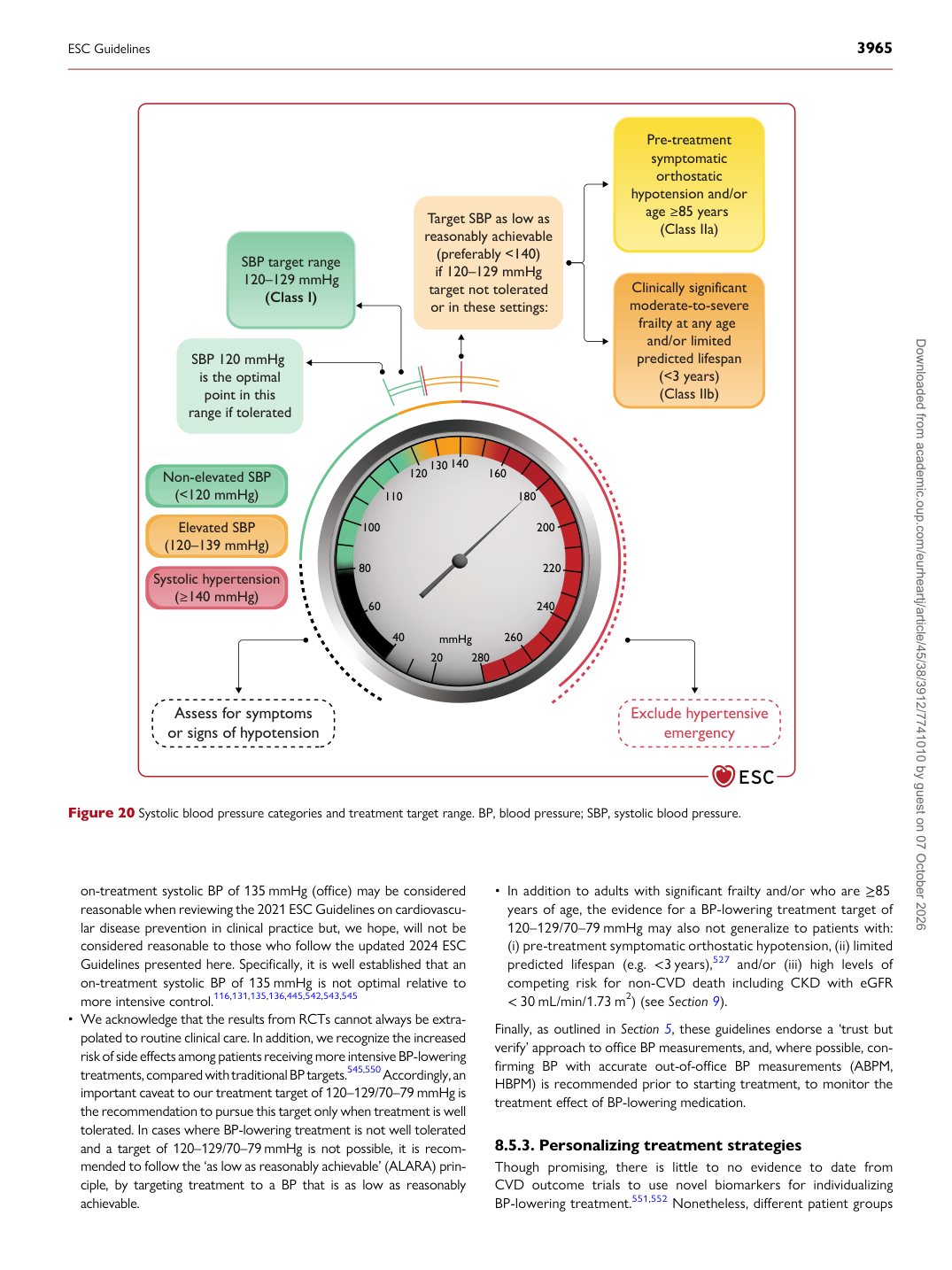
on-treatment systolic BP of 135 mmHg (office) may be considered reasonable when reviewing the 2021 ESC Guidelines on cardiovascular disease prevention in clinical practice but, we hope, will not be considered reasonable to those who follow the updated 2024 ESC Guidelines presented here. Specifically, it is well established that an on-treatment systolic BP of 135 mmHg is not optimal relative to more intensive control.116,131,135,136,445,542,543,545 • We acknowledge that the results from RCTs cannot always be extrapolated to routine clinical care. In addition, we recognize the increased risk of side effects among patients receiving more intensive BP-lowering treatments, compared with traditional BP targets.545,550 Accordingly, an important caveat to our treatment target of 120–129/70–79 mmHg is the recommendation to pursue this target only when treatment is well tolerated. In cases where BP-lowering treatment is not well tolerated and a target of 120–129/70–79 mmHg is not possible, it is recommended to follow the ‘as low as reasonably achievable’ (ALARA) principle, by targeting treatment to a BP that is as low as reasonably achievable. • In addition to adults with significant frailty and/or who are ≥85 years of age, the evidence for a BP-lowering treatment target of 120–129/70–79 mmHg may also not generalize to patients with: (i) pre-treatment symptomatic orthostatic hypotension, (ii) limited predicted lifespan (e.g. <3 years),527 and/or (iii) high levels of competing risk for non-CVD death including CKD with eGFR < 30 mL/min/1.73 m2) (see Section 9).

Finally, as outlined in Section 5, these guidelines endorse a ‘trust but verify’ approach to office BP measurements, and, where possible, confirming BP with accurate out-of-office BP measurements (ABPM, HBPM) is recommended prior to starting treatment, to monitor the treatment effect of BP-lowering medication.

8.5.3 Personalizing treatment strategies

Though promising, there is little to no evidence to date from CVD outcome trials to use novel biomarkers for individualizing BP-lowering treatment.551,552 Nonetheless, different patient groups

SBP 120 mmHg is the optimal point in this range if tolerated

SBP target range 120–129 mmHg (Class I) Target SBP as low as reasonably achievable

(preferably <140) if 120–129 mmHg target not tolerated or in these settings: Pre-treatment

symptomatic orthostatic hypotension and/or

age ≥85 years

(Class IIa)

Clinically significant moderate-to-severe

frailty at any age and/or limited predicted lifespan

(<3 years) (Class IIb)

Exclude hypertensive

emergency Assess for symptoms or signs of hypotension

Non-elevated SBP

(<120 mmHg) Elevated SBP (120–139 mmHg)

20 40

60 80 120 130 140 160 180 200

220 240

100 110

260 280 mmHg

Systolic hypertension

(≥140 mmHg)

Figure 20 Systolic blood pressure categories and treatment target range. BP, blood pressure; SBP, systolic blood pressure.

ESC Guidelines                                                                                                                                                                                          3965

Downloaded from academic.oup.com/eurheartj/article/45/38/3912/7741010 by guest on 07 October 2026