p.52 抽出テキスト
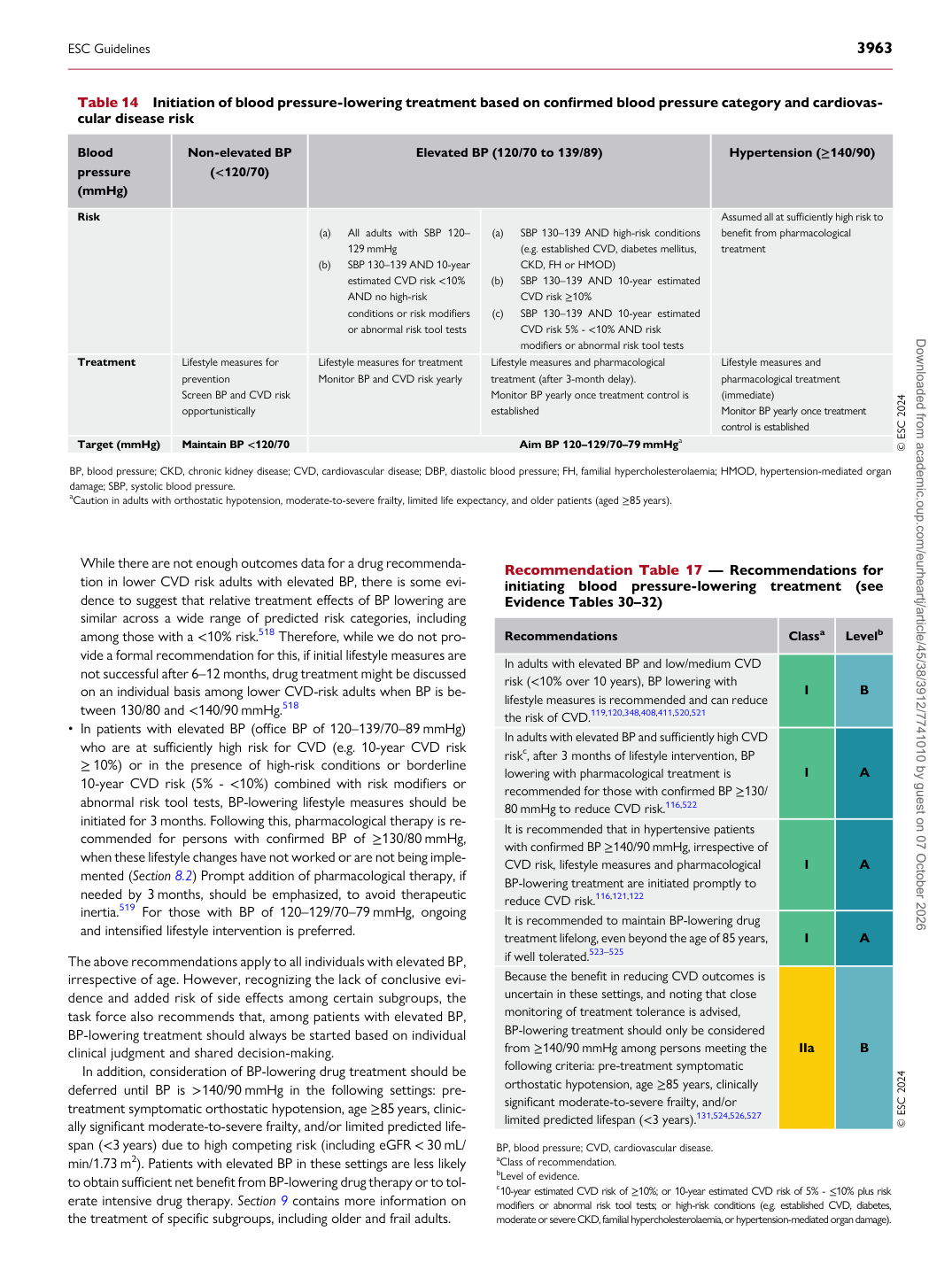
While there are not enough outcomes data for a drug recommendation in lower CVD risk adults with elevated BP, there is some evidence to suggest that relative treatment effects of BP lowering are similar across a wide range of predicted risk categories, including among those with a <10% risk.518 Therefore, while we do not provide a formal recommendation for this, if initial lifestyle measures are not successful after 6–12 months, drug treatment might be discussed on an individual basis among lower CVD-risk adults when BP is between 130/80 and <140/90 mmHg.518 • In patients with elevated BP (office BP of 120–139/70–89 mmHg) who are at sufficiently high risk for CVD (e.g. 10-year CVD risk ≥ 10%) or in the presence of high-risk conditions or borderline 10-year CVD risk (5% - <10%) combined with risk modifiers or abnormal risk tool tests, BP-lowering lifestyle measures should be initiated for 3 months. Following this, pharmacological therapy is recommended for persons with confirmed BP of ≥130/80 mmHg, when these lifestyle changes have not worked or are not being implemented (Section 8.2) Prompt addition of pharmacological therapy, if needed by 3 months, should be emphasized, to avoid therapeutic inertia.519 For those with BP of 120–129/70–79 mmHg, ongoing and intensified lifestyle intervention is preferred.

The above recommendations apply to all individuals with elevated BP, irrespective of age. However, recognizing the lack of conclusive evidence and added risk of side effects among certain subgroups, the task force also recommends that, among patients with elevated BP, BP-lowering treatment should always be started based on individual clinical judgment and shared decision-making. In addition, consideration of BP-lowering drug treatment should be deferred until BP is >140/90 mmHg in the following settings: pretreatment symptomatic orthostatic hypotension, age ≥85 years, clinically significant moderate-to-severe frailty, and/or limited predicted lifespan (<3 years) due to high competing risk (including eGFR < 30 mL/ min/1.73 m2). Patients with elevated BP in these settings are less likely to obtain sufficient net benefit from BP-lowering drug therapy or to tolerate intensive drug therapy. Section 9 contains more information on the treatment of specific subgroups, including older and frail adults.

Table 14 Initiation of blood pressure-lowering treatment based on confirmed blood pressure category and cardiovascular disease risk

Blood pressure (mmHg) Non-elevated BP

(<120/70) Elevated BP (120/70 to 139/89) Hypertension (≥140/90)

Risk

(a) All adults with SBP 120– 129 mmHg (b) SBP 130–139 AND 10-year estimated CVD risk <10% AND no high-risk conditions or risk modifiers or abnormal risk tool tests (a) SBP 130–139 AND high-risk conditions (e.g. established CVD, diabetes mellitus, CKD, FH or HMOD) (b) SBP 130–139 AND 10-year estimated CVD risk ≥10% (c) SBP 130–139 AND 10-year estimated CVD risk 5% - <10% AND risk modifiers or abnormal risk tool tests Assumed all at sufficiently high risk to benefit from pharmacological treatment

Treatment Lifestyle measures for prevention Screen BP and CVD risk opportunistically Lifestyle measures for treatment Monitor BP and CVD risk yearly Lifestyle measures and pharmacological treatment (after 3-month delay). Monitor BP yearly once treatment control is established Lifestyle measures and pharmacological treatment (immediate) Monitor BP yearly once treatment control is established Target (mmHg) Maintain BP <120/70 Aim BP 120–129/70–79 mmHga © ESC 2024

BP, blood pressure; CKD, chronic kidney disease; CVD, cardiovascular disease; DBP, diastolic blood pressure; FH, familial hypercholesterolaemia; HMOD, hypertension-mediated organ damage; SBP, systolic blood pressure. aCaution in adults with orthostatic hypotension, moderate-to-severe frailty, limited life expectancy, and older patients (aged ≥85 years).

Recommendation Table 17 — Recommendations for initiating blood pressure-lowering treatment (see Evidence Tables 30–32)

Recommendations Classa Levelb In adults with elevated BP and low/medium CVD risk (<10% over 10 years), BP lowering with lifestyle measures is recommended and can reduce the risk of CVD.119,120,348,408,411,520,521 I B In adults with elevated BP and sufficiently high CVD riskc, after 3 months of lifestyle intervention, BP lowering with pharmacological treatment is recommended for those with confirmed BP ≥130/ 80 mmHg to reduce CVD risk.116,522 I A It is recommended that in hypertensive patients with confirmed BP ≥140/90 mmHg, irrespective of CVD risk, lifestyle measures and pharmacological BP-lowering treatment are initiated promptly to reduce CVD risk.116,121,122 I A It is recommended to maintain BP-lowering drug treatment lifelong, even beyond the age of 85 years, if well tolerated.523–525 I A Because the benefit in reducing CVD outcomes is uncertain in these settings, and noting that close monitoring of treatment tolerance is advised, BP-lowering treatment should only be considered from ≥140/90 mmHg among persons meeting the following criteria: pre-treatment symptomatic orthostatic hypotension, age ≥85 years, clinically significant moderate-to-severe frailty, and/or limited predicted lifespan (<3 years).131,524,526,527 IIa B © ESC 2024

BP, blood pressure; CVD, cardiovascular disease. aClass of recommendation. bLevel of evidence. c10-year estimated CVD risk of ≥10%; or 10-year estimated CVD risk of 5% - ≤10% plus risk modifiers or abnormal risk tool tests; or high-risk conditions (e.g. established CVD, diabetes, moderate or severe CKD, familial hypercholesterolaemia, or hypertension-mediated organ damage).

ESC Guidelines                                                                                                                                                                                          3963

Downloaded from academic.oup.com/eurheartj/article/45/38/3912/7741010 by guest on 07 October 2026