p.51 抽出テキスト
among patients with hypertension, and only afterwards to start uptitrating doses to maximum amounts. Initiation with monotherapy, slower up-titration, and lower dosing should be considered in the setting of elevated BP and increased CVD risk, or in moderate-to-severe frailty, limited life expectancy, symptomatic orthostatic hypotension, or older people (aged ≥85 years). Ideally, BP should be treated to target within 3 months to retain the confidence of the patient, to ensure long-term adherence, and to reduce CVD risk.71 An overview of the recommended approach to BP management in all adult patients is provided in Figure 19 (Central Illustration). Also, of note, teleconsultation, multidisciplinary or nurse-led care, or patient self-monitoring can help with achieving BP control in certain healthcare systems.75,510,511

8.3.6 Timing of blood pressure-lowering drug

treatment Current evidence does not show benefit of diurnal timing of BP-lowering drug administration on major CVD outcomes.512 It is important that medication is taken at the most convenient time of day to improve adherence. Patients should also be encouraged to take medications at the same time each day and in a consistent setting, to help ensure adherence.246,513

8.4 Selecting patients for pharmacological

blood pressure-lowering treatment Commencement of BP-lowering treatment is often decided based on office BP measurements but, where possible, the present guidelines strongly recommend using out-of-office BP measurement for confirming elevated BP and hypertension (see Section 5). As detailed in Section 6, an office BP of <120/70 mmHg is categorized in these guidelines as non-elevated BP. When a patient is diagnosed with confirmed hypertension (sustained BP ≥ 140/90 mmHg), starting BP-lowering treatment is recommended irrespective of CVD risk, which should consist of a simultaneous combination of lifestyle interventions and pharmacological therapy. Lifestyle interventions are crucial as an initial treatment step, and must be strongly emphasized with the patient, but concurrent pharmacological therapy is recommended. This concurrent initiation of lifestyle and pharmacological therapy should not give patients the impression that lifestyle changes are of lesser importance, and the patient should be counselled that these lifestyle changes may allow subsequent discontinuation or down-titration of medication, which can be used as motivation to persist with lifestyle changes. After treatment initiation, the patient should be seen frequently (e.g. every 1–3 months with a GP or specialist) until BP is controlled. BP should be controlled, preferably within 3 months (see also Section 6 and algorithm Figure 18). If lifestyle changes are effective in BP lowering, pharmacological treatments may subsequently be down-titrated or stopped as appropriate. When office BP is 120–139/70–89 mmHg, the patient is considered as having elevated BP, and further CVD risk stratification is recommended to guide therapy (Table 14).

• In patients with elevated BP who are not at increased risk for CVD (10-year CVD risk <10%) and do not have other high-risk conditions or risk modifiers, BP-lowering lifestyle measures are recommended.

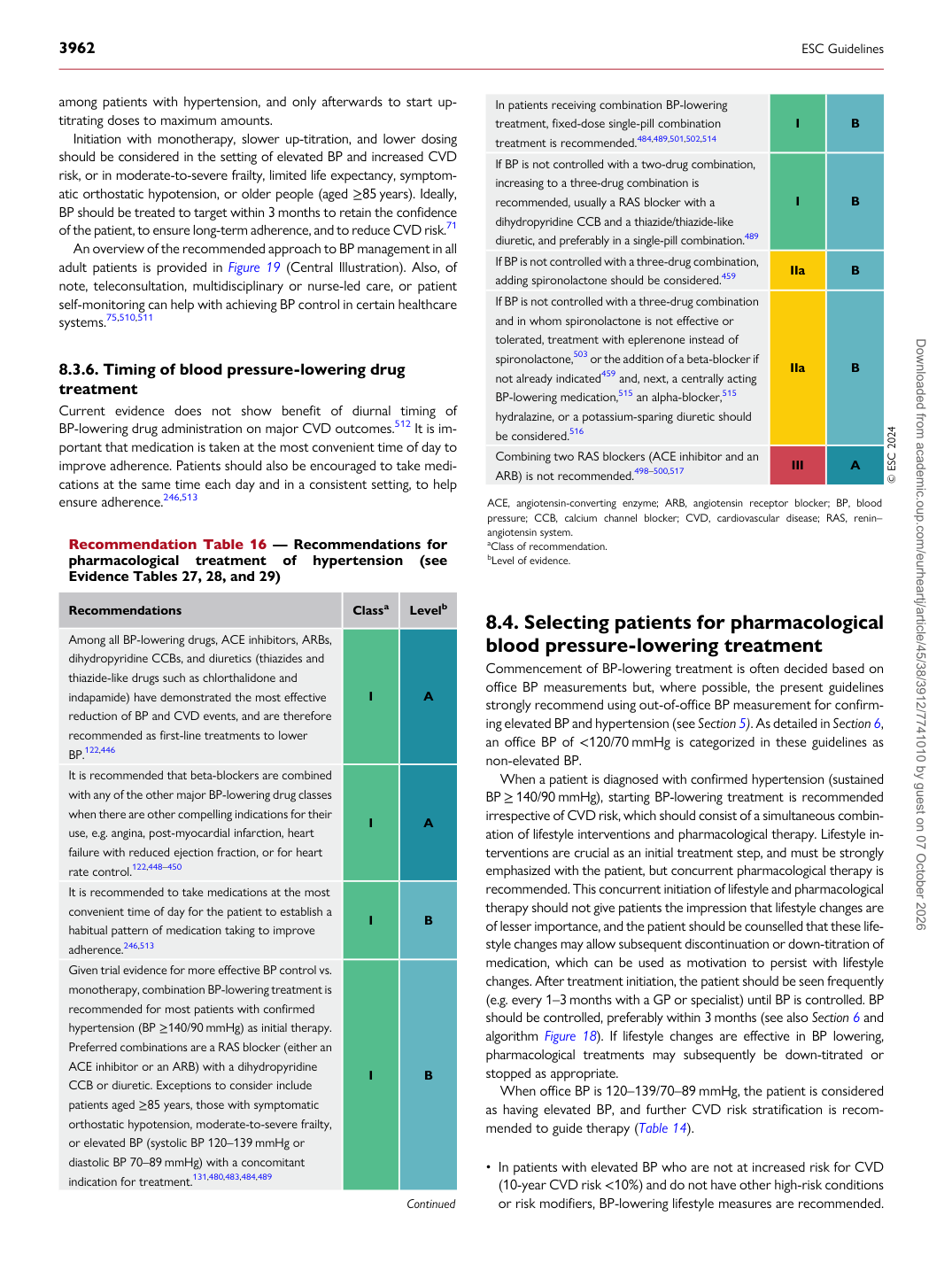
Recommendation Table 16 — Recommendations for pharmacological treatment of hypertension (see Evidence Tables 27, 28, and 29)

Recommendations Classa Levelb

Among all BP-lowering drugs, ACE inhibitors, ARBs, dihydropyridine CCBs, and diuretics (thiazides and thiazide-like drugs such as chlorthalidone and indapamide) have demonstrated the most effective reduction of BP and CVD events, and are therefore recommended as first-line treatments to lower BP.122,446 I A It is recommended that beta-blockers are combined with any of the other major BP-lowering drug classes when there are other compelling indications for their use, e.g. angina, post-myocardial infarction, heart failure with reduced ejection fraction, or for heart rate control.122,448–450 I A It is recommended to take medications at the most convenient time of day for the patient to establish a habitual pattern of medication taking to improve adherence.246,513 I B Given trial evidence for more effective BP control vs. monotherapy, combination BP-lowering treatment is recommended for most patients with confirmed hypertension (BP ≥140/90 mmHg) as initial therapy. Preferred combinations are a RAS blocker (either an ACE inhibitor or an ARB) with a dihydropyridine CCB or diuretic. Exceptions to consider include patients aged ≥85 years, those with symptomatic orthostatic hypotension, moderate-to-severe frailty, or elevated BP (systolic BP 120–139 mmHg or diastolic BP 70–89 mmHg) with a concomitant indication for treatment.131,480,483,484,489 I B

Continued In patients receiving combination BP-lowering

treatment, fixed-dose single-pill combination treatment is recommended.484,489,501,502,514 I B If BP is not controlled with a two-drug combination, increasing to a three-drug combination is recommended, usually a RAS blocker with a dihydropyridine CCB and a thiazide/thiazide-like diuretic, and preferably in a single-pill combination.489 I B If BP is not controlled with a three-drug combination, adding spironolactone should be considered.459 IIa B If BP is not controlled with a three-drug combination and in whom spironolactone is not effective or tolerated, treatment with eplerenone instead of spironolactone,503 or the addition of a beta-blocker if not already indicated459 and, next, a centrally acting BP-lowering medication,515 an alpha-blocker,515 hydralazine, or a potassium-sparing diuretic should be considered.516 IIa B Combining two RAS blockers (ACE inhibitor and an ARB) is not recommended.498–500,517 III A © ESC 2024

ACE, angiotensin-converting enzyme; ARB, angiotensin receptor blocker; BP, blood pressure; CCB, calcium channel blocker; CVD, cardiovascular disease; RAS, renin– angiotensin system. aClass of recommendation. bLevel of evidence. Downloaded from academic.oup.com/eurheartj/article/45/38/3912/7741010 by guest on 07 October 2026