p.50 抽出テキスト
N

Patient centred care

Normal Abnormal

≥10% <5% 5% – <10%

Age <40 years, resistant hypertension,

suggestive signs and/or symptoms

Targeted secondary

hypertension

treatment

Screen for secondary

hypertension

(Class I)

Calculate SCORE2/

SCORE2-OP

(Class I)

Assess risk modifiers

(Class IIa)

Consider risk tools

(Class IIb)

Age ≥85 years, moderate-to-severe frailty,

symptomatic OH, short life expectancy

Established CVD, moderate-to-severe CKD,

hypertension-mediated organ damage,

diabetes mellitusa, familial hypercholesterolaemia

Y

N N N Y

Y Y

Non-elevated BP Office SBP <120 mmHg and

DBP <70 mmHg Elevated BP Office SBP 120–139 mmHg

and/or DBP 70–89 mmHg Hypertension Office SBP ≥140 mmHg and/or

DBP ≥90 mmHg

ABPM / HBPM preferred over office BP Target SBP 120–129 mmHg

(Class I)

Target DBP 70–79 mmHg

(Class IIb)

Screen BP opportunistically Lifestyle measures

Drug treatment for confirmed

BP ≥130/80 mmHg

Monitor BP and medication toleranceb

Screening for hypertension Opportunistic: every 3 years <40 years;

every year ≥40 years HBPM/ABPM or repeated standardized office BP

Confirming hypertension

Lifestyle measures

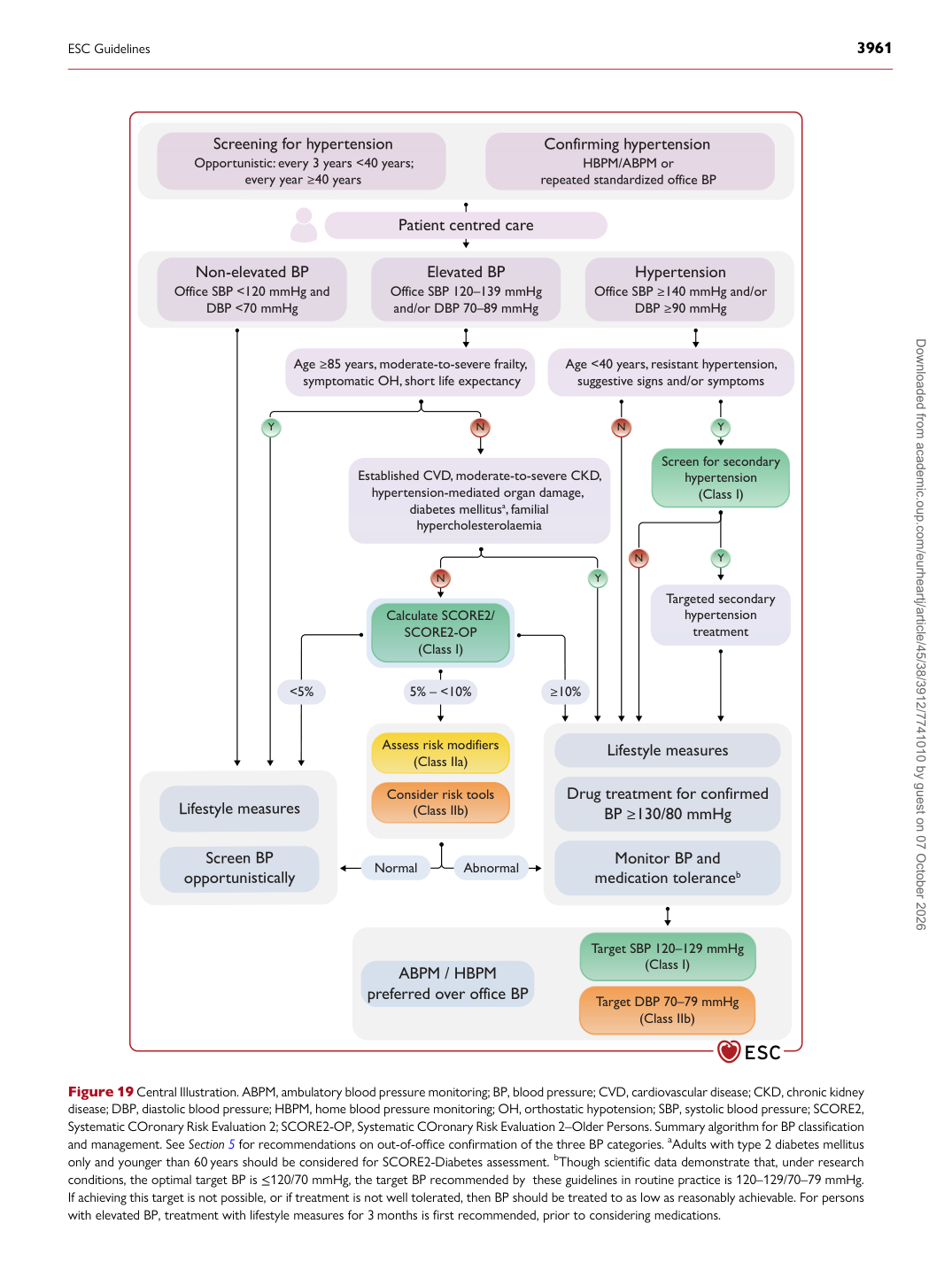
Figure 19 Central Illustration. ABPM, ambulatory blood pressure monitoring; BP, blood pressure; CVD, cardiovascular disease; CKD, chronic kidney disease; DBP, diastolic blood pressure; HBPM, home blood pressure monitoring; OH, orthostatic hypotension; SBP, systolic blood pressure; SCORE2, Systematic COronary Risk Evaluation 2; SCORE2-OP, Systematic COronary Risk Evaluation 2–Older Persons. Summary algorithm for BP classification and management. See Section 5 for recommendations on out-of-office confirmation of the three BP categories. aAdults with type 2 diabetes mellitus only and younger than 60 years should be considered for SCORE2-Diabetes assessment. bThough scientific data demonstrate that, under research conditions, the optimal target BP is ≤120/70 mmHg, the target BP recommended by  these guidelines in routine practice is 120–129/70–79 mmHg. If achieving this target is not possible, or if treatment is not well tolerated, then BP should be treated to as low as reasonably achievable. For persons with elevated BP, treatment with lifestyle measures for 3 months is first recommended, prior to considering medications.

ESC Guidelines                                                                                                                                                                                          3961

Downloaded from academic.oup.com/eurheartj/article/45/38/3912/7741010 by guest on 07 October 2026